RSS
Showing posts with label theatre reviews. Show all posts

SHOWBUZZDAILY NY THEATRE JOURNAL: 'Death of A Salesman"


Although a great work of art is great forever, the relevance of a given piece to a current moment in time does tend to fluctuate.  It turns out that Arthur Miller's DEATH OF A SALESMAN, written 63 years ago, is so remarkably attuned to this here and now that despite its period setting, it feels more contemporary than almost any play on Broadway.


It isn't just that the current economy is bad, or that Willy Loman, like so many middle-aged men with houses and families, is losing his job and having trouble making ends meet.  The words "the 1 percent" are never spoken in Miller's text--that catchphrase didn't exist in 1949--but its undercurrent is felt throughout the play.  Salesman captures the peculiar ambivalence Americans have for wealth:  Willy's mix of disdain for and envy of his neighbor's son Bernard, who plays tennis and argues before the Supreme Court, could be echoed by the Republicans who can't bring themselves to vote for Mitt Romney, while Willy's awe of his brother Ben, who walked into the jungle when he was 17 and walked out rich, evokes the admiration of ordinary people today who can't get enough of watching the rich parade the accoutrements of their wealth and tweet their often fatuous opinions.

Perhaps fueled by the affinity between Miller's vision of America and the world around us, the new production of Salesman directed by Mike Nichols (which is still in previews, so subject to change) makes no effort to jazz up the play or make it more "contemporary."  Indeed, the production makes a point of recreating Joe Mielziner's original 1949 set design, and using Alex North's incidental score.  Nichols' choices seem to stand for the proposition that what was disturbing and moving in 1949 can be just as powerful today--and he's right.

Philip Seymour Hoffman's performance as Willy is also suited to our times, with a self-knowledge that breaks his own heart, and ours.  His Willy is a big man, as Lee J. Cobb was in the original show, but sunken in his heft.  Hoffman doesn't have Cobb's bluff, bullying heartiness:  it doesn't come as a surprise that this Willy was never as successful as he wanted his family to believe.  There's a desperation in him that isn't new--he may have reached the end of his rope, but the rope has been fraying all along, and on some level, Willy has always known it.  Hoffman's Willy isn't just now discovering the wreck of his life; he's just starting to acknowledging it.  

The role of Linda, Willy's wife, is a notorious trap for preachy sentiment, but Linda Emond gives a marvelously plain-spoken, crisp reading of the part.  Andrew Garfield, as older son Biff, who can never live up to the dreams with which his father has infected him, is excellent in the flashback sequences  but somewhat problematic in the play's present-day, not because his performance is ever less than fully thought-out or passionately performed, but for simple reasons of logistics:  Garfield is 29, and a very young 29 (as you may have heard, he'll be spinning webs as a high-schooler in just a few months as The Amazing Spider-Man), and he's not able to convey the world-weariness of a 34-year old character who's been traveling a hard road around the country for the past decade.  Supporting roles, including John Glover as Willy's idealized brother and Finn Wittrock as younger son Happy, are ably filled.

Paradoxically, this Death of A Salesman, embracing the form and style of its past, feels remarkably of the moment.  Its history lesson turns out to be a bulletin of Breaking News.

  • Digg
  • Del.icio.us
  • StumbleUpon
  • Reddit
  • RSS

SHOWBUZZDAILY BROADWAY JOURNAL: "Follies"


FOLLIES may be the strangest of all Broadway masterpieces; after 40 years, it's still the most avant-garde work of Stephen Sondheim's career.

It's easy enough to make the show sound linear:  set in 1971 (which was present-day when the musical was written), it takes place at a theatre that had, for some decades, housed the Weismann's Follies musical shows, but is now about to be torn down and turned into a parking lot.  A group of Follies performers from the 1930s and 40s, hosted by Dimitri Weismann himself, have come to the darkened, emptied-out theatre to salute their pasts and air out their dissatisfaction with their presents.  Chief among these are 2 couples:  Sally and Buddy Plummer (Bernadette Peters and Danny Burstein) and Phyllis and Benjamin Stone (Jan Maxwell and Ron Raines).  Back in the 1940s when Sally and Phyllis were showgirls and best friends, Ben was Phyllis' boyfriend but secretly courted Sally as well; now Ben is a millionaire and Sally yearns for what she remembers as the love of her life.


That's pretty much the narrative of the musical, but Follies isn't fundamentally about its narrative.  Indeed, much of the first act has little overt storyline, instead following the characters almost formlessly around their reunion, dialogue interspersed with the former performers reenacting some of their old musical numbers.  What makes Follies remarkable and to some extent enigmatic is a theme underlying all this:  the relationship between the Follies performances themselves, content and style, and the crises afflicting the characters.  Visually, the Weismann theatre is inhabited by ghosts, unseen by the modern characters but sharing space with them at all times.  Some of them are the youthful versions of Sally, Buddy, Phyllis, Ben and other characters, while others are observers, outfitted in almost godlike versions of the old-time costumes.  

More essentially, Sondheim's score is an amazing collection of pastiches making use of the grammar used in musical numbers of the era:  operetta, torch song, vaudeville, musical comedy and more.  In the first act, these songs ("Beautiful Girls," "Rain On the Roof," "Ah, Paris!") are somewhat separate from the modern-day numbers, although the latter often comment on the former ("Waiting For the Girls Upstairs," "Broadway Baby," "The Road You Didn't Take").  As the characters' mental states fall apart, however, and they become ever more obsessed by their memories and fantasies, the past and present merge.  This culminates in the extraordinary "Loveland" sequence, in which each of the protagonists sings a pastiche-influenced song ("Losing My Mind," "The God-Why-Don't-You-Love-Me Blues," "The Story of Lucy and Jessie," "Live, Laugh, Love") about their own psychologies.  Perhaps the oddest thing about this sequence, which takes up most of the act, is that it provides no "objective reality," but instead envelops both us and its characters in their increasing madness.  The songs themselves are deeply emotional statements as well as commentary about the source, power and danger of show business and romantic myth.  

As you might expect, tackling a project like Follies is not a task to be taken on lightly.  The legendary original production, directed by Hal Prince and Michael Bennett, and with sets by Boris Aronson, won 7 Tonys (although not Best Musical, which went to Two Gentlemen of Verona) and ran more than a year on Broadway, but was a tremendous financial failure.  Subsequent productions and revivals have routinely changed songs and the James Goldman book, trying to find a clarity (and some sense of redemption) in the difficult material.

In the new Eric Schaffer production, which originated at the Kennedy Center in Washington and opens officially in a few days on Broadway, the biggest surprise is that the emotional center has moved from Sally, whose longing for Ben and a different life has usually been the spoke around which the show revolves, to Phyllis.  It's not clear whether that was a conscious decision by Schaffer or simply a function of the magnificent performance Maxwell gives in the role--she's like a Martha in Who's Afraid of Virginia Woolf? who can sing and dance like a demon; her renditions of "Could I Leave You?" and "Lucy and Jessie" are unmatched.  This isn't to take anything away from Peters, who sings beautifully and whose vulnerability in the role is moving, but her Sally is all desperation, her psyche not nearly as complex as Phyllis'.  Maxwell is well-matched with Raines, who is able to make Ben's selfishness comprehensible.  Burstein is a weaker link in the weakest of the main parts; his self-destructiveness is never quite compelling.  (In fairness, the Goldman book has always been sparse, particularly because it barely exists in the second act, where the Loveland sequence takes over what would ordinarily have required dramatic exposition.)

Follies is also a cornucopia of splendid supporting roles--in what other musical do landmark numbers like "Broadway Baby" and "I'm Still Here" go to minor characters?--and they're played wonderfully here.  Most prominent is Elaine Paige as Carlotta, who gets "I'm Still Here," and other notable parts are played by Mary Beth Peil, Rosiland Elias, Susan Watson, Don Correia and Jayne Houdyshell.  The ghostly young people are represented by, among others, Lora Lee Gayer, Kirsten Scott, Christian Delcroix and Nick Verina.

Although no revival of Follies will probably ever be as spectacular as the Aronson original, Derek McLane, Gregg Barnes and Natasha Katz provide sets, costumes and lighting that are atmospheric and evocative of the dim past and troubled present.  Warren Carlyle's choreography, especially in the "Who's That Woman" and "Lucy and Jessie" numbers, is exceptional.

Any production of Follies is an event, because it's the rare musical that reveals more shadings and possibilities the more it's delved into.  (In this production, it's interesting to view the show as a companion piece to Company, Sondheim and Prince's previous musical, and its more comic analysis of bad marriages.)   The show will always be spectacularly problematic--in a way, a production that solved all its mysteries would be most problematic of all--and this version, anchored by Maxwell's brilliance, particularly demands to be seen.

  • Digg
  • Del.icio.us
  • StumbleUpon
  • Reddit
  • RSS

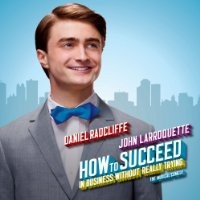
SHOWBUZZDAILY BROADWAY JOURNAL: "How To Succeed In Business Without Really Trying"


Few things bring audiences as much joy as the sight of a well-known actor or actress revealing a side of their talent that's never been seen before.  (It's not just general audiences, either--those roles become instant favorites for Oscar nominations and wins.)  It can be as simple as Halle Berry, Julia Roberts or Nicole Kidman deglamorizing themselves for Monster's Ball, Erin Brockovich and The Hours, and as immense as Daniel Day-Lewis' paralysis in My Left Foot or Robert DeNiro's weight gain in Raging Bull.  The most reliable type, though, may be the revelation that a dramatic performer can sing or dance:  Amy Adams in Enchanted, Meryl Streep in Mamma Mia!, Jeff Bridges in Crazy Heart, Rene Zellweger in Chicago... the list goes on.  The same is true on Broadway, of course--think Antonio Banderas in Nine, and practically everyone who's starred in the revival of Chicago;   Right now, the star with unexpected abilities is Daniel Radcliffe, in the new (and not particularly necessary) revival of Frank Loesser's HOW TO SUCCEED IN BUSINESS WITHOUT REALLY TRYING.


Radcliffe is, and probably always will be, known above all for the role that he spent his entire childhood playing, but Harry Potter was never called upon to sing or dance away from evil.  As J. Pierrepont Finch, the outrageously ambitious protagonist of the 50-year old musical, Radcliffe has to do both, and while his singing voice is merely decent, the man can dance.  Numbers like "Grand Old Ivy" and "The Brotherhood of Man" pretty much bring down the house, in large part because of his footwork.  

For those unfamiliar with How to Succeed, the title itself refers to a handbook used by Finch as he rapidly climbs the ranks at Worldwide Wickets, moving from window washer, to the mailroom, to a junior executive office, to the notice of boss J.B. Biggley (John Larroquette), and so forth.  Along the way, secretary Rosemary (Rose Hemingway) falls madly in love with him, and he struggles between the pulls of ambition and love, not to mention the competition posed by Biggley's evil nephew Bud Frump (Christopher J. Hanke).  The book by Abe Burrows, Jack Weinstock and Willie Gilbert provides the mildest sort of corporate satire, although it has an off-hand structural skill, effectively conveying the story as needed between Loesser's songs, that seems impressive today.

Rob Ashford's production is pleasant enough entertainment--he's a better fit for this material than he was for last year's revival of Promises, Promises, which was more character-and dialogue-based.--and Loesser's songs are always a pleasure to hear, but there's nothing revelatory going on at the Hirschfeld Theatre.  Ashford seems to have approached the material with the viewpoint that it should be played entirely as it would have been in 1961, with no allowance made or irony taken to acknowledge changes in society since then.  So there are no italics around the worship of corporate success, or the sexism the show takes for granted (the song title "Happy To Keep His Dinner Warm" says it all), and no interest in Mad Men-like commentary about the social revolutions that were just a few years away.  Radcliffe's performance is similarly straightforward, even more so than Robert Morse's somewhat maniacal one in the original version (at least as preserved in the 1967 film) and Matthew Broderick's in the 1995 Broadway revival, both of whom took a more cartoonish approach.  Given the broad nature of the material, a taste of that might have been a good idea, both for Radcliffe and for Hemingway; the actors who broaden their performances, notably Larroquette, Hanke and Tammy Blanchard as the self-explanatory Hedy LaRue, fare better.

How to Succeed is an enjoyable 2 1/2 hours, brightly choreographed by Ashford and designed by a team that includes Derek McLane (sets), Catherine Zuber (costumes) and Howell Binkley (lighting), supporting a talented, hard-working cast.  Is it worth $132 for a standard ticket?  Probably not, but discounts are available.  And there is a kick in finding out that The Boy Who Lived is also The Actor Who Can Dance.

  • Digg
  • Del.icio.us
  • StumbleUpon
  • Reddit
  • RSS