RSS
Showing posts with label documentary. Show all posts

THE BIJOU @ TIFF: Werner Herzog's "Into the Abyss"

Welcome to SHOWBUZZDAILY's coverage of the Toronto International Film Festival, where the reviews will be as plentiful as we can cram into a week.

TIFF started things off on a less-than-festive note with Werner Herzog's documentary "Into the Abyss," The title isn't kidding: this is the story of a meaninglessly brutal triple murder committed in Texas in 2000 (all for the sake of a Camaro), and the resulting fallout as it's affected the families of the victims, the convicted killers, and their own families.


Herzog isn't interested in the details of the crimes, or even who pulled the trigger. He's fascinated by lives blighted by delusion and death, a list that comes to include even the prison guards who have to deal with the condemned prisoners. Although the film isn't political per se, it opposes the death penalty as a system that merely widens the circle of pointless death.

Much of this is fascinating--one can't help but be riveted by interviews with a death row inmate conducted 8 days before his execution. And the struggle of these people to find some kind of redemption, even by way of a jailhouse groupie, can be heartbreaking. It's all rather relentless, though, both in tone and imagery--aside from a few pensive shots of a prison cemetery, fences and the execution chamber, the film is almost totally composed of talking-head interviews. The result is worthy, but not likely to lure much of a mainstream audience.


Sent via BlackBerry by AT&T

  • Digg
  • Del.icio.us
  • StumbleUpon
  • Reddit
  • RSS

THE BIJOU REVIEW: "Project Nim" - Planet of the Humans


PROJECT NIM:  Worth A Ticket - If You Can Stand It

At first I wondered why on earth Fox Searchlight hadn't grabbed James Marsh's documentary PROJECT NIM at Sundance, to serve as an unofficial prequel to Big Fox's release of Rise of the Planet of the Apes next month.  It seemed like a no-brainer:  the true story of a chimp cutely named Noam Chimpsky who was essentially adopted by a human family shortly after his birth in the 1970s, in order to be the subject of an experiment in teaching human sign language to a chimp within a human environment.  And not just any human environment:  this was a family of well-off bohemians (we'd call them "crunchy" now) who owned an Upper West Side brownstone, wrote poetry, and cheerfully allowed Nim (as he was known) to share their alcohol and pot.  Oh, and the mother breastfed Nim herself.  ("It was the 70s," one of the family explains.)  The story is practically The Royal Tenenbaums before Wes Anderson had even dreamed them up.


Before long, though, I understood why no division of Fox would want Project Nim within a hundred miles of their blockbuster-to-be, because the film becomes as heartrending--and difficult to watch--as any movie in recent memory.  Nim is taken from his off-beat yet loving home, and becomes something like a real-life version of the donkey in Bresson's Au Hasard, Balthazar, a beast who illuminates the frailty, self-centeredness and sometimes the awfulness of the humans around him.  

Chief of the awful--at least that's how he's depicted, often with words out of his own mouth--is Dr. Herbert Terrace, the Columbia linguistics professor who had the idea for the experiment.  Terrace lives up to every cliche of the arrogant, heartless clinical scientist. (with an additional bad habit of sleeping with the very young women who work for him.)  Terrace makes it fairly clear that he had little regard for Nim as a living being, and he was responsible for ripping the chimp out of the home where Nim had been raised, finding the surroundings not sufficiently scientific.  Well, maybe so; and although it was wrenching for Nim to leave the people who had become his family, his first stop after that wasn't a bad place:  an estate owned by Columbia where full-time interns and teachers worked with Nim on language skills.  But again, Terrace uprooted Nim from his life, this time declaring the entire experiment a failure on the grounds that although Nim had learned many signs for words, Terrace deemed Nim's use simply to be a way of begging for treats, without any real comprehension of their meaning.  (The people who worked with Nim bitterly disagree, and footage in the film seems to prove them right.) Once the experiment was over and Terrace had gotten his small measure of fame, the scientist had no remaining interest in Nim at all.

After that, things got ugly.  Nim was sent to an academic zoo where for the first time in his life, he had to live in a cage (although some of the people there were kind to him, and he made his first contacts with fellow chimpanzees).  When the zoo ran out of money, he was sent to the kind of research lab where drugs for humans are tested on animal subjects.  At that point, Project Nim becomes almost unbearable to watch, and even when Nim is "rescued," his life is solitary misery for years to come, although his circumstances do ultimately improve.  

Marsh does a brilliant job in only 93 minutes, of illuminating the complexities of everyone involved.  Terrace, for all his callousness, explains very clearly how he felt--and didn't feel--about Nim.  Some of the nicest people who worked with Nim were probably somewhat deluded; the person who seems most evil of all at the research lab has, it turns out, a heart.  And Nim himself is painted clearly--he wasn't a humanoid, but an animal with all the instincts and actions of one, making it difficult for even the most well-meaning people to help him.

It's hard to recommend a movie that sometimes makes you want to look away from the screen (although it's rated PG-13, I'd be careful about bringing children to see it), and despite a 97% score on Rotten Tomatoes--the same as Harry Potter!--so far its boxoffice has been puny. Audiences who are able and willing to brave Project Nim, though, will find it as moving and emotionally rich as any film this year.

  • Digg
  • Del.icio.us
  • StumbleUpon
  • Reddit
  • RSS

LIMITED RELEASE: "The Double Hour," "Incendies" & "Cave of Forgotten Dreams"


Plot spoilers are even more problematic when it comes to limited releases, because by definition they're only being seen by a few people in certain selected locations, and--if they're good--will ideally be discovered by audiences over time.  Which is a roundabout way of saying that I strongly recommend, but can reveal almost nothing about, the marvelous new Italian drama THE DOUBLE HOUR beyond its premise, or I'll give too much away.  So here's that premise:  in Turin, a Russian/Italian hotel chambermaid named Sonia (Ksenia Rappoport) attends a speed-dating night at a local club.  There she meets Guido (Filippo Timi), a former cop and now a security guard who's a widower and an alcoholic.  A spark is struck between them; then there is a robbery, a shooting, and--I have to stop.  Double Hour has a remarkable variety of tricks up its sleeve, not in the mindbending sense of an Inception (everything, ultimately, is explained, and it does all make sense), but through intricate and tricky storytelling where what you're seeing is rarely what's actually going on.  Giuseppe Capotondi, making his directing debut, manages the extraordinary feat of combining this kind of guile with romance, mystery, melancholy and surprise (the excellent script is by Alessandro Fabri, Ludovica Rampoldi, and Stefano Sardo), and the actors give tremendous, layered performances.  You'll just have to take my word for it:  The Double Hour is Europe's best genre surprise since Tell No One. Worth a Ticket.   (Goldwyn - 95 min. - unrated - 7 Theatres)
 

The Canadian (French-language) INCENDIES, directed by Denis Villeneuve, also asks for a spoiler alert, although of the more conventional don't-give-away-the-ending type.  Incendies, which was a nominee for last year's Best Foreign-Langauge Film Oscar, is structured as a mystery.  When Nawal Marwan (Lubna Azabal) dies, she leaves a strange bequest for her twin children Jeanne (Melissa Desormeaux-Poulin) and Simon (Maxim Gaudette):  Jeanne is to deliver a letter to her vanished father, Simon to bring one to a previously unknown brother; only when both are successful can they put a stone on Nawal's grave and read a third letter from her to them.  The search requires them to travel to the Middle Eastern country (seemingly Lebanon, although never explicitly identified) where Nawal was born, and to journey through that region's tangled and tragic 20th Century history.  Nawal's story, it turns out, is brutal to an extent that is ultimately more symbolic than believable in a realistic sense (Velleneueve's script is based on a play by Wadji Mouawad, and sometimes shows its theatrical roots).  At times, the movie is so concerned with hiding its secrets that it becomes more confusing than it needs to be, and the ultimate revelations are so enmeshed with the political and social statements being made, that it becomes difficult to discuss the latter without revealing the twist.  All this can become a slog over more than 2 hours.  Still, Incendies is far more dramatically intense and effective in its moral complications than the recent and somewhat similar Miral, and the acting and cinematography (by Andre Turpin) are first-rate.  A film that may benefit from the repeat and back buttons on a homevideo player.    Watch It At Home.  (Sony Pictures Classics - 130 minutes - R - 10 Theatres)


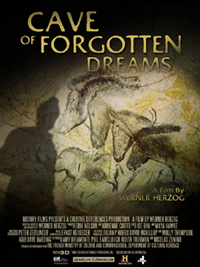
No spoiler problems in Werner Herzog's CAVE OF FORGOTTEN DREAMS, unless you were afraid of finding out the content of 30,000-year old cave paintings.  (Shhh:  they're mostly horses, lions and bears.)  The Chauvet caves in France were sealed by a giant rockslide thousands of years ago, which resulted in the preservation of these amazing works of art, the most extensive prehistoric collection yet found on earth.  By Herzog's standards, his account and tour of the caves is quite straightforward (aside from a bizarre epilogue involving albino alligators and a brief fascination with the circus performer history of one scientist).  Although the physical conditions of the filming were very demanding, as only a bare minimum of equipment and lights could be brought into the caves, and the filmmakers had to keep their distance from the paintings themselves, Herzog managed to shoot the film in 3D, providing a model for non-gimmicky, visually justified use of that technology.  With the illusion that they are in touchable proximity, the spectacular contents of the caves are even more breathtaking, and although the content of Cave is not much different than a television documentary (it was co-financed by the History Channel), the technology renders it Worth a Ticket.  (IFC/Sundance Selects - 90 minutes - unrated - 5 Theatres)


  • Digg
  • Del.icio.us
  • StumbleUpon
  • Reddit
  • RSS

LIMITED RELEASE: "POM Wonderful Presents The Greatest Movie Ever Sold"


Watch It At Home:  Morgan Spurlock's latest doc is more stunt than revelation.

If Michael Moore were a movie franchise, Morgan Spurlock would be the direct-to-video entry in the series.  Or maybe the one that adds cheesy 3D effects to squeeze out every last dollar.   Moore is, lord knows, self-aggrandizing and fond of the sound of his own voice, but agree with him or not, he's fueled by genuine moral and political outrage.  Spurlock, who gave us Super Size Me, only seems to be trying to win a reality show competition.

Spurlock's latest bears the unwieldly title POM WONDERFUL PRESENTS:  THE GREAT MOVIE EVER SOLD, and really that's the whole movie in a nutshell.  Spurlock sets out to illuminate the world of  movie product placement and marketing, and just as he personally downed gargantuan amonnts of McDonald's food in Super Size Me, here he sets out to finance this very movie by building in ads and product integrations.  We watch him meet with advertisers and gradually see as the agreed-upon product placements appear in the movie; it's as meta as an episode of "Community," except without the actual wit or insight.
Spurlock knows how to keep a documentary fast-paced and amusing, but are there really any sentient beings left who don't recognize product placement when they see it?  (Spurlock is like the guy who just discovered that digitally streamed music doesn't sound as rich as vinyl.)  If anything, we're all so conscious of being sold, and the integrations have become so blatant, that they almost defeat the purpose--hardly anything can influence us without our being consciously aware that it's happening.  Since there's not much of an issue here, all Spurlock can do is load the movie with (perfectly straightforward) commercials that he had to include to get the integration money, while making the placements ludicrous enough to get a laugh.


The frustration of Greatest Movie is that there are real points that could be explored about this topic, but Spurlock just touches on them for seconds lest they slow down his show.  We get a glimpse of the restrictions and approvals that advertisers require in exchange for their cash, but then we're assured that Spurlock didn't agree to them.  There are interviews with Florida school board members who feel the need to push advertising on their students to make up for education budget cuts, but Spurlock is more interested in making an easy gag out of the fact that one ad is for a tattoo parlor.  A series of interviews with Hollywood directors about the effect of product integrations on their work just elicits the expected denials that it's damaged their films at all.  Spurlock himself purports to be troubled by "selling out," when in fact his whole movie is based on the gimmick.  (It would have been more interesting to see what, if any, placements he had to accept in order to finance Super Size Me or his FX TV series--that topic is never raised.)  

The Greatest Movie Ever Sold is as disposable and superficial as the marketing it pretends to disdain.  The irony is that of all current documentarians, Morgan Spurlock is the one most in tune with the suits who are putting up the money; he's his own product.  But ironically enough, despite the promotional dollars and tie-ins detailed in the picture, not to mention his own presence on countless talk shows, the film opened to a mediocre $6500 in each of 18 theatres last weekend.  Sometimes the audience isn't quite as dumb as the moneymen expect them to be.

(POM WONDERFUL PRESENTS:  THE GREATEST MOVIE EVER SOLD - Sony Pictures Classics - PG 13 - 90 minutes - Director:  Morgan Spurlock - Script:  Spurlock, Jeremy Chilnick - Documentary - 18 Theatres) 

  • Digg
  • Del.icio.us
  • StumbleUpon
  • Reddit
  • RSS