RSS
Showing posts with label mystery. Show all posts

SHOWBUZZDAILY BIJOU REVIEW: "One For The Money"


ONE FOR THE MONEY:  Not Even For Free - Another Heigl Misfire

Movie stars are, make no mistake, trademarks.  Consumers who invest in 2 hours of George Clooney or Will Smith expect the same kind of reliable enjoyment that they get from a can of Coke or a pair of Nikes.  And no movie star brand in recent years has been mishandled as badly as Katherine Heigl's.

From all indications, Heigl has no one to blame but herself.  After a fairly successful run as a teen actress on Roswell and in some minor movies, she was the breakout star of TV's Grey's Anatomy, gorgeous and with the ability to handle both romantic comedy and fairly heavy drama.  When her first major big-screen role was the smash hit Knocked Up, and she followed it up with the $77M grossing 27 Dresses, the cry of "New Julia Roberts" was heard throughout the land.  And then, almost as soon as she'd made a name for herself, she started doing everything she could to demolish it.


The truth is that none of us have any idea whether George Clooney is the smooth, amiable, happy-go-lucky guy he's established himself to be, or whether Tom Hanks is solid, trustworthy and quick-witted, or Julia Roberts is lovable and sweet.  All those stars may be nothing more than the inspired creations of publicists, brilliantly performed over a period of years.  But whenever they're in public, they appear to live up to their personas, and that's all we, as a public, ask.  Heigl, though, seems incapable of saying 5 consecutive sentences aloud without appearing obnoxious and ungrateful--to the writers and her other colleagues on Grey's, to Judd Apatow and Knocked Up, and just about everyone else.  It may well be that Heigl is more honest than the more easily controlled stars around her, but movie stars sell fantasies of themselves, and Heigl's isn't a fantasy anyone wants to watch.

Combine that with what appears to be fairly atrocious script sense--even 27 Dresses was mediocre at best, The Ugly Truth was flat-out awful, and Killers was worse--and you have a perfect formula for decimating movie stardom in less than 5 years.  The latest painful evidence of Heigl's situation is ONE FOR THE MONEY, a terrible movie that Heigl and her mother/manager helped develop and produce.

The picture is based on a very successful series of crime novels by Janet Evanovich (shades of Kathleen Turner's disastrous V.I. Warshowski), and Heigl plays Stephanie Plum, a tough New Jersey girl who becomes an investigator for her cousin the bail bondsman.  For her first case, she tracks down Joe Morelli (Jason O'Mara), a cop--and ex-boyfriend of Stephanie's--accused of murder.

There's no need to spend much time on the lame storyline or grating dialogue of the movie (the script, which was in development for many years, is credited to Stacy Sherman, Karen Ray and Liz Brixius).  The on-the-lam murder suspect barely bothers to hide himself, and over and over, only Stephanie figures out the obvious place he'll be.  Of course the two end up joining forces to find the real killer, and a look at the cast list makes that identity not too hard to guess.  
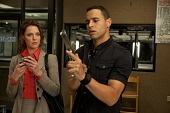
Director Julie Anne Robinson, mostly a TV hand (including on Grey's), doesn't do anything to enrich the material.  The movie looks cheap and has no rhythm--an early scene with Stephanie and her family, including her dotty grandma (Debbie Reynolds) is edited so clumsily it would look amateurish on YouTube--and there's no chemistry whatsoever between Heigl and O'Mara, despite the movie's strenuous efforts to suggest some.  (Scenes with Daniel Sunjata as Stephanie's bounty hunter mentor are more promising, but that's entirely because of Sunjata.)  The "New Joisy" stereotypes are painful, and there's not even any mindless action to enjoy.

Heigl seems to have realized that her career is in free-fall--her recent interviews have included nostalgic wishes to go back to Grey's and revisit her character, and she's doing an ensemble piece next, The Wedding with Robert DeNiro, Diane Keaton and Amanda Seyfried.  For now, she's the actress version of The Devil Inside--a big opening, followed by a horrific 2d weekend fall.  Nobody expects or wants a sequel to movies like that.

  • Digg
  • Del.icio.us
  • StumbleUpon
  • Reddit
  • RSS

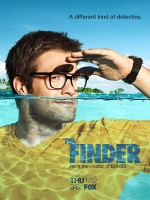
THE SKED PREMIERE REVIEW: "The Finder"


THE FINDER - Thursdays 9PM on FOX - If Nothing Else Is On...

THE FINDER has already had a pilot of sorts, which aired last season as an episode of BONES.  While the series is based on the character Walter Sherman from the "Locator" novels by Richard Greener, technically it's presented as a jerry-rigged spin-off of Bones, with Walter supposedly being an old Army friend of the Seeley Booth (David Boreanaz) character.  (Both The Finder and Bones are "created" for TV purposes by Hart Hanson.)  That Bones episode had a somewhat different supporting cast and also featured Bones cast members, so we'll consider tonight's episode the "real" pilot.


Walter Sherman (Geoff Stults), in all incarnations of the character, is a former soldier who now runs a tropical bar (in Florida for the TV series).  He suffered a brain injury that has wired his mind in such a way that he can make connections between seemingly random pieces of information and use them to track down any person or object that's been lost.  He also has a deep-rooted psychological need to locate such people and things. Hence, he's "The Finder."  His right-hand man, lawyer and muscle is Leo (Michael Clarke Duncan).  Since the original TV episode, he's lost the tough bartender played by Saffron Burrows, and instead liaises with a tough, self-described "smoking hot" cop named Isabel Zambada (Mercedes Masohn), with whom he has the obvious mix of irritated professional respect and sexual tension.  He and Leo, for reasons that aren't yet entirely clear, also have the care of teen gypsy Willa (Maddie Hasson), who's on probation from juvie living in a trailer on their land; Walter and Willa mutually pretend not to care about one another.

As in Bones, the particular mystery of the week is less critical than the banter and relationship between the characters.  In the premiere episode, Walter was hired by the military-school student son of a pilot whose life Walter had saved in Kosovo, and ultimately he proved that the father, while sadly deceased, had been a hero and a caring dad.  

The Finder hasn't quite discovered its voice yet, but then Bones took most of its first season before it hit its stride.  Right now the show feels underpopulated, compared to the ensemble rom-com that Bones turned out to be; with only 4 leads, they're all being asked to do too much.  Also, Walter is an emotionally stunted character in the mode of Brennan on Bones, but his foils aren't yet being given the material to carry his emotions for him, the way the other characters do on that show.  

That being said, The Finder is a perfectly pleasant hour of television for now.  Stults, Clarke and the women are personable and seem like a good fit, and Hanson provides the tone of wry mystery that's worked for him on Bones.  The show will have a limited number of episodes this year, as it plugs the gap in Bones episodes caused by Emily Deschanel's pregnancy, and if it doesn't lose too great a portion of Bones' rating (it will doubtless be helped by having American Idol as a lead-in starting next week, and next week also brings a visit from Bones' John Francis Daley playing his character Sweets), it should have sufficient time to develop its potential and prove whether FOX has found a companion piece for its long-running procedural hit.

  • Digg
  • Del.icio.us
  • StumbleUpon
  • Reddit
  • RSS

THE BIJOU REVIEW: "Sherlock Holmes: Game of Shadows"


SHERLOCK HOLMES:  GAME OF SHADOWS:  Watch It At Home - Far Too Elementary

We have to come to terms with the fact that an entire generation may recognize the name Sherlock Holmes not as the template for brilliant amateur crime-solving, but as a moderately intelligent action-comedy hero who dresses up in funny clothes.  This effect on the populace is what a $524M worldwide gross buys you, and with the sequel SHERLOCK HOLMES:  GAME OF SHADOWS, director Guy Ritchie, producer Joel Silver, and new screenwriters Michele and Kieran Mulroney, provide more of the same.  

Game of Shadows is in one way superior to 2009's Sherlock Holmes:  it does away with the supernatural mumbo-jumbo and takes place in some version of the real world.  There's no great mystery about who the villain is, since this time Moriarity (Jared Harris) himself is on the scene.  The convoluted and more-than-slightly ridiculous mystery Holmes has to solve is just what the evil one is plotting, which turns out to be not dissimilar from what master criminals have been plotting in big-scale action movies for decades. It all leads to a showdown between Holmes and Moriarity at a location that does come from Conan Doyle (and in being so used, reveals the ending). 


Watching Game of Shadows, one is struck more than anything else by the waste.  It's not just Robert Downey, Jr, Jude Law and Harris--the very fine cast includes Rachel McAdams, briefly reprising her role from the first movie, Noomi Rapace (Lisbeth Salander in the Swedish Dragon Tattoo series) as a Gypsy fortune-teller, Stephen Fry, having a fine old time as Holmes's brother Mycroft, and Eddie Marsan as Inspector Lestrade.  Philippe Rousselot again provides gorgeous, atmospheric photography, and Sarah Greenwood's turn-of-the-century production design is sumptuous.  No one can question Ritchie's ability to create sharp action sequences.

But to what end?  Even leaving aside the distortion of Holmes as a character, Game of Shadows is an action franchise that's already tired.  We get more signature sequences of Holmes anticipating every blow of a fight in slow-motion before the first punch is thrown or shot is fired, then enacting it all as planned; more giggly no-it's-not-really-homoerotic scenes of Holmes standing in the way of Watson's marriage to the understanding Mary (Kelly Reilly), more silly and unconvincing costumes (look, he's in drag!) for Downey to wear in disguise.  There isn't a scene that can't be overly worked for a gag; without spoiling the ending, it provides a microcosm of the movie by starting out as fairly clever and then continuing to push until it succeds in becoming farcial and dumb for the sake of a cheap laugh.  Downey seems to be leaking his ADD-plus-ego Tony Stark/Iron Man persona onto Holmes, and while the rapport between him and Law is still the center of the movie's appeal, it feels more studied and forced this time around. 

The Sherlock Holmes franchise clearly works for a wide audience, and Game of Shadows will inevitably make a great deal of money too.  Plenty of things blow up, and Downey and Law remain fairly good company.  Overall, though, the movie is 129 laborious minutes of paycheck-grabbing by a group of very talented people who don't particularly care if their secret motive is uncovered.

  • Digg
  • Del.icio.us
  • StumbleUpon
  • Reddit
  • RSS

THE BIJOU REVIEW: "Tinker, Tailor, Soldier, Spy"


TINKER, TAILOR, SOLDIER, SPY:  Worth A Ticket - An Epic of Betrayals

John LeCarre is (I guess one should say "arguably") the greatest of all spy novelists, and his 1974 TINKER, TAILOR, SOLDIER, SPY is "arguably" his finest work.  Incredibly, the 1979 BBC miniseries adaptation lived up to the level of the novel, featuring an (please--this isn't even arguable) iconic performance by Alec Guinness that was legendary even in the context of his great career.


So, no pressure on the filmmakers determined to remake it... and squeeze an exceptionally labyrinthine plot into 128 screen minutes.  And yet, to a remarkable degree, those filmmakers, led by director Tomas Alfredson, screenwriters Peter Straughan and Bridget O'Connor, and with Gary Oldman in the Guinness role, have succeeded, making a cerebral thriller faithful to the spirit and much of the letter of LeCarre's novel. 

Oldman, like Guinness before him, plays George Smiley, the recessive and brilliant mandarin of the British Foreign Intelligence Service, known colloquially as the Circus.  Shortly after the story begins, the head of the Circus, known only as Control (John Hurt) and Smiley, his closest aide, have been forced into retirement after a mission in Budapest turned disastrous.  That mission was intended to unearth information about a mole at the highest level of the Circus, a double agent Control had narrowed down to his 5 closest aides:  Percy Alleline (Toby Jones), code-named "Tinker," Bill Haydon (Colin Firth), known as "Tailor," Roy Bland (Ciaran Hinds) or "Soldier," Toby Esterhase (David Dencik), the "Poor Man"... and Smiley himself, presumably the "Beggarman."  After the Budapest mission and Control's exit, the search for the mole went away.  But when the rumor of a mole arises again, and with the 4 main suspects now running the Circus themselves, a politician with oversight authority over the Service brings Smiley back to unofficially determine whether Control was, after all, correct.

This sets off a virtuoso set of ever-deepening complications, as Smiley and his (unseen) Soviet counterpart Karla, along with their respective minions, try to outmaneuver each other by crisscrossing false leads, cover-ups and intentional dead ends.  The recurring theme is betrayal, as everyone involved, on both a professional and very personal basis, ruthlessly undercuts whoever gets in their way, often taking from them what they most value in the world.  Ideology hardly figures into the game--as a traitor explains at one point, devastating choices can be made for reasons of aesthetics as much as for political convictions.  Everyone involved is brilliant, cunning and fully capable of making big-picture decisions under deadly pressure. 

Alfredson previously directed the vampire art movie Let the Right One In (remade in the US--not by him-- as Let Me In), and his commitment to LeCarre's exhausted, almost existential viewpoint is faithful almost to the point of fetishism.  Although Alfredson is more than able to deliver a suspenseful crescendo when one is called for, no one involved with Tinker, Tailor seems to have worried about hyping up the action component of the story to find a wide audience (and probably the film won't)--Hoyte van Hoytema's photography seems gray even in sunlit scenes, and Alberto Iglesias' score is uninsistently mournful. 

The wonderful supporting cast comports with the film's overall style, although here is where the novel's compression into 2 hours takes its toll.  In order to squeeze a comprehensible version of the plot into a feature running time, something had to go, and in this case it was the complexity of some of LeCarre's characterizations.  One of the film's real problems is that none of the prime suspects gets to establish a memorable presence, which makes the emotional component of the search for the spy less involving than it should be.  (The final confrontation between Smiley and the mole doesn't have nearly the fireworks that it did in the miniseries.)  Only Tom Hardy, as a Circus agent caught in the crossfire between Karla and Smiley, and Mark Strong, as the agent involved in the Budapest fiasco, really have the chance to develop backstories. 

As for Oldman, he gives several subtle nods to Guinness's definitive Smiley, from the shape of his eyeglasses to some of his inflections.  It can't be said that he displaces Guinness as the actor who will first come to mind when the character's name is mentioned--Oldman doesn't quite have Guinness' minimalist genius for suggesting waves of feeling under an impassive countenance (then again,who does?)--but as the story develops and gradually, almost imperceptibly, Smiley emerges from the shadows to take his place at center stage, Oldman's performance becomes increasingly more commanding and richer in shading.  

Tinker, Tailor isn't, frankly, for everyone--it's the anti-24 as spy stories go, offering satisfactions of the mind rather than the gut.  It takes its time, to an extent almost revolutionary in contemporary Hollywood entertainment, and forces the audience to think, and consider, along with its characters.  Like the technology of its 1970s setting, it's hand-crafted, a little slow, and quite marvelous to behold.

  • Digg
  • Del.icio.us
  • StumbleUpon
  • Reddit
  • RSS

THE SKED PILOT REPORT: PREMIERING TONIGHT - CBS's "Unforgettable"

Disclaimer:  Network pilots now in circulation are not necessarily in the form that will air in the Fall.  Pilots are often reedited and rescored, and in some cases even recast or reshot.  So these critiques shouldn't be taken as full reviews, but rather as a guide to the general style and content of the new shows coming your way.


UNFORGETTABLE -  Tuesday 10PM on CBS:  Change the Channel

UNFORGETTABLE is a CBS procedural, which is as specific a term as any that exists in current network television.  Those who adore these shows should by all means tune in; for those of us not in the club, it's the very definition of wearily predictable. 


This one belongs to the Mentalist/Monk/Psych DNA strain, where the star sleuth has a preternatural ability to instantly absorb the tiniest details of a crime scene, unearthing clues no one else possibly could (the tip-off that it's CBS and not USA is because it's humorless). Our heroine is Carrie Wells (Poppy Montgomery, a CBS favorite from Without A Trace), who has an--apparently real--rare condition that permits her to recall every instant she has ever experienced in her life, down to the most random detail, with one glaring exception.  Like Monk and Patrick Jane, she has a calamitous murder in her past; in her case, she discovered her sister's dead body when they were children, and she's never been able to recall exactly what happened that day.  Her search for the killer will be the continuing story thread that runs every so often through the series; meanwhile, she'll solve a crime-of-the-week.

Unforgettable is written by Ed Redlich and John Belucci, both also from Without A Trace, so they know how this game is played.  The pilot crime is more or less interchangeable with the murders on any other procedural.  There's a visual gimmick to illustrate Carrie's powers, a la Psych:  when she uses her super-memory to search for incriminating details, she travels back to the moment she's recalling and watches herself in the present tense, sort of like Ebenezer Scrooge but without a Ghost of Murders Past for company.  Romantic sparks are intended to fly between her and the head of the homicide unit, also conveniently her ex-love; he's played by Dylan Walsh, a long way from Nip/Tuck  Other detectives, complete with ersatz New York accents, include Michael Gaston, Kevin Rankin and Daya Vaidya.  The cast goes through its paces adequately under the direction of Niels Arden Opley, himself a walking footnote in movie history as director of the Swedish version of The Girl With the Dragon Tattoo (aka the one that's already been eclipsed by the David Fincher remake that won't open till December); Opley doesn't bring anything to the project that a CBS house director wouldn't have done.

There's clearly an audience for a show like Unforgettable (Mitch Metcalf's Tuesday analysis has the series winning its timeslot thanks to those fans, handily beating Body of Proof and--sob--Parenthood); for the rest of us, even the pilot may feel like a rerun we can recite line by line and shot by shot, without the need of a freakish memory.

  • Digg
  • Del.icio.us
  • StumbleUpon
  • Reddit
  • RSS

THE SKED'S BUSTED PILOT THEATRE: "Poe"


We round out our survey of some of the more notable busted pilots of the season with the distinctive POE, produced by Warner Bros Television for ABC and written by Chris Hollier (a former writer for Kyle XY).  Unfortunately, this pilot stands for the proposition that "distinctive" doesn't necessarily equal "good."  

Poe's distinctiveness, for one thing, is decidedly second-hand.  It's clearly inspired by the Robert Downey Jr Sherlock Holmes movies, with a 19th Century literary figure being reconfigured as an anachronistic action hero.  Here, of course, the unlikely hero is an author rather than a fictional character:  Edgar Allan Poe (played by Chris Egan, who was the male lead in Letters to Juliet and a star of NBC's flop Kings).  We find him living in 1840 Boston as a dashing newspaper reporter (according to the always-reliable Wikipedia, in fact he was living in Philadelphia at the time, writing for literary journals and married to the 18-year old he had wed 5 years earlier, when she was only 13--but no matter). Just so we'll know this really is that Poe, the pilot includes a cask of Amontillado, a woman named Ligeia, and of course a raven.  (There's also a morgue, albeit not noticeably rue.)


The show's Poe is a true believer in the supernatural who solves seemingly impossible crimes for the police on the side, with a sidekick in the gorgeous Celeste (Natalie Dormer, The Tudors' Anne Boleyn), another reporter who's not-so-secretly in love with Edgar and who believes there's a rational explanation for any bizarre phenomenon.  (Mulder, meet Scully.)  They also have an African-American MD (Leslie Odom, Jr) to consult with them, and the inevitable authority figure (Kevin McNally) who sputters at Poe's reckless investigations but has to respect his results. 

The pilot never finds a viable tone.  It's even more anachronistic than the Downey Holmes (in a dance sequence, we watch the couples waltz while the soundtrack plays contemporary pop music), and Egan's performance seems to be a riff on John Barrowman's Captain Jack Harkness from Torchwood; aside from whether Egan is in Barrowman's league (he's not), Captain Jack is very specifically a man living outside of time, which is why the original performance makes sense.  Poe, supposedly an actual person living in 1840, just sounds silly as he bounds around in period costume, but acts like he's just back from lunch in Brentwood.

The show doesn't have much to recommend it on any other level, either.  The pilot's plot is complicated without being satisfying (women seemingly possessed by demons are actually being drugged by the villain so they'll commit murders for him), and when the show has Poe giving little attention to Celeste in order to moon after ex-fiance Sarah (Tabrett Bethell), it seems to be asking us to question his intelligence.  (Although I guess this Poe shows better judgment than the real one, staying away from 13-year-olds and all.)  Director Alex Graves tries, despite what must have been a limited budget, to give the show a polished look, but it still feels pretty cheap.  

Poe's spin on a supernatural procedural, while different, can't find its way to being fun or compelling.  Like most--although not all--of its busted pilot brethren, the show that emerged from development was nevermore worth putting on the air. 

The Sked's Verdict:  The Network Was Right

Read more about TV's new shows at THE SKED PILOT REPORT.

  • Digg
  • Del.icio.us
  • StumbleUpon
  • Reddit
  • RSS

THE LINCOLN LAWYER: McConaughey For the Defense


Worth a ticket.

It's a little mysterious that Michael Connelly's trim, twisty crime novels have so rarely hit the screen. Perhaps it was the tepid reception received by Blood Work in 2002, unfortunately one of Clint Eastwood's more dismal films of the last decade. Or just the usual horror stories of movie industry development. In any case, THE LINCOLN LAWYER is an imperfect but sturdy piece of work that could well lead to more Connelly adaptations.
Lincoln Lawyer is based on Connelly's second-tier book franchise, about the cynical defense attorney Mickey Haller (first tier is occupied by LAPD detective Harry Bosch; in the Connelly universe, Bosch and
Haller know each other and have co-starred in each other's books). Haller's gimmick, and the explanation of the title, is that he prefers to stay constantly on the move, doing his between-court work in the back seat of a Lincoln sedan rather than an office. In this entry, Haller (played by Matthew McConaughey) is asked to represent rich boy Louis Roulet (Ryan Phillippe), accused of beating a prostitute. It looks like an easy payday, but of course nothing is as it appears to be, and the story takes several satisfying turns.

It would be nice if the film didn't look so much like the pilot for a TNT series (director Brad Furman, in his first Hollywood movie, overdoes the close-ups and shows limited visual style). Most of the cast, though, is very strong: Marisa Tomei as Haller's ex-wife who happens (of course) to be a DA, William H Macy as his investigator, cops in the persons of Bryan Cranston, Mikaela Conlon and Michael Pare, Josh Lucas as opposing counsel, John Leguizamo as the local bail bondsman, and Margarita Levieva as the victim of the crime. The conspicuous exception is McConaughey--not that he's bad, but this extreme Los Angeleno (the character's dad was Mickey Cohen's lawyer) was never meant to have a thick Texas accent, and Haller's slyness and subtlety is somewhat beyond McConaughey's' powers (when he's calculating tactics, it's not that you can see the wheels turning in his head so much as you watch his windmill rotate). Nevertheless, screenwriter John Romano does a good job at compressing the complicated story into a tidy 2 hours, and the picture buzzes along. Although the film is predicted to have a mid-level opening, it should hold its place in theatres for a few solid weeks and live for years on cable and video.

(THE LINCOLN LAWYER - Relativity - 119 min. - Director: Brad Furman - Script: John Romano (based on Michael Connelly's novel) - Cast: Matthew McConaughey, Marisa Tomei, Ryan Phillippe, John Leguizamo, William H Macy, Josh Lucas, Frances Fisher, Bryan Cranston, Michael Pare, Mikaela Conlon - Wide Release)
--Mitch Salem

  • Digg
  • Del.icio.us
  • StumbleUpon
  • Reddit
  • RSS