THE ADVENTURES OF TINTIN: Worth A Ticket - The Return of Steven Spielberg
Remember how lousy the last Indiana Jones movie was? Remember watching it and wondering sadly what had become of Steven Spielberg, the magician who for decades had an irresistible, inexhaustible ability to spin action sequences into sight gags into satisfying storytelling? Who now seemed tired and creaky, his heart in more serious material like Saving Private Ryan and Munich, a million miles away from the business proposition that Indiana Jones and the Kingdom of the Crystal Skull became?
Well, that Steven Spielberg is back, at least to some extent, and in a guise that's both completely new and back to his roots. THE ADVENTURES OF TINTIN, which closed out the AFI Film Festival last night prior to a US opening on December 21 (it's already playing overseas), is a work of 3D motion-capture animation, in all of which Spielberg is a relative newcomer, but it's also, unofficially, the Indiana Jones movie he owed us.
Tintin, of course, is a literary character who predates Indiana Jones by some 50 years, having debuted in a comic book created by the Belgian artist Herge in 1929. Not well known in the US, Tintin is a giant figure in European popular culture. He's a young reporter who travels the world with his dog Snowy, solving mysteries and having adventures along the way as he hunts for stories to write.
 The movie, written by Steven Moffat, Edgar Wright and Joe Cornish (a virtual Murderers Row of British fantasy geekdom, writers respectively of Doctor Who, Shaun of the Dead and Attack the Block) and produced by Peter Jackson (who is slated to direct the next film in the series, assuming there is one), takes off from the Herge story "The Secret of the Unicorn." In it, Tintin ("played" via motion capture by Jamie Bell) comes into possession of a model replica of a 17th century ship (the Unicorn), which is also desired by the evil Ivanoviche Sakharine (Daniel Craig). Tintin discovers that's it's because of a parchment hidden in the model, which when combined with the parchments in 2 other models will reveal the location of a long-lost pirate treasure. Tintin goes in pursuit of the remaining clues, which puts him in partnership with the often-inebriated Captain Haddock (Andy Serkis), descendant of the treasure's original owner, and takes them all to the open seas and Arabian deserts.
Although the writers do a good job of propelling the action, the appeal of The Adventures of Tintin doesn't lie in its screenplay. The plot is both complicated and meaningless, other than as a Maguffin, and characterization is virtually nonexistent. Apparently (according to Wikipedia) Tintin, as a character, has been renowned and even admired for his utter blandness, and the script presents him as such, a figure without any particular traits other than spunk and enthusiasm (you'll badly miss Indy's dry wit and occasional romances). Sakharine, too, is a colorless villain, and there's a particularly unfortunate pair of bumbling cops named Thompson and Thomson (Simon Pegg and Nick Frost) who are infinitely less funny than they're intended to be. Captain Haddock and the dog Snowy are the only characters who manage to be worthy of the word. The fact that the movie is intended as the first in a series also means it ends with an anticlimactic cliffhanger that's less than satisfying.
 From beginning to end, though, Tintin is a visual treat. Spielberg uses the motion-capture technology James Cameron utilized for Avatar, but the degree of difficulty is much higher here, because Tintin has to depict human beings and not Na'vi, in recognizable locations. The result isn't perfect--sometimes the characters appear to have had too many facelifts--but it's mercifully much improved from the Robert Zemeckis House of Zombies that gave us a series of movies with characters whose dead eyes were more creepy than fanciful. Those in Tintin can be quite expressive at times, not photo-reality but a heightened quasi-realism.
Even better, the technology allows Spielberg to create and perfect action set pieces that would be impossible with live action--not just in terms of scale, but more importantly with a fantastic fluidity. Without concerns for the safety of live performers or the need to handle actual machinery or meld CG with humans, Spielberg can let characters leap and flow within long single shots that are enormously exciting. (There's a chase scene through and around an Arabian city while a dam bursts around the characters that's amazing.) Spielberg works with his usual editor, Michael Kahn, in this new medium, and the two of them bring snap and virtuosity to these sequences that would be the envy of any action movie. In fact, the whole Spielberg team is on board, including cinematographer Janusz Kaminski (in a movie like this, it's not necessarily clear what was the work of the cinematographer as opposed to the animators, but the movie has a wonderful storybook look and one that stands up beautifully to the challenge of 3D and its dimming glasses) and, of course, John Williams, who contributes an opening credits theme that nods to his own Catch Me If You Can and rousing accompaniment to the action.
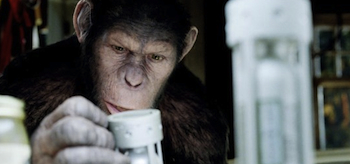
It remains difficult to judge the acting that goes into motion-capture performances, but Serkis, who has more experience with this kind of work than anyone alive, thanks to the Lord of the Rings movies, King Kong and Rise of the Planet of the Apes, brings real personality to Haddock, and Daniel Craig seems to be having a good time as the villain. Bell appears to be what was wanted as Tintin, but that's a limited order. In the end, though, the only real star of Tintin is its director.
The Adventures of Tintin isn't Steven Spielberg at his most intellectually stimulating or challenging or even poetic. It's far from the most satisfying story he's told. But for the first time, really, since Jurassic Park in 1993, it's Spielberg delivering--and seemingly having--a grand movie-movie time.