RSS
Showing posts with label england. Show all posts

THE BIJOU @ TIFF: "The Deep Blue Sea"


If you were going to describe the films of Terence Davies (Distant Voices, Still Lives, The Long Day Closes, The House of Mirth) in one word, that word would not be "dynamic."  Or "kinetic."  Or, well, "exciting."  Davies directs stately tableaux, impressive and sometimes moving, but rooted in nostalgia and regret.


Which is why choosing him to direct THE DEEP BLUE SEA, based on Terence Rattigan's 1952 play (previously filmed in 1955 with Vivien Leigh), was somewhere between inspired and doomed.  Rattigan's play is all post-war repression, unrequited love and misery; Davies' film fully realizes those themes, and provides little else.

Deep Blue Sea tells of a romantic triangle where all three parties manage to be dismally unhappy.  When the story begins, Hester (Rachel Weisz) has left her stodgy, older husband William (Simon Russell Beale) for the younger and more dashing Freddie (Tom Hiddleston).  William truly loves Hester, but arouses no passion in her; Hester is obsessively in love with Freddie, but he has only superficial feelings for her.  Freddie, too, is depressed, because apart from the clinging Hester, he knows his life peaked as a WWII pilot, and now he drinks and treats her badly.  To give an idea of how depressing all this is, the play and movie begin with Hester's failed suicide attempt because Freddie had forgotten her birthday the night before (and it doesn't get any more fun after that).  

Davies makes the experience even grimmer than it has to be.  The film has been shot (by Florian Hoffmeister) in oppressive semi-darkness, which accurately reflects the mood of the characters (and probably also relates to the post-war rationing and hardship of the time) to a fault.  There is much lugubrious singing of old wartime songs, and the production design is pinched and despondent.  Deep Blue Sea has been compared by some to David Lean's film of Noel Coward's Brief Encounter, but while that, too, was a tribute to stiff-upper-lip emotion, it also had a swoony romanticism; Deep Blue Sea, taking place after the romance has already curdled, is just sad.

Weisz and Beale give very strong performances, even if there's limited scope in the film's interpretation of their characters--both make us feel the terrible emptiness of their lives and longing.  I don't know if it's possible in 2011 to give life to a bounder like Freddie, but Davies and Hiddleston don't manage to find any depth in him, and the other characters fade into the brownish background.  

The Deep Blue Sea seems to be exactly the film its director intended, plumbing the depths of human woe and unhappiness.  Its agonized depiction of despair, however, make it an acquired taste.

  • Digg
  • Del.icio.us
  • StumbleUpon
  • Reddit
  • RSS

BROADWAY JOURNAL: "War Horse" and "Jerusalem"


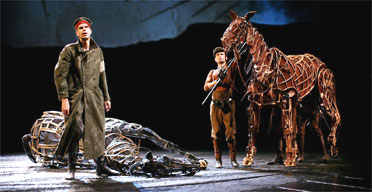
For a new play, WAR HORSE has strong movie connections.  The play is adapted for the stage by Nick Stafford from the 1982 novel by Michael Morpurgo, and that novel is also the basis of Steven Spielberg's upcoming film, which will be in theatres for Christmas (the script for which is by Lee Hall and Richard Curtis).  Further, it's pretty clear that the inspirations for the story had to include Robert Bresson's 1966 film Au Hasard, Balthazar, which tells the story of a donkey and its owners over the years, and in so doing makes a statement about humanity and grace; as well as Carroll Ballard's 1979 film of The Black Stallion.  In this story, the setting is early 20th Century rural England.  Albert (Seth Numrich) acquires the foal Joey through the fecklessness of his father (Boris McGiver), and boy and horse bond, overcoming obstacles together until World War I begins.  When Joey ends up more or less drafted to the war effort, Albert goes to France to find and rescue him; both experience the horrors of combat.  As a play, War Horse is rather thin, wearing its influences on its sleeve, but the National Theatre of Great Britain production currently at Lincoln Center is prodigiously exciting.   Conceived in association with Handspring Puppet Company and directed by Marianne Elliott and Tom Morris, it features horses that are marvels of puppetry, housing and operated by several engineers who create not a realistic facsimile of a horse but a wondrous theatrical essence of one.  Even when it isn't gripping drama, War Horse is impressive, original spectacle.  (Vivian Beaumont Theatre)


Jez Butterworth's JERUSALEM provides theatrical spectacle of a different sort:  over 3 hours of the great Mark Rylance roaring his way through a giant role.  Like War Horse, Jerusalem is concerned with the idea


of England, the very soul of the country, but in a much less sentimental way.  Rylance plays Johnny "Rooster" Byron, a former Evel Knievel-like daredevil who now lives in a dilapidated RV in the Wiltshire woods, where he uses the money he makes painting houses and selling blood to casually provide drugs and a party location for the local teens.  Rooster is a rebel who's running out of territory and friends:  a housing development is about to have him evicted, and he finds out that most of the people he loves don't love him back.  He's a symbol of an individualistic England that's vanishing, but in his case, he's not fading away quietly.  Rylance rages, jokes, sings, prances, and pretty much keeps the play going all by himself, even though there are more than a dozen other actors on stage with him.  The story, which traces the final day before the bulldozers are due to turn Rooster out, didn't really need to be 3 acts and as many hours, and Ian Rickson's direction can't always hide the fact that more than half the time, we're watching small talk.  Rylance, though, seizes the outsized role of Rooster and shakes every drop out of him, and Jerusalem is worth seeing just for his artistry.  (Music Box Theatre)

  • Digg
  • Del.icio.us
  • StumbleUpon
  • Reddit
  • RSS