RSS
Showing posts with label theatre. Show all posts

SHOWBUZZDAILY NY THEATRE JOURNAL: "Venus In Fur"


VENUS IN FUR exists, at this point in its Broadway life, as two overlapping but not identical entities:  it's a deft new play by David Ives, but also, and more prominently, it's become the Star-Is-Born vehicle for its lead actress, Nina Arianda, who's currently giving about as dazzling a performance as you're likely to see on a Broadway stage.  


No one had ever heard of Arianda before she starred in the initial 2010 Off-Broadway production of Venus, and fittingly, in the play she's introduced as an unknown aspiring actress.  Her name is Vanda, and at the end of a long day, hopelessly late, she blows into an audition hall like a scatterbrained force of nature, desperate to try out for the lead in the play Venus In Fur--a character coincidentally also named Vanda.  The only one still in the audition room is writer/directorThomas (Hugh Dancy), who's packing up to leave, but Vanda talks herself, in her seemingly bubble-headed, flaky-funny way, into being allowed to read.  Once she begins, everything changes.

Thomas' play is based on the real late 19th century novel of the same name by Leopold von Sacher-Masoch.  His name became the root of the term "masochism," and that pretty much tells you the subject matter of the work.  It concerns a man named Severin and his obsession with Vanda, before whom he finds sexual satisfaction in abasement and humiliation.  Thomas claims to have written the adaptation out of purely academic fascination, with no personal feelings attached, but when Vanda convinces him to take the role of Severin opposite her, it's no surprise that before long, his real emotions begin to show.

The role of Vanda (the actress) is spectacularly mercurial, presented initially as a sort of savant who doesn't have a thought in her mind when she's being herself, but instantly takes on--embodies--all the necessary characteristics (accent, bearing) as well as the complexities and nuances of Vanda (the character) as soon as she's reading the role.  And there are increasing hints that she may not just be a gifted actress...

Venus In Fur (the play) is ultimately more of a game (and a satire on actor/director politics) than a serious commentary on male/female relationships, as Vanda the actress and Vanda the character constantly shift and begin to merge, and the balance of power between her and Thomas/Severin inevitably comes to resemble the story they're enacting.  But what a game!  The role of Vanda is a gift to a performer in the way that split-personality roles like Sybil and The 3 Faces of Eve have been gifts to actresses in the past:  Arianda gets to become less and more intelligent, submissive and powerful, American and European, seductive and revolted, 21st Century and 19th, all with split-second hairpin turns of body language and voice.  It's the very definition of a tour de force, and she pulls it off gloriously.

Dancy's work is less overwhelming than Arianda's, but shouldn't be underestimated.  He also has to transition between eras, characters-within-characters, and contrasting positions of power, and does so with seeming ease  Ultimately, though, his character's throughline is more clearly preordained, and Thomas is destined to be Vanda's foil.  

Walter Bobbie's direction brings a welcome clarity to what could have been a mess of confusion:  even when we don't know exactly what's going on, or who a character 'is," we always feel comfortable that we know as much as the play wants us to at that given moment, and where we are in Ives' process.  John Lee Beatty's set design and Peter Kaczorowki's lighting design are also notable for squeezing a remarkable variety of changes out of a single fixed set.

Venus In Fur is constantly enjoyable, even if not particularly profound, a satisfying, sexy, funny exercise in theatrical gamesmanship (gameswomanship?).  It's destined to remembered, though, mostly for unleashing Nina Arianda and her powerhouse set of skills onto an audience that finds itself more than willing to yield.

  • Digg
  • Del.icio.us
  • StumbleUpon
  • Reddit
  • RSS

SHOWBUZZDAILY BROADWAY JOURNAL: "How To Succeed In Business Without Really Trying"


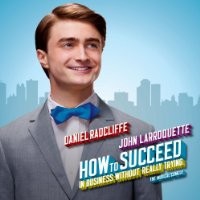
Few things bring audiences as much joy as the sight of a well-known actor or actress revealing a side of their talent that's never been seen before.  (It's not just general audiences, either--those roles become instant favorites for Oscar nominations and wins.)  It can be as simple as Halle Berry, Julia Roberts or Nicole Kidman deglamorizing themselves for Monster's Ball, Erin Brockovich and The Hours, and as immense as Daniel Day-Lewis' paralysis in My Left Foot or Robert DeNiro's weight gain in Raging Bull.  The most reliable type, though, may be the revelation that a dramatic performer can sing or dance:  Amy Adams in Enchanted, Meryl Streep in Mamma Mia!, Jeff Bridges in Crazy Heart, Rene Zellweger in Chicago... the list goes on.  The same is true on Broadway, of course--think Antonio Banderas in Nine, and practically everyone who's starred in the revival of Chicago;   Right now, the star with unexpected abilities is Daniel Radcliffe, in the new (and not particularly necessary) revival of Frank Loesser's HOW TO SUCCEED IN BUSINESS WITHOUT REALLY TRYING.


Radcliffe is, and probably always will be, known above all for the role that he spent his entire childhood playing, but Harry Potter was never called upon to sing or dance away from evil.  As J. Pierrepont Finch, the outrageously ambitious protagonist of the 50-year old musical, Radcliffe has to do both, and while his singing voice is merely decent, the man can dance.  Numbers like "Grand Old Ivy" and "The Brotherhood of Man" pretty much bring down the house, in large part because of his footwork.  

For those unfamiliar with How to Succeed, the title itself refers to a handbook used by Finch as he rapidly climbs the ranks at Worldwide Wickets, moving from window washer, to the mailroom, to a junior executive office, to the notice of boss J.B. Biggley (John Larroquette), and so forth.  Along the way, secretary Rosemary (Rose Hemingway) falls madly in love with him, and he struggles between the pulls of ambition and love, not to mention the competition posed by Biggley's evil nephew Bud Frump (Christopher J. Hanke).  The book by Abe Burrows, Jack Weinstock and Willie Gilbert provides the mildest sort of corporate satire, although it has an off-hand structural skill, effectively conveying the story as needed between Loesser's songs, that seems impressive today.

Rob Ashford's production is pleasant enough entertainment--he's a better fit for this material than he was for last year's revival of Promises, Promises, which was more character-and dialogue-based.--and Loesser's songs are always a pleasure to hear, but there's nothing revelatory going on at the Hirschfeld Theatre.  Ashford seems to have approached the material with the viewpoint that it should be played entirely as it would have been in 1961, with no allowance made or irony taken to acknowledge changes in society since then.  So there are no italics around the worship of corporate success, or the sexism the show takes for granted (the song title "Happy To Keep His Dinner Warm" says it all), and no interest in Mad Men-like commentary about the social revolutions that were just a few years away.  Radcliffe's performance is similarly straightforward, even more so than Robert Morse's somewhat maniacal one in the original version (at least as preserved in the 1967 film) and Matthew Broderick's in the 1995 Broadway revival, both of whom took a more cartoonish approach.  Given the broad nature of the material, a taste of that might have been a good idea, both for Radcliffe and for Hemingway; the actors who broaden their performances, notably Larroquette, Hanke and Tammy Blanchard as the self-explanatory Hedy LaRue, fare better.

How to Succeed is an enjoyable 2 1/2 hours, brightly choreographed by Ashford and designed by a team that includes Derek McLane (sets), Catherine Zuber (costumes) and Howell Binkley (lighting), supporting a talented, hard-working cast.  Is it worth $132 for a standard ticket?  Probably not, but discounts are available.  And there is a kick in finding out that The Boy Who Lived is also The Actor Who Can Dance.

  • Digg
  • Del.icio.us
  • StumbleUpon
  • Reddit
  • RSS

SHOWBUZZDAILY BROADWAY JOURNAL: "Spider-Man: Turn Off the Dark"


Haven't all the jokes been made?  In the history of Broadway, there may never have been a show as relentlessly ridiculed as SPIDER-MAN:  TURN OFF THE DARK.  At this point, it may be that the only interesting thing that could be said about the show would be if it weren't as bad as you'd expect.  Sadly, though, that isn't the case.

The long and miserable history of this misbegotten project is well known and has been exhaustively detailed elsewhere.  Very briefly:  the celebrated director Julie Taymor (Broadway's smash hit, hugely profitable version of The Lion King) teamed with no less than U2's Bono and The Edge to create a stage extravaganza based on the comic-book series.  They planned and worked on the musical for years, and as its ambitions mounted, so did the cost.  Investors fell in and out, the scheduled start of production slipped, the biggest names in the original cast (which was to feature Evan Rachel Wood and Alan Cumming) left, and finally, at a cost of $65M--by far the most expensive show in Broadway history--a version of the show began "preview" performances in late November 2010.


This should have been the beginning of the end of the show's troubles, but it turned out only to be the end of the beginning.  Word of mouth was deadly, and the performances themselves were, if not deadly, certainly dangerous, with repeated injuries to cast members who had to fly around the theatre on wires and harnesses.  Even when people weren't hurt, often the flying system balked, and performances had to be delayed while the actors hung in mid-air and waited to be rescued.  However, tickets continued to be sold at a brisk pace, and the producers apparently decided they were in no hurry to spoil the fun by inviting the press.  Thus began the longest "preview" period in the history of Broadway, with successive "opening nights" postponed.  Finally critics decided they'd had enough, and began to review the "unfinished" version of the show.  Their reviews were as catastrophic as everyone expected they'd be, and the producers decided to dump Taymor and a great deal of her original, myth-laden conception, and bring in a new creative team, including "Creative Consultant" Philip Wm McKinley as director, and Roberto Aguirre-Sacasa as a new book writer.   This new, streamlined, and reportedly less bizarre version of the show finally opened to the critics in June 2011 (drawing a tepid, but less vitriolic response), and is now officially playing on Broadway.

And after all that... it's for the most part a dull, tuneless waste of time, and certainly a waste of $150 for a weeknight orchestra ticket.  Even Spider-Man 3, by far the worst of the Sam Raimi film series, is far superior to this formless, atonal bore.  

The Frankenstein-like cobbled-together nature of this beast is clear from the outset, as its tone is all over the place.  Act I is the origins story familiar from every version of the Spider-Man tale:  Peter Parker (here played by Reeve Carney, who had been in Taymor's movie of The Tempest), a high-school student much-bullied and hopelessly in love with the beautiful Mary Jane Watson (Jennifer Damiano, from Broadway's Next To Normal and Spring Awakening), is bit by a mutated spider, and finds himself spinning webs and leaping up and down the sides of buildings.  (The musical makes little use of his "Spidey sense," or some of his other comic-book powers.)  In order to earn a paycheck, Peter finds a job working as a photographer for the awful J.Jonah Jameson (Michael Mulhearn here) at the Bugle, where his convenient specialty is taking photos of the elusive Spider-Man.  Along the way, Peter learns that With Great Power Comes Great Responsibility.  In the Broadway version, all this is recounted ploddingly, with little attempt at style or imagination. (The Greek figure Arachne, turned into a spider by the gods, was apparently a key part of Taymor's conception, but appears only briefly in the current version of the show.) 

Act II is more of an overt mess.  The spider that bit Peter was owned by Norman Osborn (Patrick Page), who becomes the Green Goblin--however, his story as presented here is far more like the Doc Octopus storyline from the Spider-Man 2 movie, crossed with Jack Nicholson's Joker in Tim Burton's first Batman picture.  In an apparent bid to get some laughs, the Goblin speaks in an exaggerated Southern accent, re-enacts a voice-mail comedy routine that's at least a decade old, and ultimately plays a burlesque version of "I'll Take Manhattan" on a green piano on the top of the Chrysler Building.  None of this is scary, exciting or humorous--it's just desperate (similarly, when the strains of an old U2 song are faintly heard at one point, it's a mildly funny bit, but when, after that, "Vertigo" is used in a dance scene, it's a little pathetic). The cast does what it can, but only Damiano emerges with much coherence.  (It should be said, though, that the more Page overacts, the more he pleases the audience.)  Meanwhile, many minor characters wear outsized cartoon heads, an idea that one assumes traces back to Taymor and her fascination for puppetry and masks, while the production design is a mix of giant forced perspective sets and semi-animated projected backdrops.

Even the much-vaunted flying scenes are a disappointment.  Although they've apparently been ramped up since McKinley came in (he's directed as much for the circus as for Broadway), and feature a number where multiple Spider-Men pop up around the theatre using confetti for webs, there's simply no way the sight of men wearing heavy harnesses and thick wires to fly can substitute for what we routinely see in the movies these days, with those details CG'd out.  Even worse, for the most part, the flyers aren't the actual actors who play Spider-Man or the Goblin, they're stuntpeople who circle around while pretaped quips play over the soundsystem, dubbed by the real actors--the effect is so hokey and fake that it's impossible to suspend disbelief, the opposite of what live theatre is supposed to provide.

The best that can be said for Spider-Man:  Turn Off the Dark is that it serves as a fine trailer for the upcoming movie reboot of the series:  after watching all these amateurs screw up a very serviceable, entertaining franchise, one wants nothing more than to see fine actors like Andrew Garfield and Emma Stone in these parts.  As for the musical itself, can it make back its gargantuan investment?  Although grosses have remained over $1M per week and most seats are filled, the show is so expensive to produce that most of that goes to running costs, and little to reimbursing the budget--and it can't be a good sign that the show has half-price tickets available, not to mention online discounts.    There's been talk of taking the show on the road, to Vegas and other locales, with sort of a Cirque de Soleil model, and that may be where its future lies. As a Broadway musical, though, its web is downright murderous.

  • Digg
  • Del.icio.us
  • StumbleUpon
  • Reddit
  • RSS

BROADWAY JOURNAL: "War Horse" and "Jerusalem"


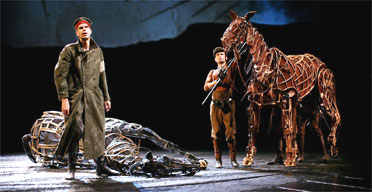
For a new play, WAR HORSE has strong movie connections.  The play is adapted for the stage by Nick Stafford from the 1982 novel by Michael Morpurgo, and that novel is also the basis of Steven Spielberg's upcoming film, which will be in theatres for Christmas (the script for which is by Lee Hall and Richard Curtis).  Further, it's pretty clear that the inspirations for the story had to include Robert Bresson's 1966 film Au Hasard, Balthazar, which tells the story of a donkey and its owners over the years, and in so doing makes a statement about humanity and grace; as well as Carroll Ballard's 1979 film of The Black Stallion.  In this story, the setting is early 20th Century rural England.  Albert (Seth Numrich) acquires the foal Joey through the fecklessness of his father (Boris McGiver), and boy and horse bond, overcoming obstacles together until World War I begins.  When Joey ends up more or less drafted to the war effort, Albert goes to France to find and rescue him; both experience the horrors of combat.  As a play, War Horse is rather thin, wearing its influences on its sleeve, but the National Theatre of Great Britain production currently at Lincoln Center is prodigiously exciting.   Conceived in association with Handspring Puppet Company and directed by Marianne Elliott and Tom Morris, it features horses that are marvels of puppetry, housing and operated by several engineers who create not a realistic facsimile of a horse but a wondrous theatrical essence of one.  Even when it isn't gripping drama, War Horse is impressive, original spectacle.  (Vivian Beaumont Theatre)


Jez Butterworth's JERUSALEM provides theatrical spectacle of a different sort:  over 3 hours of the great Mark Rylance roaring his way through a giant role.  Like War Horse, Jerusalem is concerned with the idea


of England, the very soul of the country, but in a much less sentimental way.  Rylance plays Johnny "Rooster" Byron, a former Evel Knievel-like daredevil who now lives in a dilapidated RV in the Wiltshire woods, where he uses the money he makes painting houses and selling blood to casually provide drugs and a party location for the local teens.  Rooster is a rebel who's running out of territory and friends:  a housing development is about to have him evicted, and he finds out that most of the people he loves don't love him back.  He's a symbol of an individualistic England that's vanishing, but in his case, he's not fading away quietly.  Rylance rages, jokes, sings, prances, and pretty much keeps the play going all by himself, even though there are more than a dozen other actors on stage with him.  The story, which traces the final day before the bulldozers are due to turn Rooster out, didn't really need to be 3 acts and as many hours, and Ian Rickson's direction can't always hide the fact that more than half the time, we're watching small talk.  Rylance, though, seizes the outsized role of Rooster and shakes every drop out of him, and Jerusalem is worth seeing just for his artistry.  (Music Box Theatre)

  • Digg
  • Del.icio.us
  • StumbleUpon
  • Reddit
  • RSS