RSS
Showing posts with label retrospective. Show all posts

THE BIJOU RETROSPECTIVE: "Harry Potter and the Deathly Hallows (Part 1)"


When the announcement was made that Warner Bros would split HARRY POTTER AND THE DEATHLY HALLOWS into 2 full-length movies, there was a certain amount of cynicism about studio greed--and, indeed, why not pick up an extra billion or so if the opportunity arises?  But really, J.K. Rowling's novels have all been stuffed so full of plot that any of the adaptations could have been 2 movies long--as it is, readers had been complaining all along about the scenes and storylines that had to be cut for time.  (For that matter, this season HBO spent 10 hours on a single volume of Game of Thrones--just nominated for a slew of Emmys--and nobody seemed to have a problem with that.)  


Dividing Deathly Hallows in particular, though, guaranteed that the first film would be what is almost certainly the bleakest, most unsettling movie in the history of giant Hollywood franchises--a picture so awash in futility and death that if it were a standalone project, it probably couldn't get financed, much less muster a deluxe $150M+ budget.  The first half of the Deathly Hallows novel and film presents the Harry Potter saga at low ebb, with its central characters spending much of its length wandering through an unforgiving countryside at a complete loss, falling apart emotionally and failing at all of their goals; they're like Beckett protagonists with wands. 

All of which makes Deathly Hallows (Part 1) perhaps the trickiest production of the whole series, and despite its inherent difficulties, in some ways a special triumph for the filmmakers and stars.  David Yates, directing his third consecutive chapter, has to craft the film out of the bare essentials of the saga; most of the huge supporting cast is reduced to brief appearances, there's no Hogwarts at all, and only a few action sequences.  (Although this film isn't about its guest stars, added to the cast this time--in case the series didn't already have enough great British actors--are Bill Nighy, Rhys Ifans and Peter Mullen.)

Behind the camera this time is Eduardo Serra, the French cinematographer whose works include Girl With a Pearl Earring and many of the later films of Claude Chabrol; once the film has left the city and its black-walled Ministry of Magic, Serra's images becomes warmer than those in Order of the Phoenix and Half-Blood Prince, with gorgeous landscapes that emphasize the smallness of these teenagers as they try to defeat a mad and murderous army.  The composer is Alexandre Desplat, whose superb recent scores include The King's Speech and The Tree of Life; his music here is more delicate than any other Potter score (John Williams' original theme is barely to be heard).  Mark Day again serves as Yates' editor, keeping the pace moving forward even as the characters are in stasis.  Stuart Craig is the production designer, as he's been all along; note the subtle way the sequences in the Muggle world, although set in ordinary places like cafes and public restrooms, are slightly off-kilter, odd in a way that suggests a world alien to witches and wizards.  The special effects, often cartoonish and obvious in 2001 (although state-of-the-art at the time), have become so realistic that they seem as real as the sets, and special note should be made of a lovely, distinctive animated sequence that explains the story of the Deathly Hallows themselves.

Ultimately, though, while Deathly Hallows is part of an epic adventure, it's a very intimate story, and the fact that the film is so compelling has to be credited to screenwriter Steve Kloves and the stars Daniel Radcliffe, Rupert Grint and Emma Watson.  Those three (and for a chunk of the time, just Radcliffe and Watson)  carry almost an hour of screen time virtually alone, an accomplishment they seem to bring off with ease.  (Kloves, Radcliffe and Watson have justly been praised for adding the brief, exhausted dance between Harry and Hermione that isn't in the book.)  Although there were some complaints about the story's relentlessly grim focus on Harry, Ron and Hermione, it was yet another very smart decision by Rowling and then Yates and Kloves:  staying closer to those three, without the distraction of huge sets and starry supporting characters, and watching them suffer and struggle, only brings the audience more into their story, heightening the emotions for the grand finale.

And so:  the cliff is hanging, the advance ticket sales are record-breaking, the clocks are ticking to 12:01AM.  All that remains is for film projectors around the world to be switched to "On."  

  • Digg
  • Del.icio.us
  • StumbleUpon
  • Reddit
  • RSS

THE BIJOU RETROSPECTIVE: "Harry Potter and the Order Of the Phoenix"


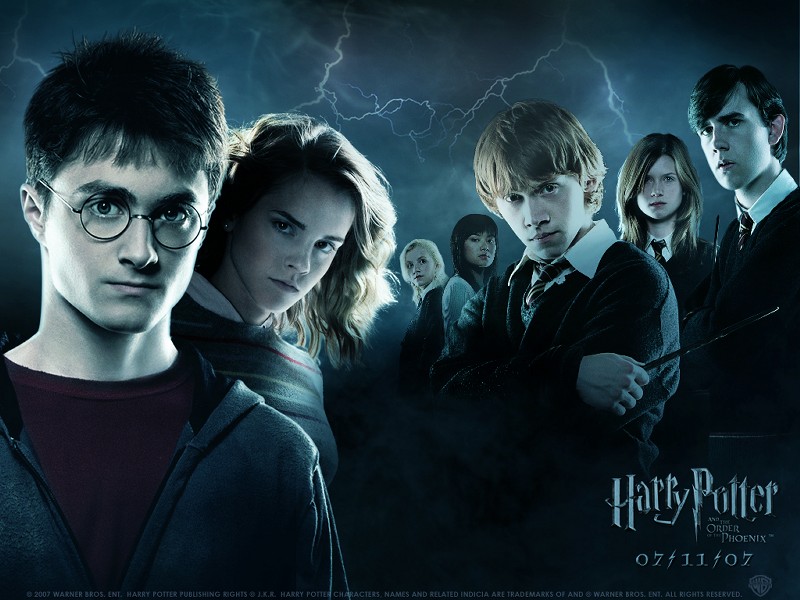
The magically moving portraits are pulled off the walls of Hogwarts in 2007's HARRY POTTER AND THE ORDER OF THE PHOENIX, and the colors have started draining from the Potter universe.  Gone are the lush visuals of Prisoner of Azkaban and Goblet of Fire; the palette of Slawomir Idziak's photography (his films include Kieslowski's great Decalogue and also Black Hawk Down) is dominated by grays, blacks and browns.  The visual message is clear:  we're not in a kiddie movie franchise anymore. 


The pastel exception to these subdued hues, of course, is the pink favored by Dolores Umbridge (Imelda Staunton), the smiling, giggling gorgon who becomes the latest Defense Against the Dark Arts professor at Hogwarts as a stepping stone on her way to fascist dictatorship.  Umbridge, even with her tortures significantly toned down from those in J.K. Rowling's book, is one of the author's most frightening creations, beautifully realized by Staunton.

In franchise terms, the biggest development on Order of the Phoenix was the decision to hire David Yates as house director for the remainder of the series.  Yates was hardly an obvious choice, having never directed a feature film before (his most notable credit was the BBC version of State of Play, later--and badly--remade by Hollywood); there was concern when he was named that the studio had chosen a TV hack whose main interest would be keeping on budget as he rattled through the script pages.  Yates, though, has been creative and wholehearted in embracing the darkness of the story's later chapters; Order of the Phoenix isn't as dramatically satisfying as the more epic Goblet of Fire, but it's emotionally fierce.  And despite the overall sense of desolation, Yates is able to vary the moods where needed, supplying one of the most rousing sequences in the whole series with the montage of Harry's illicit Order of the Phoenix training sessions (helped tremendously by the excellent Nicholas Hooper score--he had worked frequently with Yates in TV). 

Order of the Phoenix is also notable as the only Potter film not written for the screen by Steve Kloves (he pleaded exhaustion after 4 giant films in a row, but returned for the final 3 chapters).  Michael Goldenberg handles the script instead, and the segue is just about seamless.  Goldenberg only makes one structural misstep:  by omitting the admittedly complicated backstory of the prophecy that's at the core of the Phoenix story, he makes the revelation of its contents feel somewhat anti-climactic, and that makes the huge battle scene and major death that follow seem like special effects merely for the sake of spectacle.

At this point in the saga, most of the major characters had been introduced, but in addition to Umbridge, we do get Evanna Lynch as the ineffable Luna Lovegood, and Helena Bonham Carter as the utterly insane Bellatrix Lestrange.  This is also one of the chapters where Alan Rickman gets to do more than swat students whispering in Potions class, and his angry training sessions with Daniel Radcliffe are among the best scenes in the film.  With such regulars as Dumbledore and Hagrid out of the picture for much of this story, the bulk of the dramatic heavy lifting is handled by the story's young stars, who by now are more than able to bear the burden.

Order of the Phoenix is where the Potter franchise could easily have gone wrong, with a slew of major creative changes and a drastic shift in story tone.  Instead, the series seemed stronger than ever as it started to head into its home stretch, with stability both at the boxoffice ($43M higher than the previous chapter) and in the director's chair.

HARRY POTTER RETROSPECTIVE REVIEWS
Harry Potter and the Sorcerer's Stone
Harry Potter and the Chamber of Secrets
Harry Potter and the Prisoner of Azkaban
Harry Potter and the Goblet of Fire
Harry Potter and the Order of the Phoenix
Harry Potter and the Half-Blood Prince
Harry Potter and the Deathly Hallows (Part 1)


  • Digg
  • Del.icio.us
  • StumbleUpon
  • Reddit
  • RSS

THE BIJOU RETROSPECTIVE: "Harry Potter and the Goblet of Fire"


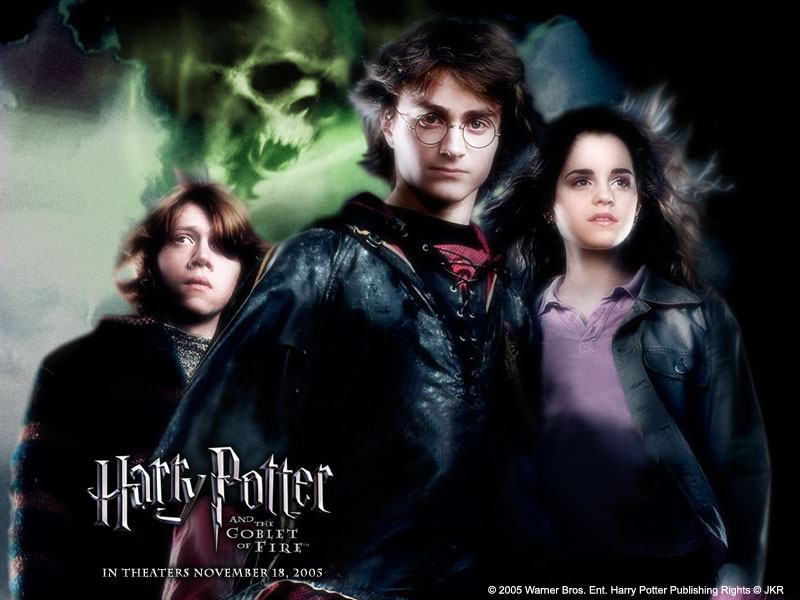
Pending the arrival of this week's finale, Mike Newell's 2005 HARRY POTTER AND THE GOBLET OF FIRE may be, on balance, the most satisfying of the series.  It combines first-rate moviemaking with one of J.K. Rowling's most ingeniously constructed, emotionally rich stories--capped, of course, by the unveiling of Ralph Fiennes as the finally fully alive Lord Voldemort.


Newell isn't the cinematic wizard that Alfonso Cuaron is, and visually Goblet of Fire is a bit of a step backwards from Prisoner of Azkaban.  Newell, who started his career in the 1960s, had made such fine films as Donnie Brasco, Four Weddings and a Funeral and Dance With A Stranger, but he wasn't exactly an epic adventure guy; when he tried the genre again after his Potter sojourn, the result was the sad Prince of Persia.  Roger Pratt, who had photographed Chamber of Secrets, returned behind the camera for Goblet of Fire, making for a somewhat more stagier look and more old-fashioned lighting.  In other respects, though, the picture certainly has more drive and snap than the Chris Columbus chapters, with sharp editing by Mick Audsley (who's worked often with Stephen Frears) and score by Patrick Doyle.

Newell handles the action well enough (the dragons and mer-people are extremely convincing, and the living maze quite disturbing).  He also compellingly guides viewers through the complications of the storyline--screenwriter Steve Kloves had his hands full with Goblet of Fire, which could easily have been expanded to 2 full-length films (it's too bad so much of the Quidditch World Cup and the Hagrid/Madame Maxime romance had to be lost).  It would have been easy to tangle the audience in the shifts between Twiwizard Cup action sequences, inter-student conflicts and the overriding Voldemort plot, but Newell and Kloves do a yeoman's job of steering the tale forward.  

Newell's greatest strength is with the actors.  The usual giant cast of British veterans inhabit Goblet, and they're joined by Miranda Richardson (who had starred in Dance With A Stranger), delicious as Rita Skeeter; David Tennant, briefly but scarily vicious as Barty Crouch Jr; and especially Brendan Gleeson, so good as Mad-Eye Mooney that it's too bad subsequent chapters didn't give him more to do.  (And of course there's Robert Pattinson, whose on-screen death became an omen of how successful he'd become as one of the undead.)  Goblet of Fire, though, is most notable as the movie that first showcased how polished its young stars had become.  The Yule Ball storylines allow them (especially Rupert Grint) to show off their comic chops, and Newell gives Emma Watson a lovely little Audrey Hepburn moment as she walks down the stairs at the ball and everyone else in the cast realizes how beautiful she is.  Later on, as the story takes its darker turns, Daniel Radcliffe faces down Ralph Fiennes--Amon Goeth of Schindler's List in all his sneering villainy--and proves himself a worthy adversary.

Goblet of Fire returned the series to the boxoffice heights of the first two films, grossing $100M more worldwide than Prisoner of Azkaban had.  Tonally, it was the film that turned the corner for the series, providing plenty of large-scale action sequences and humor, but also effectively laying the ground for the much darker, more demanding storylines that would soon follow.

HARRY POTTER RETROSPECTIVE REVIEWS
Harry Potter and the Sorcerer's Stone
Harry Potter and the Chamber of Secrets
Harry Potter and the Prisoner of Azkaban
Harry Potter and the Goblet of Fire
Harry Potter and the Order of the Phoenix  
Harry Potter and the Half-Blood Prince
Harry Potter and the Deathly Hallows (Part 1) 


  • Digg
  • Del.icio.us
  • StumbleUpon
  • Reddit
  • RSS

THE BIJOU RETROSPECTIVE: "Harry Potter and the Chamber of Secrets"


Everything is a little smoother in 2002's HARRY POTTER AND THE CHAMBER OF SECRETS.  The young actors give more assured performances; Steve Kloves' script, having gotten so much exposition out of its way in Sorcerer's Stone, is faster and more character-based; the camerawork (by Roger Pratt instead of John Seale) is more fluid; the sets by Stuart Craig more believable; the editing (by Peter Honess instead of Richard Francis Bruce) more even.  Chris Columbus' direction is still staid, compared with the films that were to come, but it has an easier, more confident feel.


Chamber of Secrets benefits from a stronger core plot from J.K. Rowling's novel than Sorcerer's Stone had--indeed, it's too bad that in order to keep the film to a manageable 161-minute length (it's still the longest of the series), so much detail about Tom Riddle's vicious diary and its possession of Ginny Weasley had to be sacrificed.  (One wonders if the filmmakers knew at the time how critical a place Ginny would come to play in the overall saga and if that might have changed the balance of the script.)  It introduces such important characters as Moaning Myrtle (wonderfully played by Shirley Henderson), the house-elf Dobby (voiced by Toby Jones) and Lucius Malfoy (Jason Isaacs), as well as Gilderoy Lockhart, who turned out to be relatively incidental to the series but is great fun as played by Kenneth Branagh. The story also starts to introduce the darker emotional notes that would come to dominate later chapters.

One of the side pleasures of watching the Potter movies together is the education it provides in how special effects have improved in the past decade.  Even though Chamber of Secrets came only a year after Sorcerer's Stone, the CG animation of Dobby is far better than the troll had been in the previous film, and the Quidditch match is less cartoony and more exciting.  The actors also do a better a job of integrating their actions with the effects.

Chamber of Secrets, however upgraded, is still superior as a film only to Sorcerer's Stone in the Potter canon.  Columbus, for all his improvement the second time around, continued to be an unexceptional director who couldn't accomplish much more cinematically than a professional job of storytelling.  The actors, too, were still working at inhabiting their characters:  Grint grimaces slack-jawed too much to indicate surprise and fear, and there's not much differentiation between Tom Felton's sneers as Draco Malfoy.  

With Chamber of Secrets, he Harry Potter series was moving in the right direction, trying to improve despite its great success, but not even the most optimistic viewer would have imagined just how much Warners was willing to allow the franchise to be reimagined going forward.  The great leap in the series was still to come.


HARRY POTTER RETROSPECTIVE REVIEWS
Harry Potter and the Chamber of Secrets
Harry Potter and the Prisoner of Azkaban
Harry Potter and the Goblet of Fire
Harry Potter and the Order of the Phoenix  
Harry Potter and the Half-Blood Prince
Harry Potter and the Deathly Hallows (Part 1) 

  • Digg
  • Del.icio.us
  • StumbleUpon
  • Reddit
  • RSS