

HUGO: Worth A Ticket - If Only For the Visual Splendors
Paramount doesn't have much choice but to market Martin Scorsese's HUGO as a family movie: it's got a PG rating, a young boy and girl as the hero and heroine, a children's book ("The Invention of Hugo Cabret" by Brian Selznick) as source material, all manner of visual effects wizardry (including 3D) on display, and a $100M+ production budget. But the occasional young cineaste aside, it's hard to imagine what most kids will make of what is ultimately a very personal meditation by Scorsese on the nature of film both as an art form and as a mystical, liberating, life-changing experience. Happy Feet Two this ain't.
John Logan's script, and before it Selznick's novel, is a fantasy built around a kernel of historical truth, namely that the legendary early filmmaker Georges Melies (played in the film by Ben Kingsley), who singlehandedly invented the first versions of motion picture special effects at the turn of the 20th century (he's best known now for A Trip To the Moon, and especially for the iconic shot of a rocket hitting the moon's face in the eye), went bankrupt later in life and was rediscovered in the 1930s after some years working at a toy store in a Paris railway station. In Hugo, the agent of Melies' rebirth is young Hugo (Asa Butterfield), an orphan since the death of his watchmaker father (Jude Law) and disappearance of his drunken uncle (Ray Winstone). The uncle was in charge of keeping all the clocks at the station in operation, and he and Hugo lived in a cubbyhole within the walls of the station itself; after he vanishes, the intrepid Hugo takes over care of the clocks without telling anyone and lives in the apartment inside the walls, dividing most of his time between dodging the local station inspector (Sacha Baron Cohen) and trying to repair an automaton (sort of a robot precursor operated by clockwork) left to him by his dad.
 In pursuit of the latter, Hugo swipes parts from the toy store, where the stern, unyielding Georges catches him and as punishment takes away the notepad depicting the inner workings of the automaton that Hugo also inherited from his father. Hugo is desperate to get the notepad back, and he follows Georges home, where he makes the acquaintance of Georges' goddaughter Isabelle (Chloe Grace Moretz), a book-lover who is instrumental in Hugo becoming a sort of unofficial (and unpaid) apprentice at the toy shop to earn back his right to the notepad That's pretty much it for the plot--once those pieces are in place, we wait for Hugo to solve the twin mysteries of the automaton and Georges' cold anger with him, which of course turn out to be linked.
 Story is far from the strong suit of Hugo, and neither is character. The people either stay the way they are when we meet them, or change for the better in exactly the ways we'd expect them to. (Other rail station inhabitants include Frances de la Tour and Richard Griffiths as a potential couple kept apart by her barking dog, Emily Mortimer as a kindly flower-seller, and Christopher Lee as an even more kindly bookseller.) Scorsese directs these sequences as though he had one eye on a video monitor playing Ernst Lubitsch movies, trying to figure out how the master made them work, even as he lets Cohen do a Peter Sellers dub as the stern but fumbling cop. Butterfield is very much a trained child-actor as Hugo, never remotely believable as a boy who's run wild on his own for years--this is particularly sad because Hugo is so clearly a stand-in for the young Martin Scorsese; Hugo watches the action around him from his high perch within the station clock just as Scorsese has described watching the mean streets of his youth from his window when he was too sickly as a child to be allowed outdoors. (And of course watching action from afar, not able to participate, is what a movie audience does.) Moretz, who's been superb in transgressive movies like Kick-Ass and Let Me In, has a much stronger presence than Butterfield, but there's very little depth to her part. Kingsley is the only one on screen who suggests hidden emotions within.
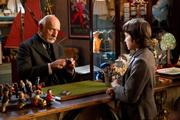 Despite all of this, Hugo is consistently a marvel to watch, as Scorsese outdoes himself with the look and feel of the universe he's created. Here, finally, is a 3D movie that absolutely has to be seen that way, the first picture since Avatar that isn't just about throwing objects and snowflakes into the forefront of the action, but the painstaking construction of images that simulate genuine dimensionality. As Hugo repeatedly tells us, Melies himself started as a magician, and the way Scorsese creates depth and surprise in almost every frame of this film is the very manifestation of his own magic. (Although Melies is the official guiding spirit of Hugo, it's impossible to watch the film without also recalling Scorsese's avowed passion for the team of Michael Powell and Eric Pressburger, and their technicolor fantasies like The Red Shoes and A Matter of Life and Death.) All the other technical credits are similarly marvelous: cinematography by Robert Richardson, production design by Dante Ferretti, editing by Thelma Schoonmaker, music by Howard Shore, and of course the endless, wondrous effects of the railway's interior and the city of Paris.
 As a piece of Hollywood entertainment, Hugo is lovably perverse--who else but Scorsese, the world's most prominent cinema preservationist, would devote extended sequences to actual (and gorgeously restored) footage from classic works of the earliest cinema? In its passionate devotion to the church of movies, Hugo in some spiritual sense resembles Scorsese's Kundun, about the child who would grow into being the Dalai Lama--one imagines Hugo becoming Scorsese's version of a holy man: a movie director. Is there an audience for this large enough to pay for Hugo's not incidental cost? Very possibly not--the last big-budget mainstream movie to tread this ground was Bogdanovich's Nickelodeon in 1976, and that didn't go well for anyone. But Scorsese's film is a gift for anyone who cares about the spectacle and rapt sorcery of movies.


