RSS
Showing posts with label moore. Show all posts

SHOWBUZZDAILY REVIEW: "Being Flynn"


BEING FLYNN:  Watch It At Home - Troubling Story That Doesn't Go Deep Enough

There's a scene in Paul Weitz's new film BEING FLYNN where Jonathan Flynn (Robert DeNiro), the alcoholic, narcissistic, pitiful, self-destructive father of Nick (Paul Dano), reads to his son from a publisher's rejection letter.  Jonathan sees himself as one of the greatest of all American writers--albeit unpublished--his only peers being Mark Twain and J.D.Salinger, and he considers it a great compliment that in rejecting his novel, the publisher termed it a "virtuoso display of personality."  The phrase comes awfully close to describing DeNiro's performance and Being Flynn itself.


Being Flynn is based on Nick Flynn's memoir "Another Bullshit Day In Suck City," and it tells a mostly pathetic and depressing story.  Jonathan was arrested for bad checks when Nick was just a child, and even when he was released from prison, he was never a meaningful part of Nick's life.  He did, however, send his son scores of letters, mostly desperately self-aggrandizing, and his presence overshadowed Nick's youth and the single mother (Julianne Moore) who diligently raised him but ultimately committed suicide.  Nick, passive and rootless, and also an aspiring writer, drifted into a job at a homeless shelter, and it was there that he and his father, who had been sleeping on the streets, truly met, and and the two began a painful, dysfunctional relationship. 

This is extremely difficult material, much of it no picnic to watch, and Weitz, whose work ranges from the lovely About A Boy to the execrable Little Fockers, doesn't find a tone to make it work.  The film's Jonathan is all mannerism with very little substance.  While it's great to see DeNiro stretching to give a real performance, something he's rarely done in the past 15 years (it's hard to avoid the feeling that Weitz and DeNiro felt so mutually disgusted with Little Fockers that they both needed to cleanse themselves afterward with something serious), he never finds Jonathan's center.  His work feels full of effort and yet superficial.  From the actor who gave us indelible portraits in Taxi Driver and Raging Bull, it's subpar.  

DeNiro isn't helped by Weitz's script, which while heartfelt never really draws a bead on who Jonathan is.  For all its gritty detail--no recent Hollywood product (even the indie part of Hollywood) has dealt so seriously with homelessness in quite a while--the film sidesteps complications and settles for bland emotion (and toward the end, sentimentality) too often.  

Dano has a more straightforward role:  he's the guy who hits bottom (getting to know his father leads him to some serious drug use) and manages to climb back up, turning out to be terrifically talented to boot.  Yet while his arc is the more simplistic and undeveloped part of the film, Dano's own odd qualities as an actor make Nick more interesting for a while.  Dano doesn't have a lot of gears, at least not that he's shown thus far--his killer app is a sort of intense distraction that can be played for humor or for surprisingly powerful repressed anger--but they serve him well here.  Olivia Thirlby, as the only sane person around, does so much with very little that one wishes she'd been given more of a part, and Moore, only briefly on screen, is her usual expert self.   

Being Flynn is a hard movie to recommend, because the hard truth is that filmmakers who deal with challenging, uncomfortable material have far less margin for error.  The work is transcendent or it's trite, and Weitz's film isn't transcendent.  It's intermittently powerful and worth watching for some strong scenes and interesting performances, without ever quite achieving a satisfying whole.


  • Digg
  • Del.icio.us
  • StumbleUpon
  • Reddit
  • RSS

THE BIJOU REVIEW: "Margin Call"


MARGIN CALL:  Worth A Ticket - The Real Sequel to"Wall Street"

MARGIN CALL is smarter and more gripping than Moneyball and The Ides of March combined--and those are two smart, gripping movies.  However, the superb ensemble cast of Margin Call doesn't boast a name as instantly bankable as Brad Pitt's or George Clooney's, so the film needs--and deserves--to be sought out.

The place is Wall Street, and the time is that precise moment when it suddenly became clear to a very few people that the world financial system had a staggeringly serious problem.  Margin Call isn't a documentary about the crisis (for that, see the excellent Inside Job), and it's not, unlike HBO's recent Too Big To Fail, based on a specific true story.  It's triumphantly fictional, with a brilliant script by first-time writer/director J.C. Chandor that illuminates the situation without ever slowing down to plod through the specifics (it's a running joke in the movie that even the people who make their living from these complex financial products don't remotely understand them).


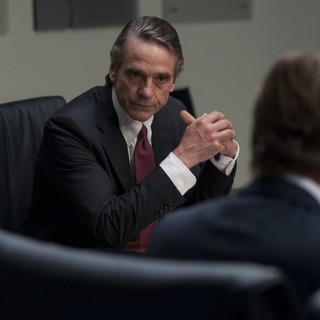
Although Margin Call is clearly inspired by the stories of Lehman Brothers and the other investment banks that packaged high-risk mortgage debts for sale to buyers who were too greedy to stay away, it's largely about the process of crisis itself, the ways people react to the end of their particular world, and how they behave when they have a chance to save themselves at the expense of others.   In Chandor's script, a fired bank executive (Stanley Tucci) gives a low-level analyst (Zachary Quinto, also one of the lead producers) data showing that the bank's bubble of assets is about to burst.  The movie traces how, in the course of a single long night's journey into day, this information makes its way up the chain of command, to successively higher executives played by Paul Bettany, Simon Baker, Kevin Spacey, Demi Moore, and ultimately the master of this universe, Jeremy Irons.  First, there is the stumbling attempt to comprehend what's happening--then the focused, ruthless hunt for a way to, above all, survive.

With its harsh, eloquent speeches about loyalty and greed, and its largely male environment of players who sardonically and savagely scheme against each other, Margin Call begs comparison with David Mamet, and specifically with Glengarry Glen Ross.  The comparisons are apt, and Chandor's dialogue stands up to the competition, but Margin doesn't have Mamet's agenda of describing manhood (or, despite some four-letter words, his spectacular flair for profanity).  These men are less overtly desperate than Mamet's; they're friendly, even courtly, as they slash each other's throats.  These are the guys who did get the good leads, and now they'll do virtually anything to hold on to them.

The cast is the ensemble of the year, handled by Chandor with perfect balance.  Kevin Spacey, as an old hand at the bank who understands both convenience and conscience, almost redeems the terrible movies he's done over the past decade--he leaves behind all his glib mannerisms and cuts down to his character's bone.  Irons, on the other hand, is fabulously superficial; he's the man who is not, under any circumstances, going to lose his private helicopter.   Bettany, Baker and Moore provide other steps on the road to corporate hell, while Quinto and Penn Badgley, as a young man less smart than he thinks he is, represent the newcomers almost instantly out of their depth.  Tucci has the emotionally richest part (none of these people have private lives, not because they're thinly drawn, but because in this context it just doesn't matter), and he manages to goes to town with it and yet not chew the scenery.

The film is low-key and low-budget, but beautifully put together.  Frank G. DeMarco's photography captures the increasing wear and tear of that endless night within the bank's elegant surroundings, while Pete Beaudreau's editing knows when to allow the characters some space and when to leap into the hurtling pace of a thriller.  

Margin Call originally premiered at Sundance in January, and against the odds, it's become only more topical in the last few weeks:  it lays bare the mindset that Occupy Wall Street and its brethren are furiously opposing.  With any luck, that will help the fortunes of a movie that might otherwise be dismissed as a bunch of well-dressed, well-educated, well-spoken people exchanging snappy dialogue in board rooms.  Margin Call has earned the luck; it's an extraordinary piece of work.

  • Digg
  • Del.icio.us
  • StumbleUpon
  • Reddit
  • RSS

THE BIJOU REVIEW: "Crazy Stupid Love"


CRAZY STUPID LOVE - Worth A Ticket:  It All Works


Without further ado:  CRAZY STUPID LOVE is the comedy of the summer.  Also the drama.  There are certainly spectacles out there now providing fantastic visual thrills, and some of them (X-Men, Harry Potter) are quite good, too; but if you want to watch an uproarious, surprising story about human beings whose only magic powers are for screwing up and somehow managing to keep trying again, this is your movie.


The script by Dan Fogelman (previously known mostly for cartoons like the original Cars, Tangled and Bolt) and direction by Glenn Ficarra and John Requa (themselves screenwriters, with idiosyncratic films to their names like Bad Santa and I Love You, Philip Morris) are triumphs of tone that mix slapstick with surprising poignancy.  The story begins with the marital break-up of Cal (Steve Carell) and Emily (Julianne Moore), a function of midlife crisis and Emily's straying with co-worker David (Kevin Bacon).  Cal is utterly bereft by the loss of his family, and his attempts to rejoin the dating scene are pathetically bad.  He's fascinated to watch a local Lothario, Jacob (Ryan Gosling) in action, and Jacob in turn is amused and horrified by Cal's failures; he takes Cal under his wing, teaching him tricks to attract women. 

This is the part of the movie featured in the marketing, and it delivers a lot of big laughs, fueled by the terrific comic chemistry between Carell and Gosling.  The great thing about Crazy Stupid Love, though, is that even that relationship has more to it than just comedy:  Cal may master Jacob's tips, but he's too genuine to use them without feeling, and on some level, Jacob envies that.  And all of this is just a slice of the film's portrait of romantic and family misadventure, which keeps expanding to such an extent that I can't reveal some of what happens toward the end without spoiling the fun.  We stay with the developing friendship between Cal and Jacob, but we're also following Jacob's own relationship with the reluctant Hannah (Emma Stone), a young lawyer who threatens to change Jacob's carefree theories about sex and life.  We watch Emily's experiences as a newly single woman, and the awkward crush her son Robbie (Jonah Bobo) has on his babysitter Jessica (Analeigh Tipton)--not to mention Jessica's own romantic issues.  At its best, Crazy Stupid Love recalls the classic Woody Allen movies of the 1970s and 80s, presenting a wide, varied portfolio of lovers both skilled and inept.

The cast is just about perfect.  Carell keeps his physical comedy emotionally grounded and delivers a performance more like his work in Dan In Real Life and Little Miss Sunshine than in his big-budget vehicles.  Julianne Moore is, as always, remarkably truthful even in comedy, and she and Carell fit together better than you'd expect.  Gosling is the film's major surprise, effortlessly shifting from the wrenching indie drama of Blue Valentine to reveal himself as a suddenly deft Hollywood comedian; it's no surprise at this point, though, that Stone is peerlessly appealing and smart.  Marisa Tomei is hysterical in a role that shouldn't be described in too much detail, and the lesser-known Bobo and Tipton more than hold their own in the ensemble.

Crazy Stupid Love is so smoothly engineered that it's easy to underrate:  Ficarra, Requa and Fogelman maneuver hairpin turns between pathos and farce as though they're moving up their own driveway.  There are a few minor missteps (the ending could be a little less neat), and the movie is content to work within the confines and style of conventional Hollywood filmmaking--there's nothing innovative about it.  (Although the cinematography by Andrew Dunn--he shot Precious, among many others--and editing by Lee Haxall are notably first-rate.)  But it affords the pleasure of a marvelous story, superbly told.

This has been an odd summer for comedy:  R-rated comedies aplenty, all of them proud of their own raunch, and all of them tremendously successful (only Friends With Benefits won't get to $100M, and even that film will do fine), but hardly anything geared to simple old-fashioned storytelling.  This could well explain the huge success of Woody Allen's Midnight In Paris, an intelligent, likable little film that's exploded (by indie standards) at the boxoffice, even though no one would seriously compare it to his classic work.  Crazy Stupid Love, with its PG-13 rating and largely older cast, seems unlikely to hit the first weekend heights of its rowdy mates--Mitch Metcalf is predicting a mild $16M opening--but it should thrive over time as people see it and spread the word.  It's sane exhilarating good.

  • Digg
  • Del.icio.us
  • StumbleUpon
  • Reddit
  • RSS

ARTHUR: 12-Step Programmer


Watch It At Home.

Were the executives at Warner Bros so desperate to be in business with Russell Brand that they huddled together in a conference room one day, frantically going through their library titles in search of alcoholic lead roles he could play?  ("Days of Wine and Roses... a little dark.  Clean and Sober... no, that's coke--too edgy.  Who's Afraid of Virginia Wolff... not quite yet.")  The new remake of ARTHUR only exists because playing drunks is what Brand does; it's not as though they were going to make the picture with Lindsay Lohan if he turned it down (although that might have been a more interesting movie). 

Even in 1981, Arthur was an anachronism, a throwback to the screwball comedies of the Depression era in which very rich people often lost their dignity but never their wit.  It was an enormous hit--$95M in the US alone, and those were 1981 dollars--and was the only film written and directed by Steve Gordon, who died just a year later at the tragically young age of 43.  (He was long gone in 1988 when the dreadful sequel Arthur On the Rocks came and went.)   It provided Dudley Moore with his signature role and John Gielgud with a lifetime achievement Oscar, as well as winning another for the inescapable Christopher Cross song.  

Both the original and the remake tell the same basic story:  Arthur is a not-so-young man born to a huge family fortune; he's spent his entire life drinking and carousing, chronically irresponsible but also, at the core, utterly likable.  His family pushes him to marry an equally wealthy woman, and it's just then that he meets the poor girl of his dreams, forcing him finally to grow up.  In the new version, there are some notable gender switches:  the butler who's cared for Arthur all his life (Gielgud) is now a nanny (Helen Mirren), and the parent
forcing Arthur into marriage is likewise his mother rather than his father.  A few supporting characters have been dropped, like Arthur's grandmother and the poorer girl's dad. The role of Arthur's enforced fiancee (Jill Eikenberry before, now Jennifer Garner) has been greatly expanded--she didn't even enter the original film until the halfway point--presumably to make the role appealing to someone of Garner's stature.  And some concession has been made to political correctness, as Arthur now eventually has to attend AA meetings as the price for being gleefully drunk, and even tries to work for a living when he decides to give up his fortune for love.


None of these changes are necessarily damaging in Peter Baynham's script.  But comedy is a fragile thing, and under the direction of Jason Winer (a TV veteran whose credits include the terrific pilot for "Modern Family"), the new film doesn't capture the fizz or charm of the original.  In 1981, the comedy was founded on classic New York verbal wit, and marvelous supporting players showed up in practically every scene (when Arthur buys some flowers, the florist is Lou Jacobi).  The love of Arthur's life was Liza Minnelli's Linda, a fast-talker not above shoplifting; she's transformed into Greta Gerwig's Naomi, who's been made idealistic and salt-of-the-earth (the police cite her only because she gives unauthorized, sentimental tours of the city), draining her of all humor.  Gerwig deserves better:  she comes from the mumblecore school of improvisational film and was the best thing in Noah Baumbach's Greenberg; here she mostly looks puzzled.   Mirren is, as always, impeccable, and she has better chemistry with Brand than either Gerwig or Garner, but she isn't permitted to be the implacable snob that Gielgud was, and softening the character dulls the movie out.  Garner's been given a lot of not particularly funny broad humor (in an odd shift, the original Arthur loved horses, while here Garner forces a terrified Brand to ride with her), and Nick Nolte as her bullying father (Stephen Elliott in 1981) is close to embarrassing.


But of course Arthur is all about Arthur, and the film rests on that actor's back.  Dudley Moore's performance was dotted with lovely grace notes and superb physical comedy; the delicate way he balanced a glass of Scotch on a rounded car bumper and checked if it was safe is a lesson in off-hand balletics.  Brand is essentially doing a PG13 version of the same guy he played in Forgetting Sarah Marshall and Get Him To the Greek (he's in danger of turning into Foster Brooks), and even though he gets his laughs, there's not a single surprising moment in his performance.  Worse, we never believe in the soulful innocence of his Arthur underneath it all--he just seems cynical and flip.  Brand gives us the TMZ version of Arthur.

A great comic structure is no small thing, and Arthur is far from unpleasant to watch, particularly when Mirren and Brand play off one another.  It's a decent enough piece of studio entertainment.  This time, though, too much gets in the way between the moon and New York City. 

(ARTHUR - 110 min. - Warners - PG 13 - Director:  Jason Winer - Script:  Peter Baynham - Cast:  Russell Brand, Helen Mirren, Greta Gerwig, Jennifer Garner, Nick Nolte - Wide Release)

  • Digg
  • Del.icio.us
  • StumbleUpon
  • Reddit
  • RSS