RSS
Showing posts with label yates. Show all posts

THE BIJOU REVIEW: "Harry Potter and the Deathly Hallows (Part 2)"


HARRY POTTER AND THE DEATHLY HALLOWS (PART 2) - Worth A Ticket - The Event of the Summer

The boxoffice totals for tonight's midnight screenings of HARRY POTTER AND THE DEATHLY HALLOWS PART 2 aren't available quite yet, but it was a remarkable experience to go to a shopping center multiplex and find its 6-story garage filled up to the roof even though every store and restaurant in the place was long closed.  (And then, leaving after 2AM, to walk through the throngs just arriving for 3AM overflow shows.)  J.K. Rowling's 7 novels, and the 8 films based on them, are arguably the most powerful narrative engines of their generation, a combination of plotting, character and a completely imagined, inhabited magical world that's left its contemporaries in the dust. 


If Deathly Hallows Part 1 was the healthy meal audiences needed to consume in order to gather their energy and maintain good health for the struggles ahead, Part 2 is practically all dessert. Where the earlier Potter movies were set over the course of an entire school year, the bulk of Deathly Hallows Part 2 takes place within a single 24-hour period, and it's a collection of mammoth action sequences that keep following one after another.  Unlike, say, some Michael Bay movies one could name, these sequences aren't spectacle simply for the sake of showing off the filmmakers' technical prowess, but carefully crafted steps that proceed toward the confrontation that's been a decade in the making (more than that if you start with the first book's publication):  Harry vs. Voldemort.  

Despite all the budget in the world and a combined 4 1/2 hours of screen time to play with, Deathly Hallows wasn't an easy work for screenwriter Steve Kloves (veteran of all the films except Order of the Phoenix) to adapt.  Rowling's plotting is so dense that thick slices of the novel's pie (Dumbledore's history is mostly gone) still had to be omitted, and short shrift is given to others.  Even the deaths of well-loved characters are sometimes observed only in a couple of shots, and while some iconic characters (Maggie Smith, front and center as Professor McGonagall) are showcased, others (Hagrid) are reduced to a few on-screen moments; when one budding romance is revealed, the characters haven't even shared a scene together in this movie.  

Compared to a typical Hollywood action epic, some of the narrative choices can seem eccentric.  Twice the action is interrupted for long stretches, first (vague Spoiler Alert)  for what is essentially The Severus Snape Story, and then for what readers will recognize as The Dumbledore Railway Scene.  Enormously important twists in the action are determined by obscure rules of wand ownership, which have to be expositioned after the fact.  The latter part of the story becomes somewhat spiritual, in the fairly familiar quasi-religious form that was always latent in a saga that calls its protagonist "The Chosen One," but which the previous stories avoided.  

With all these quirks, the film is a mostly triumphant entertainment.   David Yates, finishing out the series with his fourth consecutive film, moves smoothly from beautifully observed character moments to epic scale, from humorous action sequences that evoke the earliest films in the series (the Gringotts heist) to heartrending revelations about characters we thought we knew.  He's working here with the same technical group as in Deathly Hallows Part 1, including cinematographer Eduardo Serra, editor Mark Day and composer Alexandre Desplat, all of whom do beautiful work; special note should be taken in this installment of Stuart Craig's massive production design (no doubt aided seamlessly by CG) for the war-torn Hogwarts, and the combination of make-up technicians and CG wizards who pulled off the how-are-they-gonna-do-this? epilogue.  (The 3D is a conversion, and while it's not necessary by any means, it's quite good as conversions go.)

The Potter series, though, has most distinguished itself from all other franchises by the phenomenal skill of its cast.  Even the Lord of the Rings series didn't have the depth of characterization and quality of performance that these films have drawn; for this final installment, Ciaran Hinds and Kelly McDonald join the astonishing ensemble.  With all the plotting and action, and the return of many old characters (dead and alive), inevitably while Rupert Grint and Emma Watson are impeccable, they have less to do here than they did in Deathly Hallows Part 1, where they were responsible for carrying whole chunks of the story.  Part 2, though, is very much Daniel Radcliffe's movie, as Harry pieces together the story of his own life, learning truths about himself that Rowling had been nursing through 6 previous books; his stunned disillusion and then his resolute decisions to go on anyway are as inspiring as those of any screen hero one can name.  There's nothing glib about the character or the performance; Harry's ultimate heroism is his insistence on being ordinary.

It's unlikely that we'll see the like of the Potter series again, at least for quite a while, although we'll certainly get  many attempts to duplicate its appeal.  (Coming next year:  The Hunger Games, to name just one.)  Its original author, the filmmakers, cast and crews have done an exemplary job in a genre that's often a cynical display of trailer moments with no particular interest in context.  And credit is due, too, to Warner Bros:  it can't be a coincidence that two of the three best franchises of the past decade, Potter and Christopher Nolan's Batman films, come from the same studio (and the third, Lord of the Rings, was from New Line, a Warners division).  One can't begrudge them any of their billions.

There are people already begging J.K. Rowling to come back to Hogwarts and keep the stories going (and no doubt Warners would be happiest of all if she did).  But think about the last Indiana Jones movie, the last Godfather, Wall Street 2.  Rowling and the thousands responsible for making the films have managed to bring an epic tale to a satisfying conclusion.  Harry Potter deserves to enjoy his life.

HARRY POTTER RETROSPECTIVE REVIEWS
Harry Potter and the Sorcerer's Stone
Harry Potter and the Chamber of Secrets
Harry Potter and the Prisoner of Azkaban
Harry Potter and the Goblet of Fire
Harry Potter and the Order of the Phoenix
Harry Potter and the Half-Blood Prince
Harry Potter and the Deathly Hallows (Part 1)
 

  • Digg
  • Del.icio.us
  • StumbleUpon
  • Reddit
  • RSS

THE BIJOU RETROSPECTIVE: "Harry Potter and the Deathly Hallows (Part 1)"


When the announcement was made that Warner Bros would split HARRY POTTER AND THE DEATHLY HALLOWS into 2 full-length movies, there was a certain amount of cynicism about studio greed--and, indeed, why not pick up an extra billion or so if the opportunity arises?  But really, J.K. Rowling's novels have all been stuffed so full of plot that any of the adaptations could have been 2 movies long--as it is, readers had been complaining all along about the scenes and storylines that had to be cut for time.  (For that matter, this season HBO spent 10 hours on a single volume of Game of Thrones--just nominated for a slew of Emmys--and nobody seemed to have a problem with that.)  


Dividing Deathly Hallows in particular, though, guaranteed that the first film would be what is almost certainly the bleakest, most unsettling movie in the history of giant Hollywood franchises--a picture so awash in futility and death that if it were a standalone project, it probably couldn't get financed, much less muster a deluxe $150M+ budget.  The first half of the Deathly Hallows novel and film presents the Harry Potter saga at low ebb, with its central characters spending much of its length wandering through an unforgiving countryside at a complete loss, falling apart emotionally and failing at all of their goals; they're like Beckett protagonists with wands. 

All of which makes Deathly Hallows (Part 1) perhaps the trickiest production of the whole series, and despite its inherent difficulties, in some ways a special triumph for the filmmakers and stars.  David Yates, directing his third consecutive chapter, has to craft the film out of the bare essentials of the saga; most of the huge supporting cast is reduced to brief appearances, there's no Hogwarts at all, and only a few action sequences.  (Although this film isn't about its guest stars, added to the cast this time--in case the series didn't already have enough great British actors--are Bill Nighy, Rhys Ifans and Peter Mullen.)

Behind the camera this time is Eduardo Serra, the French cinematographer whose works include Girl With a Pearl Earring and many of the later films of Claude Chabrol; once the film has left the city and its black-walled Ministry of Magic, Serra's images becomes warmer than those in Order of the Phoenix and Half-Blood Prince, with gorgeous landscapes that emphasize the smallness of these teenagers as they try to defeat a mad and murderous army.  The composer is Alexandre Desplat, whose superb recent scores include The King's Speech and The Tree of Life; his music here is more delicate than any other Potter score (John Williams' original theme is barely to be heard).  Mark Day again serves as Yates' editor, keeping the pace moving forward even as the characters are in stasis.  Stuart Craig is the production designer, as he's been all along; note the subtle way the sequences in the Muggle world, although set in ordinary places like cafes and public restrooms, are slightly off-kilter, odd in a way that suggests a world alien to witches and wizards.  The special effects, often cartoonish and obvious in 2001 (although state-of-the-art at the time), have become so realistic that they seem as real as the sets, and special note should be made of a lovely, distinctive animated sequence that explains the story of the Deathly Hallows themselves.

Ultimately, though, while Deathly Hallows is part of an epic adventure, it's a very intimate story, and the fact that the film is so compelling has to be credited to screenwriter Steve Kloves and the stars Daniel Radcliffe, Rupert Grint and Emma Watson.  Those three (and for a chunk of the time, just Radcliffe and Watson)  carry almost an hour of screen time virtually alone, an accomplishment they seem to bring off with ease.  (Kloves, Radcliffe and Watson have justly been praised for adding the brief, exhausted dance between Harry and Hermione that isn't in the book.)  Although there were some complaints about the story's relentlessly grim focus on Harry, Ron and Hermione, it was yet another very smart decision by Rowling and then Yates and Kloves:  staying closer to those three, without the distraction of huge sets and starry supporting characters, and watching them suffer and struggle, only brings the audience more into their story, heightening the emotions for the grand finale.

And so:  the cliff is hanging, the advance ticket sales are record-breaking, the clocks are ticking to 12:01AM.  All that remains is for film projectors around the world to be switched to "On."  

  • Digg
  • Del.icio.us
  • StumbleUpon
  • Reddit
  • RSS

THE BIJOU RETROSPECTIVE: "Harry Potter and the Half-Blood Prince"


It was all so cute when it started...

David Yates' 2009 HARRY POTTER AND THE HALF-BLOOD PRINCE is surprisingly funny at times--surprising, because in all other ways the film was, up to that point, by far the grimmest entry in the series.  It's curiously structured:  part romantic comedy, complete with love potions and pining teenagers, and part a baleful story that begins in the immediate aftermath of one tragic death and ends with another, one that will clearly just begin the reign of terror hitting the Potter universe..   


The visual transformation that began with Order of the Phoenix continues in Half-Blood Prince:  the photography, this time by Bruno Delbonnel (his films include Amelie and Across the Universe), is so desaturated that the last reels are almost a greenish-tinged black and white.  Hagrid, the living soul of Hogwarts, is barely present in the film.  The magic portraits and friendly ghosts have vanished from the school, and the hallways themselves seem to have closed in on the students.  Nicholas Hooper's score is a subdued version of his music for Phoenix. The violence, when it comes, is sudden and deadly; no longer do the wizards and witches proudly call out their spells as they wield their wands; much of the time they don't speak at all or mutter the words under their breath.  Yates and his team wring a desolately gripping beauty from this apocalyptic world, with its Death-Eater cloud formations and hungry fires; there's a lovely shot near the end of the students and staff with their wands over their heads, tips glowing, in memorium for their terrible losses. 

The cast, while recognizing the increasingly dark sides of their characters, is able to keep the mood bearable.  The only major addition for Half-Blood Prince is Jim Broadbent, who does a marvelous turn as the vain, secretly shamed Professor Slughorn.   This chapter was Michael Gambon's great showcase, and he leaves (more or less:  like Obi-Wan Kenobi, death doesn't entirely remove him from the saga) a great presence behind.  Daniel Radcliffe is here a legitimate leading man, capturing the heroism, determination and occasional foolhardiness of Harry; he, Emma Watson and Rupert Grint are so practiced in their scenes together (which now have a hormonal charge), they can suggest seismic shifts in their relationships with a shifted shoulder or a glance.  Slytherin house points, too, to Tom Felton, who moves past being the school bully to show a boy trying to live up to a level of evil he'd only thought he could imagine.

Steve Kloves, perhaps reenergized by his Order of the Phoenix break, returns to the series with one of his most effective screenplays, expertly traversing the difficult tonal shifts of the material.  As usual, the struggle to keep the film down to 153 minutes requires some characters (Lavender Brown) and details (Harry and Dumbledore's hunt for the horcrux) to get disappointingly short shrift, but the narrative pushes forward commandingly.

Half-Blood Prince was, in a way, the last "Harry Potter movie," and it carries its own nostalgia.  It was the final picture to follow the pattern of the chapters that preceded it:  the half-hour of screen time spent getting to Hogwarts, the next hour or so following our leads in their classes and relations with each other, the build to an epic finale.  All that would be shaken up, as we were pushed steadily ($934M worldwide) to the franchise's grand finale.

HARRY POTTER RETROSPECTIVE REVIEWS
Harry Potter and the Sorcerer's Stone
Harry Potter and the Chamber of Secrets
Harry Potter and the Prisoner of Azkaban
Harry Potter and the Goblet of Fire
Harry Potter and the Order of the Phoenix
Harry Potter and the Half-Blood Prince
Harry Potter and the Deathly Hallows (Part 1)


  • Digg
  • Del.icio.us
  • StumbleUpon
  • Reddit
  • RSS

THE BIJOU RETROSPECTIVE: "Harry Potter and the Order Of the Phoenix"


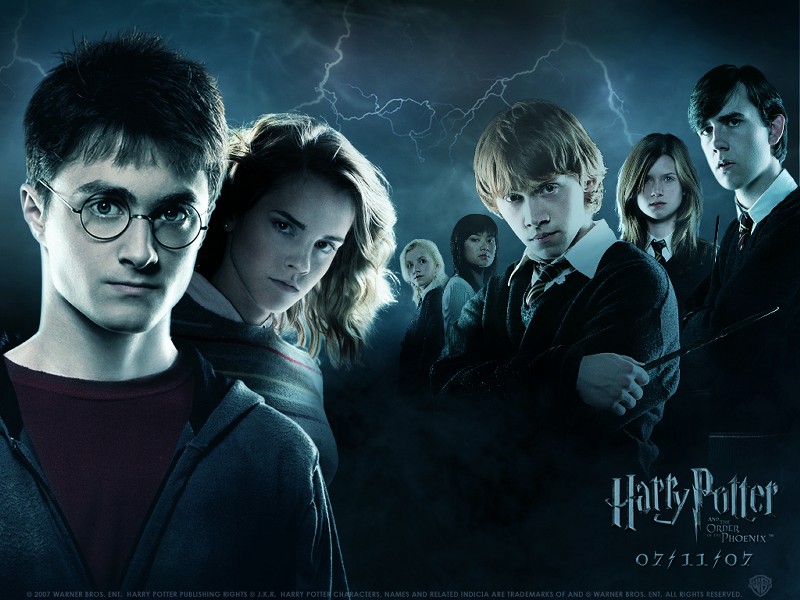
The magically moving portraits are pulled off the walls of Hogwarts in 2007's HARRY POTTER AND THE ORDER OF THE PHOENIX, and the colors have started draining from the Potter universe.  Gone are the lush visuals of Prisoner of Azkaban and Goblet of Fire; the palette of Slawomir Idziak's photography (his films include Kieslowski's great Decalogue and also Black Hawk Down) is dominated by grays, blacks and browns.  The visual message is clear:  we're not in a kiddie movie franchise anymore. 


The pastel exception to these subdued hues, of course, is the pink favored by Dolores Umbridge (Imelda Staunton), the smiling, giggling gorgon who becomes the latest Defense Against the Dark Arts professor at Hogwarts as a stepping stone on her way to fascist dictatorship.  Umbridge, even with her tortures significantly toned down from those in J.K. Rowling's book, is one of the author's most frightening creations, beautifully realized by Staunton.

In franchise terms, the biggest development on Order of the Phoenix was the decision to hire David Yates as house director for the remainder of the series.  Yates was hardly an obvious choice, having never directed a feature film before (his most notable credit was the BBC version of State of Play, later--and badly--remade by Hollywood); there was concern when he was named that the studio had chosen a TV hack whose main interest would be keeping on budget as he rattled through the script pages.  Yates, though, has been creative and wholehearted in embracing the darkness of the story's later chapters; Order of the Phoenix isn't as dramatically satisfying as the more epic Goblet of Fire, but it's emotionally fierce.  And despite the overall sense of desolation, Yates is able to vary the moods where needed, supplying one of the most rousing sequences in the whole series with the montage of Harry's illicit Order of the Phoenix training sessions (helped tremendously by the excellent Nicholas Hooper score--he had worked frequently with Yates in TV). 

Order of the Phoenix is also notable as the only Potter film not written for the screen by Steve Kloves (he pleaded exhaustion after 4 giant films in a row, but returned for the final 3 chapters).  Michael Goldenberg handles the script instead, and the segue is just about seamless.  Goldenberg only makes one structural misstep:  by omitting the admittedly complicated backstory of the prophecy that's at the core of the Phoenix story, he makes the revelation of its contents feel somewhat anti-climactic, and that makes the huge battle scene and major death that follow seem like special effects merely for the sake of spectacle.

At this point in the saga, most of the major characters had been introduced, but in addition to Umbridge, we do get Evanna Lynch as the ineffable Luna Lovegood, and Helena Bonham Carter as the utterly insane Bellatrix Lestrange.  This is also one of the chapters where Alan Rickman gets to do more than swat students whispering in Potions class, and his angry training sessions with Daniel Radcliffe are among the best scenes in the film.  With such regulars as Dumbledore and Hagrid out of the picture for much of this story, the bulk of the dramatic heavy lifting is handled by the story's young stars, who by now are more than able to bear the burden.

Order of the Phoenix is where the Potter franchise could easily have gone wrong, with a slew of major creative changes and a drastic shift in story tone.  Instead, the series seemed stronger than ever as it started to head into its home stretch, with stability both at the boxoffice ($43M higher than the previous chapter) and in the director's chair.

HARRY POTTER RETROSPECTIVE REVIEWS
Harry Potter and the Sorcerer's Stone
Harry Potter and the Chamber of Secrets
Harry Potter and the Prisoner of Azkaban
Harry Potter and the Goblet of Fire
Harry Potter and the Order of the Phoenix
Harry Potter and the Half-Blood Prince
Harry Potter and the Deathly Hallows (Part 1)


  • Digg
  • Del.icio.us
  • StumbleUpon
  • Reddit
  • RSS