RSS
Showing posts with label rickman. Show all posts

SHOWBUZZDAILY NY THEATRE JOURNAL: "Seminar"


There's an inescapable irony in Theresa Rebeck's play SEMINAR when the bilious novelist (Alan Rickman) who's reluctantly teaching a group of aspiring young writers launches an attack on one of them by predicting that his "whorishness" will make him more suited for a life in Hollywood than one in the finer precincts of the arts.  Rebeck herself has recently acquired a corner of the pop zeitgeist all her own:  she's the creator and head writer (sole writer of the initial 3 episodes) of Smash, a little TV effort of which you may have heard.


Seminar, a small-scale play performed (except for one scene) on a single set and without intermission, is far from the big-budget glitz of Smash.  Both works, though, share a way of looking at the arts that parades world-weariness and cynicism while barely hiding an idealism verging on sentimentality.   In Seminar, the artistic effort of choice is the writing of fiction:  Preppy Kate (Lily Rabe), who may not be rich but has a fabulous rent-controlled apartment in the family, has organized the seminar and is one of the 4 participants paying thousands of dollars each to have Leonard (Rickman) read their work and provide individualized critiques.  Other students include Douglas (Jerry O'Connell), who Has Connections and has already had short pieces published, and Izzy (Hettienne Park), a young woman far more comfortable with her sexuality than Kate is.  Most crucial is Martin (Hamish Linklater), on whom Kate has a crush obvious to everyone except Martin.

Each student submits more-or-less meekly to the eloquent assassinations of talent and character that seem to be Leonard's only mode of communication--except Martin, who refuses to submit his writing to the teacher.  This being a play, that can mean only one of two possibilities:  Martin is a fraud, or he's a genius.  (Warning:  Spoilers Ahead)  As it turns out, the latter is the case--although, as so often happens with narratives depicting fictional genius, the bits and pieces of Martin's work that we hear about certainly don't sound as remarkable as we keep being told they are.  Martin's writing prompts, finally, a show of legitimate emotion from Leonard, who reveals himself underneath it all to be as devoted and self-sacrificing for his art as any of his young charges.

All through Seminar, the soap opera aspects of who ends up sleeping with whom have been fairly glib (when Kate is miserable, she gorges on ice cream), but Rebeck gets away with that, because these callow characters' choices about whom to sleep with are meant to be fairly glib too.  When things turn serious at the end, though, and reverence for Literature is being invoked, the play becomes problematic:  the notion that Leonard, with his decades of anger and profound bitterness, merely has to read a promising manuscript to be transformed into a self-effacing champion of art is one that's more romantic than believable (writing talent is treated almost like a super-power), and Martin for his part becomes a character increasingly unable to bear the narrative burden placed on him. 

Much of Seminar works, though, because Rebeck supplies plenty of snappy dialogue before things get too self-important, and the play. fluidly directed by Sam Gold, has a great cast.  It's not exactly a stretch for Alan Rickman to play an ill-tempered professor who resents his students (he must have to restrain himself from deducting nightly points from Gryffindor), but there are few actors more enjoyable to watch in that part.  Rabe is so strong as Kate that one wishes Rebeck had provided a less dismissive ending for her character.  Linklater almost manages to pull off Martin, although he can't quite make the final scene work.  O'Connell and Park, despite having much less substance to work with, are consistently engaging.

The flaws of Seminar--plot turns for the sake of diversion alone, a point of view less challenging than it initially appears--are associated not so much with serious artistic statement as they are wth popular entertainment... like television.  Perhaps the real happy ending to this story happened off-stage.  (Although given last night's ratings--perhaps not.)

  • Digg
  • Del.icio.us
  • StumbleUpon
  • Reddit
  • RSS

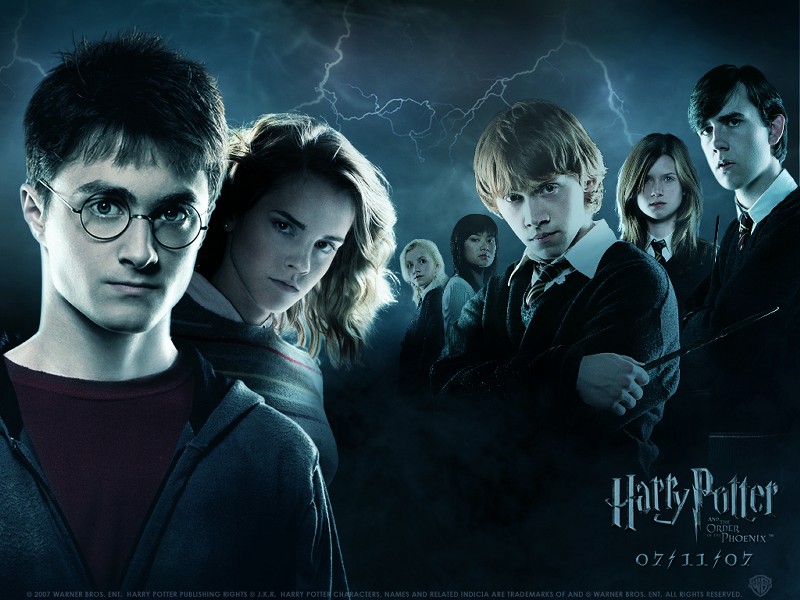
THE BIJOU RETROSPECTIVE: "Harry Potter and the Order Of the Phoenix"


The magically moving portraits are pulled off the walls of Hogwarts in 2007's HARRY POTTER AND THE ORDER OF THE PHOENIX, and the colors have started draining from the Potter universe.  Gone are the lush visuals of Prisoner of Azkaban and Goblet of Fire; the palette of Slawomir Idziak's photography (his films include Kieslowski's great Decalogue and also Black Hawk Down) is dominated by grays, blacks and browns.  The visual message is clear:  we're not in a kiddie movie franchise anymore. 


The pastel exception to these subdued hues, of course, is the pink favored by Dolores Umbridge (Imelda Staunton), the smiling, giggling gorgon who becomes the latest Defense Against the Dark Arts professor at Hogwarts as a stepping stone on her way to fascist dictatorship.  Umbridge, even with her tortures significantly toned down from those in J.K. Rowling's book, is one of the author's most frightening creations, beautifully realized by Staunton.

In franchise terms, the biggest development on Order of the Phoenix was the decision to hire David Yates as house director for the remainder of the series.  Yates was hardly an obvious choice, having never directed a feature film before (his most notable credit was the BBC version of State of Play, later--and badly--remade by Hollywood); there was concern when he was named that the studio had chosen a TV hack whose main interest would be keeping on budget as he rattled through the script pages.  Yates, though, has been creative and wholehearted in embracing the darkness of the story's later chapters; Order of the Phoenix isn't as dramatically satisfying as the more epic Goblet of Fire, but it's emotionally fierce.  And despite the overall sense of desolation, Yates is able to vary the moods where needed, supplying one of the most rousing sequences in the whole series with the montage of Harry's illicit Order of the Phoenix training sessions (helped tremendously by the excellent Nicholas Hooper score--he had worked frequently with Yates in TV). 

Order of the Phoenix is also notable as the only Potter film not written for the screen by Steve Kloves (he pleaded exhaustion after 4 giant films in a row, but returned for the final 3 chapters).  Michael Goldenberg handles the script instead, and the segue is just about seamless.  Goldenberg only makes one structural misstep:  by omitting the admittedly complicated backstory of the prophecy that's at the core of the Phoenix story, he makes the revelation of its contents feel somewhat anti-climactic, and that makes the huge battle scene and major death that follow seem like special effects merely for the sake of spectacle.

At this point in the saga, most of the major characters had been introduced, but in addition to Umbridge, we do get Evanna Lynch as the ineffable Luna Lovegood, and Helena Bonham Carter as the utterly insane Bellatrix Lestrange.  This is also one of the chapters where Alan Rickman gets to do more than swat students whispering in Potions class, and his angry training sessions with Daniel Radcliffe are among the best scenes in the film.  With such regulars as Dumbledore and Hagrid out of the picture for much of this story, the bulk of the dramatic heavy lifting is handled by the story's young stars, who by now are more than able to bear the burden.

Order of the Phoenix is where the Potter franchise could easily have gone wrong, with a slew of major creative changes and a drastic shift in story tone.  Instead, the series seemed stronger than ever as it started to head into its home stretch, with stability both at the boxoffice ($43M higher than the previous chapter) and in the director's chair.

HARRY POTTER RETROSPECTIVE REVIEWS
Harry Potter and the Sorcerer's Stone
Harry Potter and the Chamber of Secrets
Harry Potter and the Prisoner of Azkaban
Harry Potter and the Goblet of Fire
Harry Potter and the Order of the Phoenix
Harry Potter and the Half-Blood Prince
Harry Potter and the Deathly Hallows (Part 1)


  • Digg
  • Del.icio.us
  • StumbleUpon
  • Reddit
  • RSS

THE BIJOU RETROSPECTIVE: "Harry Potter and the Sorcerer's Stone"


Whatever one can say about Chris Columbus--and there'll be plenty of less than glowing words about him below--he's the man who cast Daniel Radcliffe, Rupert Grint and Emma Watson as the leads in 2001's HARRY POTTER AND THE SORCERER'S STONE, and for that Warners should name a building after him.  The three grew over 10 years into plausible physical embodiments of their characters (the studio probably would have liked Radcliffe a little taller, but it hasn't hurt the character; and Watson is really more beautiful than Hermione is meant to be, which in Hollywood is called "casting"), but it was more than that.  In a decade notable for scandals involving one young star after another, they've all remained impossibly professional--when Radcliffe disclosed last week that he'd had a drinking problem during some of the latter years, it seemed to come as much of a surprise to the UK press as to everyone else.  


Oh, and they could act--in fact, they've proven themselves able to evolve and deepen their performances as each successive chapter required more of them. Even more remarkably, it wasn't just the stars who had that capability, but the young supporting actors too--even Bonnie Wright, who as Ginny Weasley has maybe 30 total seconds on screen to start.  In Sorcerer's Stone, the first and weakest of the series, the stars are appealing but show only hints of their potential.  Columbus has them all giving fairly typical child performances for the most part, with too many broad double-takes and expressions of awe mixed with astonishment; occasionally, though, we see the steely resolve and crack comic timing they'd all develop as the films progressed. 

Columbus (along with producer David Heyman and Warners itself, of course) made other good decisions.  No expense was spared on the superb cast of adults:  Maggie Smith, Richard Harris, Alan Rickman, John Cleese, Richard Griffiths, Julie Walters, Fiona Show, and Robbie Coltrane were just some of the great actors who caught the train to Hogwarts.  Steve Kloves, whose previous work, however good, hadn't touched the fantasy genre (Racing With the Moon, The Fabulous Baker Boys) became the workhorse of the series, writing all but one of the scripts that had to pare down J.K. Rowling's enormous, intricate stories to feature length. The production was first-class in every respect, even if the special effects from 2001, particularly the Troll and the somewhat embarrassing Quidditch game, look awfully dated today.  (The baby dragon looks good, though.)

Sorcerer's Stone is quite entertaining, an extraordinary universe capably presented; there's just not anything special about it as a film.  Columbus has cinematographer John Seale shoot Stuart Craig's enormous sets without any personality, using long pans and tracking shots that seem designed only to show off the scale of the production.  Columbus bungles the opening sequences with the Dursleys, playing them for comedy without any of the dark undercurrents Rowling brings to those scenes, and thus flattening some of Harry's emotions that follow.  Because this is the first of the series, there's a huge amount of exposition that has to be explained--Diagon Alley!  Gringott's!  Muggles!  Hogwarts!  Voldemort!  Dumbledore!  Snape!  Quidditch!--and the plot itself, Voldemort trying to use the Stone so he can come back to life, doesn't really kick in until the second half of the movie.  While the picture is never boring, Columbus often coasts from sequence to sequence with indifferent pacing.  Some of the storytelling is surprisingly clumsy, with important plot developments turning on Hagrid blurting things out and then saying "I shouldn't have told you that," Hermione forgetting that she's had the book they've all been searching for all along, and the unlikely "detention" that consists of sending the kids to wander alone through the Dark Forest late at night. 

Sorcerer's Stone provides a decent foundation for the rest of the series, and to the credit of everyone involved, despite its massive success, there was a commitment to improve the franchise going forward.  Watching it now, it's best thought of as the picture you have to get through to get to the good ones.

HARRY POTTER RETROSPECTIVE REVIEWS
Harry Potter and the Sorcerer's Stone
Harry Potter and the Prisoner of Azkaban 

  • Digg
  • Del.icio.us
  • StumbleUpon
  • Reddit
  • RSS