RSS
Showing posts with label history. Show all posts

THE BIJOU REVIEW: "J. Edgar"


J. EDGAR:  Watch It At Home - Brokeback Hoover

It's a little unexpected that of all the films Clint Eastwood has directed, his new biography J. EDGAR most resembles The Bridges of Madison County.  Measured and mournful, the film, which opened the AFI Film Festival in Los Angeles last night and opens nationwide next week, provides a superficial account of American politics over 50 years while favoring the story of an agonized love that dared not speak its name.

The title, of course, refers to J. Edgar Hoover, the first and only head of what became the FBI from the post-World War I era until Nixon was in the White House.  Hoover (played by Leonardo DiCaprio) was legendary for his iron-willed control of his agency and, behind the scenes, for his "private files" that supposedly contained the dirt on every public figure in the country, which he used unmercifully to blackmail everyone from Presidents on down to bend to his every command.


Dustin Lance Black's script (he wrote Milk) has a loose flashback structure that jumps from the 1960s, when Hoover is dictating his memoirs to a variety of junior G-men (including, disconcertingly, Chuck Bass from Gossip Girl) while obsessing over the sex tape he's recorded of Martin Luther King, Jr. (he thinks its existence will compel King to turn down the Nobel Peace Prize he's just won), to the early part of his career, especially his pursuit of anarchists and Bolsheviks in the 1920s and the investigation of the Lindbergh baby kidnapping in the 1930s.  Along the way he builds and protects his power base, constantly increasing the bureau's budget and autonomy.

The emotional focus of the story, however, becomes Hoover's close relationship with his mother (Judi Dench), and his savagely repressed homosexual feelings for his closest aide, Clyde Tolson (Armie Hammer).  In the film, at least, Tolson wants the two of them to have a full-fledged romance, but Hoover, while obsessed with Tolson and keeping him close till the end of his life, is--at least in part because of his mother's brutal rejection of the very suggestion that he could be gay--unable to reciprocate, and even forces himself into relationships with occasional women.  The result is emotional torture that goes on for decades.

J. Edgar is an extremely odd movie, sometimes powerful but not really successful.  It's hardly news that a swift pace isn't part of Eastwood's repertoire as a director--when his material has a pulpy drive, like Mystic River or Grand Torino, that deliberate pace can bring a crushingly effective fatalism to the storytelling.  His historical pageants like Changeling, Flags of Our Fathers and Invictus, however, often just feel slow, and that's the case here; even with a half-century of dramatic material to choose from, the pace is often glacial.

Eastwood is also famous for not favoring a great deal of script development--if he reads something he likes, he just films it, more or less as is.  In this case, Black's screenplay needed some more work.  Huge swaths of American history are summed up in bite-sized pellets with little or no explanation (you'll get a better idea of Hoover's role in the pursuit of Depression-era bank robbers by watching Billy Crudup as a young J. Edgar in Michael Mann's Public Enemies).  Although intellectually one can see how Hoover's use of massive, unchecked power against perceived threats ties into concerns about revenge and the justification for violence that have always fascinated Eastwood, as presented here they have little force or complexity. 

Hoover had to have been an immensely complicated man, both hero and monster, able to function at the highest levels of political strategy but also an uncomfortable outsider, but the figure portrayed in the film exists in a narrow band of ambition, repression and panic.  (While we see his obsession with King, there's no consideration of any feelings he may have had about race--it's all subordinated to Hoover conflating what he sees as King's aberrant sexual behavior to his dread of his own desires.)  All of this constricts DiCaprio's performance--it's hard to imagine him getting the Oscar for this role.  He ends up re-using mannerisms from his (better) Howard Hughes in The Aviator, and looking generally agonized.  Secondary characters are even thinner--to describe Naomi Watts's role as "loyal secretary" is to say absolutely everything there is about her character (there's an early scene where she expresses that she has her own ambitions, but we never learn anything else about her after that).  And although Hammer is the most human character in the story as Tolson, since he's the only one who gets to express his emotions, mostly all he does is cast despairing and disapproving glances in Hoover's direction.

Stylistically, J. Edgar almost looks and feels like an imitation of Eastwood's house style:  Tom Stern's photography drained to an almost monochromatic consistency; spare plinking piano keys for music; editing by Joel Cox and Gary Roach that is never in a rush.  The old-age make-up on DiCaprio is fairly successful, but Watts and Hammer look mummified.

In an era where Hollywood has almost abandoned the concept of serious adult biography, the fact that Eastwood is still out there making movies like J. Edgar is nothing but admirable, and the film's final act, in which Hoover wrestles both with his legacy and his (apparently) never-realized love for Tolson, is sometimes quite moving.  In the end, though, it doesn't come to much more than warmed-over Brokeback Mountain with a lot of prosthetics, and Hoover's monumental, unsettled place in American history merited more than that.

  • Digg
  • Del.icio.us
  • StumbleUpon
  • Reddit
  • RSS

THE BIJOU @ TIFF: "Albert Nobbs"

Rodrigo Garcia's film ALBERT NOBBS (he shares auteurship with Glenn Close, who served as screenwriter with John Banville and Gabriella Prekop and as a producer as well as star) caters to what used to be called the James Ivory audience, when he was still churning his films out. In NY, these are the audiences at the Paris Theatre; in LA, they're at the ArcLight and (even more) the Landmark. They like their intelligent historical dramas with a social theme; they were starting to be neglected in recent years, until The King's Speech came along, and this year, Albert Nobbs is there for them.


As is widely known, getting Nobbs made has been a crusade for Close, who played the title role off-Broadway more than a decade ago. Nobbs the character is an ordinary butler in a late 19th Century Irish hotel--ordinary, that is, except that he's actually a woman pretending to be a man, it being a time when women weren't permitted to hold such jobs. He/she's succeeded in fooling those around him for decades, but an accidental meeting with another cross-dressing worker (a house painter played by Janet McTeer) who has actually married another woman and lives with her as man and wife, broadens Albert's horizons and eventually leads to dire consequences. 

The main point of Nobbs the movie, of course, is Close's performance, and it's a model of restraint--so much so that it could put a dent in her Oscar hopes, as voters tend to favor the flamboyant over the repressed (think Anthony Hopkins in Silence of the Lambs versus Hopkins in Remains of the Day).  The performance makes sense, as Albert (we never learn the butler's original female name) has been hiding his/her whole life, but it's also somewhat problematic dramatically, because Albert is apart from anything else a completely blank slate, utterly naive about love, sex and just about everything else--which, after a life spent in hotels, among staff and guests, seems somewhat contrived.  Also problematic is Close's make-up, which is so extreme as to make her appear robotic in certain shots--not, it seems, because of the gender-switching (McTeer has a far more naturalistic look), but because Close, in her early 60s, is really far too old to be playing Nobbs, who's meant to be 20 years younger.  Close's age, which is never effectively masked despite all the effort, is a mixed blessing, in that it helps to confirm how out of touch Albert is with everyone else at the hotel, but on the other hand makes Albert's fumbling attempts at romance seem inappropriate for reasons having nothing to do with gender.

Despite these troublesome issues, Albert Nobbs is fairly consistently entertaining.  Much of it has to do with our endless fascination with upstairs/downstairs stories of the British well-to-do and their servants, as evidenced by the runaway success of the recent (and far superior Downton Abbey).  In some ways, the sections of the script having to do with the rest of the staff at Albert's hotel are more engaging than Albert's own story.  The cast includes Mia Wasikowska as the pretty maid everyone desires, Brendan Gleeson as the (naturally alcoholic) doctor, and Aaron Johnson as the new handyman who ends up central to Albert's difficulties.

Garcia's direction is considerably more varied than in his earlier films like Nine Lives and Mother and Child, which tend to play out as set-piece scenes for his actors.  Nobbs, while no one will mistake it for a Michael Bay picture, has some sense of pace, and an ability to build plot urgency.  As always, Garcia is wonderful with the performers, and here he has effective photography (by Michael McDonough, who also shot Winter's Bone) and production design as well.

Albert Nobbs is a very safe kind of social story--there's not a lot of dispute these days about the ability of women to work without hiding their gender, and any gay rights message the picture may intend is muddled at best by Albert's curious standing as a character.  It's best appreciated by those Paris and Landmark crowds, as a new contribution to the film archive of stories about elegant old-time settings and the people who inhabited them.   

  • Digg
  • Del.icio.us
  • StumbleUpon
  • Reddit
  • RSS

THE BIJOU REVIEW: "The Help"


THE HELP - Worth A Ticket:  The Story May Be Soft, The Acting Isn't

THE HELP is--and I mean this in a good way--a big-screen Hallmark Hall of Fame.   It's a long, absorbing, emotionally satisfying piece of mainstream Hollywood moviemaking that skims the surface of its difficult subject--the life of black maids and nannies in the pre-Civil Rights era South--in a way that used to win Best Picture Oscars back in the post-World War II era.  (Think Gentleman's Agreement or The Best Years of Our Lives.)  These days, we expect serious subjects to be addressed in less comfortable ways on screen, and The Help has already gotten plenty of backlash and meta-criticism for its style and format.  Taken for what it is, though, the picture delivers.


Based, of course, on the bestselling novel by Kathryn Stockett (which I haven't read), the film version of The Help is written for the screen and directed by Tate Taylor, whose only previous feature credit was a low-budget comedy called Pretty Ugly People that barely appeared in theaters.  (It didn't hurt that Taylor is an old friend of Stockett's who lobbied for him to get the job.)  One key element of the controversy around the book and film is that its central character is a young white woman.  Skeeter Phelan (Emma Stone), a recent college graduate in 1963 Mississippi, doesn't fit in with her debutante surroundings.  (In a different universe, Skeeter would be Peggy on Mad Men.)  Skeeter works as a local reporter, but she chafes at the pretensions of the girls she grew up with (headed by Hilly Holbrook, played by Bryce Dallas Howard), and when she sees the way that group treats their maids, she has the idea of compiling a book of interviews with those women.

The soul of The Help lies in these women, and particularly two of them:  Aibileen (Viola Davis), who lovingly raises the young children of white families that treat her as chattel, and Minny (Octavia Spencer), who works for the odious Hilly.  Matters in the town come to a head with Hilly decides that the maids should not be allowed to use the family toilet, and that all houses in town should have special outhouses built for their help.  Although Skeeter may be the protagonist of The Help, and we're forced to watch a fair amount of her not-very-interesting relationships with a suitor (Chris Lowell) and her ailing mother (Allison Janney), the film does understand that the humiliation and courage of the maids is its true center.  

Whenever a Hollywood movie approaches a painful subject, there's always the dicey task of balancing the hard-to-watch facts with enough entertainment value to make audiences willing to endure the experience.  The Help is unafraid of frosting its heartache with comedy, sometimes broadly so, and there are those who object to that.  None of the humor, though, takes away from the awful situations depicted.  What Taylor does very well is present a portrait of the profoundly mixed emotions the races had for one another in that place and time, where many of the children raised so fondly by these maids grow up to become their oppressors. 

The acting is as good as anyone could ask.  Davis, who's been terrific for years in movies like Doubt and Antwone Fisher, is superb and strong, and Davis navigates the tricky line between the movie's comedy and drama impeccably.  Stone is as radiant as any young actress in movies today, while Howard, who can easily be dull in nice-girl roles, seems revivified by the chance to play a monster.  Also worth noting is Jessica Chastain, as a white-trash nouveau riche wife whose story intersects with Minny's, and Sissy Spacek, who does a marvelous job as Howard's mother, a woman who stays crafty even as dementia is setting in.

It can't be said that Taylor impresses as a film artist with a rare eye, but for what's essentially his debut, he does a fine job:  he's marvelous with the actresses (none of the men make much of an impression) and does a solid, professional job behind the camera, helped by such pros as cinematographer Stephen Goldblatt and composer Thomas Newman. 

The Help is more than a little retro as a movie; it certainly doesn't offer the kind of insight and commentary about its era that we get in Mad Men.  The film has no great revelations to offer, either in story or in style.  But there's a place for accomplished narrative at the movies, especially when accompanied by the kind of acting we have here, and The Help gratifyingly meets that goal.

  • Digg
  • Del.icio.us
  • StumbleUpon
  • Reddit
  • RSS

THE SKED PILOT REPORT: AMC's "Hell On Wheels"


Disclaimer:  Network pilots now in circulation are not necessarily in the form that will air in the Fall.  Pilots are often reedited and rescored, and in some cases even recast or reshot.  So these critiques shouldn't be taken as full TV pilot reviews, but rather as a guide to the general style and content of the new shows coming your way.

HELL ON WHEELS -  Sundays 10PM on AMC starting November 6:   If Nothing Else Is On...


As we noted earlier today, AMC is suffering some growing pains:  negotiations and behind-the-scenes maneuvering at its signature shows Mad Men, Breaking Bad and The Walking Dead have become very public, and The Killing practically caused an audience revolt with its season finale.  The best cure for these kinds of problems is a new hit, and AMC will take its next shot at the brass ring with HELL ON WHEELS, in some ways its most ambitious to date, which launches (with Walking Dead as lead-in) on November 6.


AMC has become HBO's biggest competitor in recent years in the all-important category of Emmy glory, with multiple award winners Mad Men and Breaking Bad taking the honors that used to belong to The Sopranos.  Hell On Wheels escalates the competition, aiming itself directly at HBO's wheelhouse of large-scale historical drama.  Specifically, Hell is pretty clearly AMC's version of the late lamented Deadwood.  We're once again in the Old West at that moment when the frontier was being pierced by railroads, a time where savage violence and the beginnings of modern American society were balefully co-existing.  There's even a stand-in for Ian McShane's epic villain Al Swearengen:  Colm Meany as Thomas Durant, a loquacious railway magnate who expounds on his theories about evil and good as he ruthlessly pushes his tracks forward.  And our hero Cullen Bohannan (Anson Mount), while not a sheriff like Timothy Olyphant's Seth Bullock, carries a similar don't-mess-with-me vibe. 

But this, alas, isn't Deadwood.  Which is to say, Hell On Wheels creators Joe and Tony Gayton are very far from being David Milch.  (The Gaytons' previous credits include Uncommon Valor and the recent Dwayne Johnson flop Faster.)  Instead of filthy, poetic eloquence, we get stretches of clunky expository dialogue; instead of gasp-inducing plot turns, there's a standard story of vengeance.  A lot happens in the Hell On Wheels pilot--a couple of murders, a brutal Indian attack on a railroad scouting party--but there's very little in the way of a gripping storyline.  The best scene in the entire pilot is the pre-credits teaser, which raises expectations the rest of the show can't match. 

Hell On Wheels wants to have monumental sweep (director David Von Ancken, a cable TV vet, provides some lovely landscapes), but there's no narrative vision behind it.  Characters are introduced who presumably will have much more to do as the series continues--Common as an ex-slave who won't brook ill treatment, Dominique McElligott as the wife of a railroad surveyor--and given little to make them interesting.  The pilot kills off its most interesting figure, and although Mount is a likable lead, he has to work very hard to convince us he has any sort of dark edge.  Worse, the show doesn't seem to have anything particularly on its mind regarding the west, or the events surrounding the railroad's arrival:  it throws in elements one after another, with no organizing principle in view.  The result is busy but uncompelling.

As the producers of Cowboys and Aliens could tell you, westerns are a tough sell.  Deadwood itself, however acclaimed, was never one of HBO's most popular shows, and it was cancelled before its time.  Hell On Wheels is launching into a very tough timeslot, against the new Homeland on Showtime, the Hung/How To Make It In America duo on HBO, and the new Pan Am on ABC.  AMC is giving it their best lead-in, but that's no guarantee people will return after trying the premiere.  The show is interesting, hardly a total loss... but the network should really close its deal for more Breaking Bad.


Read more about TV's new shows at THE SKED PILOT REPORT.


  • Digg
  • Del.icio.us
  • StumbleUpon
  • Reddit
  • RSS

THE BIJOU REVIEW: "Sarah's Key" - Doors That Stick


SARAH'S KEY - Watch It At Home:  Misses a Difficult Mark


There may be no cinematic minefield more dangerous for filmmakers than the Holocaust.  For films entering that difficult territory, the choices of tone, approach and imagery may not just be called into question, but outright offend audiences, and viewers have very personal standards.  I considered Life Is Beautiful to be almost unwatchably reprehensible, but the movie wasn't just a worldwide smash hit ($229M), but the winner of major Academy Awards (thanks for that, Harvey Weinstein).  On the other hand, for me Schindler's List is a genuine masterpiece, but there are more than a few who passionately believe it's a middlebrow distortion of the horrors it depicts.  Despite the potential for controversy, the subject matter can lead to a surprising amount of success at the boxoffice; besides Life and Schindler, recently The Reader made over $100M worldwide.


And so, SARAH'S KEY has joined the group of Holocaust-driven movies.  Based on the bestselling novel by Tatiana de Rosnay, it's directed by Gilles Paquet-Brenner (whose track record is little known in the US), and adapted for the screen by the director and Serge Joncour.  Like THE READER, it's structured as a story that flashes back and forth between World War II and the present.  In 1942, the young Sarah (Melusine Mayance) is captured with her family by the Paris police and (in a real life incident) imprisoned at the Vel d'Hiv bicycle stadium on the way to the concentration camps.  Sarah is further haunted by the fact that she "rescued" her young brother by locking him in a closet when the authorities came, and carries the key to that door with her always.  Meanwhile, in the present day, Julia (Kristin Scott Thomas), an American journalist living with her French husband in Paris, discovers in the course of her research on the Val d'Hiv roundup that her husband's boyhood apartment--where the two of them and their daughter are planning to renovate and move in--may have been Sarah's original home.

You can see, watching the film, why this parallel structure was employed:  Julia's presence allows the film to explore the way even now, 40 years after Marcel Ophuls' epocal The Sorrow and the Pity, the French still resist acknowledging that their own people directly sent Jews to their slaughter.  (Reportedly, the novel has had a similar effect on the nation as Julia's story does in the film.)  But there's no way to equate the power of the two storylines, and this has the unfortunate effect of distancing us from Sarah and her ordeal--particularly because Scott Thomas is such an arresting actress that even with a relatively weak plotline, her presence dominates the film. This only becomes worse when the present-day story brings in the topic of abortion, which is dealt with in the most cliched way imaginable (Spoiler Alert:  people who watch mainstream movies and TV could easily believe that abortion clinics don't actually perform the procedure at all--they just exist so that women can show up there and then change their minds.)  

The result in Sarah's Key is a slick production that tries to balance a tragic story with one that's ultimately feel-good, and succeeds only in damaging both.  Scott Thomas is excellent as always, not to mention in this case invaluably fluent in both English and French, and Mayance is strong as the young Sarah (although it's not clear why Sarah had to be such a blond-haired movie star beauty).  In supporting roles, Niels Arestrup (he was the old crime boss in A Prophet) brings emotional weight to his role as a farmer who figures in Sarah's life, and late in the modern-day story, Aidan Quinn does an enormous amount with just a couple of scenes opposite Scott Thomas.

A question--perhaps an unanswerable one--that's been raised since Holocaust stories became part of popular culture is whether the infusion of standard drama into such horror, by its very nature, acts as a disservice to the magnitude of the event--makes the ultimate in indigestible history into something easier to swallow.  Opposed to this, of course, is the very real educational function that these stories can provide, and the fact that people simply wouldn't watch a depiction of the actual Holocaust without some avenue of dramatic escape.  Sarah's Key tries to tread that line and falls into superficiality and sentimentality; it's not a bad movie, but it's an unworthy one.
 

  • Digg
  • Del.icio.us
  • StumbleUpon
  • Reddit
  • RSS

LIMITED RELEASE: "The Double Hour," "Incendies" & "Cave of Forgotten Dreams"


Plot spoilers are even more problematic when it comes to limited releases, because by definition they're only being seen by a few people in certain selected locations, and--if they're good--will ideally be discovered by audiences over time.  Which is a roundabout way of saying that I strongly recommend, but can reveal almost nothing about, the marvelous new Italian drama THE DOUBLE HOUR beyond its premise, or I'll give too much away.  So here's that premise:  in Turin, a Russian/Italian hotel chambermaid named Sonia (Ksenia Rappoport) attends a speed-dating night at a local club.  There she meets Guido (Filippo Timi), a former cop and now a security guard who's a widower and an alcoholic.  A spark is struck between them; then there is a robbery, a shooting, and--I have to stop.  Double Hour has a remarkable variety of tricks up its sleeve, not in the mindbending sense of an Inception (everything, ultimately, is explained, and it does all make sense), but through intricate and tricky storytelling where what you're seeing is rarely what's actually going on.  Giuseppe Capotondi, making his directing debut, manages the extraordinary feat of combining this kind of guile with romance, mystery, melancholy and surprise (the excellent script is by Alessandro Fabri, Ludovica Rampoldi, and Stefano Sardo), and the actors give tremendous, layered performances.  You'll just have to take my word for it:  The Double Hour is Europe's best genre surprise since Tell No One. Worth a Ticket.   (Goldwyn - 95 min. - unrated - 7 Theatres)
 

The Canadian (French-language) INCENDIES, directed by Denis Villeneuve, also asks for a spoiler alert, although of the more conventional don't-give-away-the-ending type.  Incendies, which was a nominee for last year's Best Foreign-Langauge Film Oscar, is structured as a mystery.  When Nawal Marwan (Lubna Azabal) dies, she leaves a strange bequest for her twin children Jeanne (Melissa Desormeaux-Poulin) and Simon (Maxim Gaudette):  Jeanne is to deliver a letter to her vanished father, Simon to bring one to a previously unknown brother; only when both are successful can they put a stone on Nawal's grave and read a third letter from her to them.  The search requires them to travel to the Middle Eastern country (seemingly Lebanon, although never explicitly identified) where Nawal was born, and to journey through that region's tangled and tragic 20th Century history.  Nawal's story, it turns out, is brutal to an extent that is ultimately more symbolic than believable in a realistic sense (Velleneueve's script is based on a play by Wadji Mouawad, and sometimes shows its theatrical roots).  At times, the movie is so concerned with hiding its secrets that it becomes more confusing than it needs to be, and the ultimate revelations are so enmeshed with the political and social statements being made, that it becomes difficult to discuss the latter without revealing the twist.  All this can become a slog over more than 2 hours.  Still, Incendies is far more dramatically intense and effective in its moral complications than the recent and somewhat similar Miral, and the acting and cinematography (by Andre Turpin) are first-rate.  A film that may benefit from the repeat and back buttons on a homevideo player.    Watch It At Home.  (Sony Pictures Classics - 130 minutes - R - 10 Theatres)


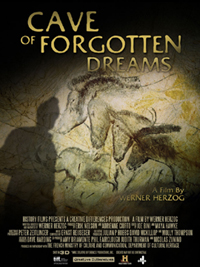
No spoiler problems in Werner Herzog's CAVE OF FORGOTTEN DREAMS, unless you were afraid of finding out the content of 30,000-year old cave paintings.  (Shhh:  they're mostly horses, lions and bears.)  The Chauvet caves in France were sealed by a giant rockslide thousands of years ago, which resulted in the preservation of these amazing works of art, the most extensive prehistoric collection yet found on earth.  By Herzog's standards, his account and tour of the caves is quite straightforward (aside from a bizarre epilogue involving albino alligators and a brief fascination with the circus performer history of one scientist).  Although the physical conditions of the filming were very demanding, as only a bare minimum of equipment and lights could be brought into the caves, and the filmmakers had to keep their distance from the paintings themselves, Herzog managed to shoot the film in 3D, providing a model for non-gimmicky, visually justified use of that technology.  With the illusion that they are in touchable proximity, the spectacular contents of the caves are even more breathtaking, and although the content of Cave is not much different than a television documentary (it was co-financed by the History Channel), the technology renders it Worth a Ticket.  (IFC/Sundance Selects - 90 minutes - unrated - 5 Theatres)


  • Digg
  • Del.icio.us
  • StumbleUpon
  • Reddit
  • RSS

THE CONSPIRATOR: Court In Session

Watch It At Home:  Scrupulously accurate, to a fault.

In an era that so recently gave us "The Kennedys," possibly the worst piece of pop culture history ever produced for American television, it seems downright rude to criticize Robert Redford's new film THE CONSPIRATOR for sticking to the facts.  Accuracy and drama, however, are not always the best of friends.

The Conspirator illuminates a little-known corner of one of the most famous stories in US history.  While the name of John Wilkes Booth is known to everyone (one would hope), relatively few people are aware that after Booth was killed by soldiers, the government prosecuted several others for conspiring in Lincoln's assassination.  One of those charged was Mary Surratt (played by Robin Wright in the film), who had been the landlady at a boardinghouse where her son, among others, reportedly helped plot the crime (which was intended to include not just the attack on Lincoln, but also on the Vice President and Secretary of State).  Surratt was specifically accused of supplying weapons and other materials to Booth and his cohorts.

Surratt's arrest and trial took place in the glare of the country's shock and fury over Lincoln's killing, and the fear that further attacks by recently defeated Confederates might well be coming--Redford and his screenwriter, James D Solomon, want the audience to recognize the similarities to America after 9/11.  Surratt was subjected to trial by a military tribunal, where the normal rules of evidence did not apply, and Secretary of War Edwin Stanton (Kevin Kline, doing a good job as essentially Dick Cheney/Donald Rumsfeld) was instrumental in making sure her civil liberties were kept to a minimum, partly in the hope that this treatment would bring her son, who was on the run, to justice.  In the end (Spoiler Alert?), she was convicted and--despite a seeming commutation--hung. 

 
Redford and Solomon are dogged about recreating the details of the testimony against Surratt and the details of her trial--chunks of the film are taken from the 1865 tribunal transcripts.  These are informative and certainly prove the point, but somewhat lacking in pace and drama.  The "personal" story in the film, such as it is, concerns Surratt's lawyer, the young and inexperienced Frederick Allen (James McAvoy); I don't know the history on him, but the story told--a Union war hero who reluctantly takes the case, only to become increasingly convinced of his client's innocence and thus jeopardize his own bright future by his efforts on her behalf (his socialite fiancee, played by Alexis Bledel?  Not as loyal as he'd hoped)--feels too hackneyed by half.  

Despite the film's muted tone, Robin Wright gives a performance that's intense and haunting; it's the best part she's had in a long time (probably since White Oleander, almost a decade ago), and she acts the hell out of it. McAvoy is passable in the thinnest role, and a lot of very fine actors make appearances, some to good effect (Tom Wilkinson is the senior lawyer who enlists McAvoy to the case, Evan Rachel Wood is Surratt's daughter, Danny Huston the chief judge), some not so much (Justin Long should never again do a period film).  

One doesn't want to diminish The Conspirator too much.  It's a genuinely worthy film, made with nothing but the best of motives.  It oozes seriousness in every frame, from Newton Thomas Sigel's dark photography to Mark Isham's somber score.  You walk out of it knowing more than you did before about American history, and able to make worthwhile connections between the country's past and its present. Ultimately, though, Redford has illustrated a lesson plan more than he's made a movie.  

(THE CONSPIRATOR - Roadside Attractions - PG 13 - 123 min. - Director:  Robert Redford - Script: James D Solomon, from a story with Gregory Bernstein - Cast:  James McAvoy, Robin Wright, Tom Wilkinson, Alexis Bledel, Danny Huston, Evan Rachel Wood, Kevin Kline - Moderate Release (700+ theatres)


  • Digg
  • Del.icio.us
  • StumbleUpon
  • Reddit
  • RSS