RSS
Showing posts with label plummer. Show all posts

STATUETTE STAKES: The Oscar Race That Wasn't


This year's Academy Awards have so far engendered the kind of enthusiasm and excitement usually associated with a suburban DMV office on a Tuesday afternoon.  People seem to be sullenly resigned to the inevitability of THE ARTIST's victory, even though it would be unlikely to get anything like a majority of the Academy's estimated 5000 votes--but with the Best Picture vote split 9 ways, it doesn't need to come anywhere near that (the winning movie could theoretically take the award with only around 556 votes).  In any case, no unified opposition has formed in favor of any particular competing film, and the same apathy exists in almost every other major category.  At this rate, we might as well be talking about presidential politics.  

Are the Oscars really doomed to be this dull?  (ABC certainly hopes not, or this could be the lowest-rated ceremony in history.)  Is there no possibility for any unexpected moments of shock or even mild surprise?  Let's take a look.


BEST ORIGINAL SCREENPLAY:  As Mitch Metcalf noted in his survey of Oscar wagering odds, this is one category where The Artist is at a disadvantage (odds of 2:1), probably because as a silent movie, its intertitles don't provide much in the way of sparkling dialogue.  There are many who would like to see Woody Allen get some recognition for his late-career renaissance with MIDNIGHT IN PARIS, and that's currently the 2:5 favorite.  The other nominees MARGIN CALL, A SEPARATION and BRIDESMAIDS are all likely of the "be happy you're nominated" variety, although lovers of longshots might want to consider a wager on Bridesmaids at 23:1--it's by far the biggest hit of the group, and somewhat trendy after its critics' awards.  CHOICE:  Margin Call.  PREDICTION:  Midnight In Paris.

BEST ADAPTED SCREENPLAY:  No one particularly cares about this category this year, but it's one of the very few to be fairly wide open.  THE DESCENDANTS is the favorite at 2:5 because of its perceived stature in the Best Picture race, and because with its polished dialogue it feels "written," but strictly as a work of adaptation, MONEYBALL, at 4:1, probably deserves to win, and its script is by the all-star team of Aaron Sorkin and Steven Zaillian.  There's also increasing sentiment pointing to HUGO at 5:1, another tough adaptation from a children's picture book.  TINKER TAILOR SOLDIER SPY, which deserves its place, and THE IDES OF MARCH, which doesn't (it's actually weaker than its source material), are probably just along for the ride.  CHOICE AND PREDICTION:  Moneyball.

BEST SUPPORTING ACTRESS:  Here's where things get easy, and thus somewhat tedious.  Octavia Spencer is an overwhelming 1:20 favorite for THE HELP, and no other nominee seems to have a prayer of catching her.  Those who believe the Academy will utterly genuflect to The Artist may want to take a chance on 2d choice Berenice Bejo at 9:1, but 2011 It Girl Jessica Chastain will be back again to win in some future year, and Melissa McCarthy and Janet McTeer, with 2 of the year's most distinctive performances, will have to be content with their nomination certificates.  CHOICE:  Jessica Chastain.  PREDICTION:  Octavia Spencer.

BEST SUPPORTING ACTOR:  Did the Academy bother to nominate anyone besides Christopher Plummer?  Oh, they did?  At 1:25, Plummer is the biggest favorite in any major category, and since unlike racehorses, actors can't be disqualified from a race for bumping another nominee or falling down and breaking their leg, he's pretty much unbeatable.  In another year, he and  Max Von Sydow (at 19:1) might have split the lovable old codger vote, but Plummer's accumulated industry goodwill just outweighs Von Sydow.'s  That leaves Kenneth Branagh (9:1) out of luck. Nick Nolte, while no longer young, isn't yet at the old codger stage of his career, and Jonah Hill is just in the promising newcomer stage of his.  CHOICE:  Max Von Sydow.  PREDICTION:  Christopher Plummer.

BEST ACTRESS:  There was a time when this looked like a real race between Meryl Streep and Viola Davis, but Davis has plunged ahead like Secretariat at the Belmont.  The current odds of 5:6 for Davis and 1:1 for Streep are misleadingly close, although one can never count out Harvey Weinstein and his none-too-subtle campaign bellowing the 29 years since Streep last won.  Michelle Williams might as well have gone lame down the stretch, Glenn Close picked the wrong year to seek a lifetime achievement award, and Rooney Mara is this category's Promising Newcomer.  CHOICE:  Michelle Williams.  PREDICTION:  Viola Davis.

BEST ACTOR:  The closest we're going to come to an exciting result this year.  George Clooney (1:2) is, well, George Clooney, as well-loved as anyone in Hollywood and with a solid stack of critics' awards to back him up this year.  Jean Dujardin (6:4) is the star of the probable Best Picture winner, and quite a charmer himself, plus he has the added degree of difficulty of performing silently (if there's one thing the Academy loves, it's degree of difficulty).  The fact that Dujardin shockingly won the SAG award means that either he has this sewn up, or that it was a reality check for Clooney's supporters, who realized they'd better get their votes in or risk blowing it.  Could Brad Pitt sneak in there at 18:1 for a universally-respected performance in a lower-profile film?  Probably not, but if this were a horserace, you'd want to include him on your exacta tickets.  Gary Oldman is a less likely sleeper at 22:1, especially because Tinker Tailor never really took off at the boxoffice.  Demian Bechir, while no newcomer, gets the Hey, We Just Noticed You slot.  CHOICE:  Brad Pitt.  PREDICTION:  George Clooney.

BEST DIRECTOR:  The smart money at 1:6 says that as Best Picture goes, so does Best Director, and that's probably right, clearing the way for Michel Hazanavicius to make his triumphant way to the podium.  If Martin Scorsese hadn't won just 6 years ago, this year would certainly be his, but he did, making his 4:1 odds probably overly optimistic.  Alexander Payne isn't the kind of showy director likely to win if his movie doesn't, so 13:1 sounds about right for him.  Terrence Malick, on the other hand, is both adored and disdained by passionate viewers on each side, and THE TREE OF LIFE wasn't enough of a hit to break him out of his art-house cell.  Those with some spare cash might want to consider Woody Allen, a huge longshot at 35:1 who's coming off the biggest hit of his career.  CHOICE:  Martin Scorsese.  PREDICTION:  Michel Hazanavicius.

BEST PICTURE:  Well, here we are.  Harvey Weinstein has, as is his wont, run an absolutely brilliant campaign for The Artist, successfully obscuring the fact that audiences in general haven't been taken by it, and playing up every conceivable voter-friendly angle.  (My favorites:  the ad emphasizing that Artist was the only Best Picture nominee to be shot in Los Angeles, and the screening hosted by producer Thomas Langmann strictly so Langmann could couple the film with The Two Of Us, the 1967 Best Foreign Film winner directed by Langmann's father Claude Berri, so that The Artist could magically be linked in voter minds with the older film's storyline of a Jewish boy rescued from the Nazis by an elderly gentile--Jews, children, the Holocaust and a lovable old codger, all in one neat package!)  The movie's 1:6 odds are well-earned.  Could anything beat it?  The 2d choice is The Descendants at 6:1, a movie that has gathered no head of steam whatsoever, and after that is the huge money-loser Hugo at 14:1 (remember, Scorsese had his victory lap 6 years ago).  Those looking for something, anything, to take the prize should probably concentrate on The Help at 18:1, the only genuine boxoffice hit of the nominees and winner of the SAG ensemble award (but the fact that the picture couldn't even get nominated for Best Director or Adapted Screenplay shows how tenuous its support probably is).  War Horse, a disappointment in every way, is somewhat puzzlingly next at 26:1.  Then the unlikely Midnight In Paris, Moneyball and Extremely Loud and Incredibly Close follow at 55-59:1, and at the rear is the aesthete's dream, The Tree of Life at 73:1.  CHOICE:  Extremely Loud and Incredibly Close.  PREDICTION (reluctantly):  The Artist.

Sigh.  Yawn.  We'll look in on the Oscar race again as we get closer to the big night... if we can find the energy.
 

  • Digg
  • Del.icio.us
  • StumbleUpon
  • Reddit
  • RSS

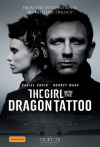
THE BIJOU REVIEW: "The Girl With the Dragon Tattoo"


THE GIRL WITH THE DRAGON TATTOO:  Worth A Ticket - David Fincher Meets Lisbeth Salander

The most remarkable thing about David Fincher's version of THE GIRL WITH THE DRAGON TATTOO (written for the English-language screen by Steven Zaillian) is that while remaining, for the most part, scrupulously faithful to the best-selling novel by Stieg Larsson, the new film fits so comfortably with Fincher's style and thematic concerns.


As probably no one needs to be told by now, Dragon Tattoo is the first of a massively popular trilogy of thrillers by the late Swedish novelist Larsson.  It's also, very unusually, already been the source of a quite recent Swedish film, widely seen in the US ($10M at the boxoffice), which was directed by Niels Arden Opley and screenwritten by Nikolaj Arcel and Rasmus Heisterberg.  The content of the two films overlap greatly, although Fincher and Zaillian have altered the solution to one of the novel's mysteries in a way that's more efficient without changing anything fundamental about the story, and the US version covers some territory omitted from the Swedish adaptation (a distinction that may vanish in the "extended edition" of the Swedish film recently released on video).  

In all of its various forms, Dragon Tattoo centers around a decades-old mystery.  In the 1960s, on a small private island in the north of Sweden largely owned and occupied by the rich and corrupt Vanger family, teenager Harriet Vanger vanished, never to be seen again.  Her only decent relative, patriarch Henrik (Christopher Plummer in the new film) has received taunting yearly reminders of Harriet from, Henrik assumes, her killer.  As Henrik approaches his own appointment with the Grim Reaper, he decides to hire a very unconventional investigator, the journalist Mikael Blomkvist (Daniel Craig), currently in disgrace because of a libel conviction that stems from a story Blomkvist wrote about an industrialist who had once worked for Vanger.

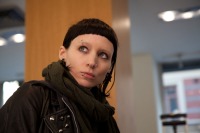
All of this would normally set up an interesting but fairly routine detective story, one in which the initial puzzle leads, as these things do, to other and increasingly more disturbing mysteries that need to be solved.  Larsson's master-stroke, however, was the creation of Lisbeth Salander (Rooney Mara), the woman who had performed Vanger's background check on Blomkvist and succeeded in unearthing--legitimately and otherwise--everything there was to know about him, and whom Blomkvist hires to help him with Harriet's case.  Lisbeth is a fabulous character, utterly brilliant and profoundly damaged (due to events disclosed in later books, along with some dreadful experiences she suffers in this one).  Distinctive in every way, from her spiky dyed hair and, yes, many flamboyant tattoos to her more-than-willing violence in the face of some sickening adversity, she takes possession of Larsson's books and the movies as well. 

Fascinatingly, although Lisbeth is of course a preexisting character who wasn't invented by David Fincher, she could be a punk cousin to the Mark Zuckerberg of Fincher's The Social Network, who also overwhelmed everyone around him with his sheer intellect and who otherwise seethed with impatience and frustration at nearly all human interaction.  Lisbeth's outsider status, and the occasional glimpses we get of her longing for human contact, tie her in not just with Zuckerberg but with the title character of Fincher's The Curious Case of Benjamin Button.   Her style and mindset are reminiscent of  Fight Club's Tyler Durden.  The lengthy, complicated investigation that takes up much of Dragon Tattoo's story recalls Fincher's Zodiac, and although Dragon Tattoo's mystery does come to more of a conclusion than Zodiac's did, the overall sense of moral hopelessness is very similar--and both that, and the psychopathic violence at the story's center, are themes also found in  Se7en.  (Consumer warning:  another way that the film suits Fincher's sensibiliity is in its often extreme violence.  Sensitive souls beware.)

In short, The Girl With the Dragon Tattoo, while a franchise movie, could have been written with David Fincher in mind.  And although the initial Swedish film is thoroughly competent, and features an extremely strong performance by Noomi Rapace as Lisbeth (later chapters in the series continued to be well-acted, but suffered from directoral changes and seemingly lower budgets), it can't compare with what Fincher--plus a reported $90M budget--can bring to a project.  The photography by Jeff Cronenweth is supple and atmospheric, and Trent Reznor and Atticus Ross's menacing, disturbing score outdoes their work on Social Network.  Despite the 158-minute length, the editing by Kirk Baxter and Angus Wall shoots the story out of a gun barrel. 

Fincher has surrounded Rooney Mara with a very fine supporting cast, and that includes Daniel Craig--his Blomkvist may technically be the protagonist of the story, but he too is mere support once Lisbeth enters the scene, and Craig seems content not to get in Mara's way.  Along with Craig and Plummer, Robin Wright, Stellan Skarsgard and Joely Richardson play important characters with great skill.  But any version of Dragon Tattoo will rise and fall on its Lisbeth, and Mara is all that readers could ask.  Underneath her often deliberately blank exterior, we can see that she's almost entirely an exposed nerve ending, infinitely sensitive to every nuance of her surroundings and constantly gauging her potential for being hurt.  Although Rapace was a superb Lisbeth, Mara is somewhat closer to the character of the book, in her youth and flickers of vulnerability.  It's a great, commanding performance.

The Girl With the Dragon Tattoo is, in the end, a genre story, and it obeys the imperatives of the form:  we get the somewhat cliched scenes where a villain starts "monologuing" (as The Incredibles would say) at length before violence, and the sequences where tiny bits of evidence are examined and found to reveal further clues.  Fincher stages all of these beautifully, but they're inescapably familiar.  He and Zaillian also have a problem with the structure of the novel, which keeps going for quite a while after the story's central mysteries have been solved, an extended epilogue dealing with plot points of considerably less interest (the Swedish film, at least in the theatrical-release version, omitted much of this).  The scenes connect to Larsson's larger political points about the nature of Swedish politics and society, and the way in which he saw the various storylines as illustrating the rot afflicting the nation; for an American audience, these are largely lost.  The film can't achieve the perfect roundedness of, say,  Se7en, which owed no allegiance to source material.

For all that, it would be hard to imagine a better, or more gripping, adaptation of Larsson's novel.  It's a very happy coincidence when a great filmmaker has the chance to film a story perfectly suited for his talents--decades later, the Robert Altman version of E. L. Doctorow's Ragtime that was never made is still mourned-- and Fincher's Dragon Tattoo is, luckily for us, one of those.   

  • Digg
  • Del.icio.us
  • StumbleUpon
  • Reddit
  • RSS

STATUETTE STAKES: National Board of Review Has Its Day


The National Board of Review is an organization with a virtually unknown membership that exists in public consciousness for precisely one day per year, and this is their day:  the announcement of their film awards.  Their claim to fame, such as it was, came from being the first ones out of the awards gate--but this year the NY Film Critics Circle stole their thunder by revealing their picks 2 days ago.  So there's not much reason to give the NBR choices much credence in terms of the bigger race.  Having said all that, they've made some interesting and worthy choices that are very different from NYFCC's.  Below are the NBR selections and some thoughts:


Best Picture:  HUGO. 

Best Director:  Martin Scorsese, HUGO.  These awards are crucial to Hugo, which is attempting the difficult feat of coming into the market as a family entertainment and staying there as a critically acclaimed player in the Oscar game.  The film is adding theaters this weekend, and hopes to keep expanding through December.

Best Actor:  George Clooney, THE DESCENDANTS.  Certainly no surprise, but officially puts Clooney into the race. 

Best Actress:  Tilda Swinton, WE NEED TO TALK ABOUT KEVIN.  A great performance in a very difficult film that's only getting a 1-week Oscar qualifying run in a couple of theatres this month.  Swinton and the film desperately need some awards momentum to get any kind of audience for this picture.

Best Supporting Actor:  Christopher Plummer, BEGINNERS  As with Clooney, this is a pro-forma introduction of Plummer into the race.

Best Supporting Actress:  Shailene Woodley, THE DESCENDANTS  A definite help to Fox Searchlight's hope to get Woodley an Oscar nomination for this role.

Best Original Screenplay:  Will Reiser, 50/50  An unexpected but very welcome choice, as this is an excellent script that hasn't been getting much attention.

Best Adapted Screenplay:  Alexander Payne, Jim Rash & Nat Fason, THE DESCENDANTS  Certainly one of the frontrunners along with Moneyball.

Best Animated Film:  RANGO  NYFCC apparently didn't find any animated film this year worthy of an award, which was bizarre in a year that gave us this exceptional picture.

Best Foreign Language Film:  A SEPARATION  A groundswell beginning to develop?

Best Documentary:  PARADISE LOST 3:  PURGATORY.  On the official Oscar short-list for this category.

Best Debut Director:  J. C. Chandor, MARGIN CALL.  Some more well-earned attention for a very dark horse in the race.

Best Ensemble:  THE HELP  The other organization that gives this award is the critically important Screen Actors Guild (actors form the largest single group of Oscar voters), and DreamWorks/Disney will be beating this drum loudly.

Breakthrough Performances:  Felicity Jones, LIKE CRAZY; Rooney Mara, THE GIRL WITH THE DRAGON TATTOO  Consider these "they're here too" runner-up awards for Best Actress  The Mara award is important because it's the first indication Dragon Tattoo (a very violent genre movie, despite its pedigree) and its star could be awards contenders.

"Spotlight" Award:  Michael Fassbender.  Another runner-up award.

The NBR also announces catch-all lists of the Best Films, Foreign-Language Films, Independent Films and Documentaries, so no one (well, hardly anyone) goes away empty-handed.  They are:

Best Film:  THE ARTIST, THE DESCENDANTS, DRIVE, THE GIRL WITH THE DRAGON TATTOO, HARRY POTTER AND THE DEATHLY HALLOWS PART 2, THE IDES OF MARCH, J. EDGAR, THE TREE OF LIFE, WAR HORSE

Best Independent Film:  50/50, ANOTHER EARTH, BEGINNERS, A BETTER LIFE, CEDAR RAPIDS, MARGIN CALL, SHAME, TAKE SHELTER, WE NEED TO TALK ABOUT KEVIN

Best Foreign Language Film:  13 ASSASSINS, ELITE SQUAD 2:  THE ENEMY WITHIN, FOOTNOTE, LE HAVRE, POINT BLANK

Best Documentary:  BORN TO BE WILD, BUCK, GEORGE HARRISON:  LIVING IN THE MATERIAL WORLD, PROJECT NIM, SENNA

  • Digg
  • Del.icio.us
  • StumbleUpon
  • Reddit
  • RSS

LIMITED RELEASE: "Beginners"


Worth a Ticket:  A funny, moving story about navigating the twists of life.

 
Mike Mills' BEGINNERS is about the fumble for love, the wrong turns and mistakes that can delay--although luckily not always prevent--true happiness.  Mills has said that this story is semiautobiographical:  like his protagonist Oliver (Ewan McGregor), Mills learned after the death of his mother that his 75-year old father (Hal in the film, played by Christopher Plummer) was and had always been gay.  Uncloseted at last, Hal, like Mills' father, lived as an openly gay man for the last years of his life, finding love with the younger Andy (Goran Visnjic) before succumbing to cancer.  


Beginners takes place along 3 simultaneous timelines in Oliver's life, intercutting between them:  his childhood relationship with his mother Georgia (Mary Page Keller), who was troubled and dissatisfied for reasons Oliver would only come to understand decades later; the period after her death when he became closer to his father as his dad happily explored his own sexuality; and shortly after his father's death, as Oliver enters into a relationship with a beautiful French actress, Anna (Melanie Laurent).  As the movie develops, we see how each period of Oliver's life affected the next, and the ways echoes of his youth have shadowed his adulthood.  He comes to understand that neither of his parents did anything wrong, exactly, and certainly not to hurt him; they were just trying to live within the strictures of their times and upbringing (Oliver gives us mini-documentary slideshows within the film to tell us about the differences and similarities of the eras).  Still, it's all affected him in ways he'll need to move beyond if he's to have fulfilling relationships of his own. 

Mills has come a long way from his pretentious debut Thumbsucker (which was based on a novel rather than his own material).  Beginners flows beautifully between its chronologies, with humor and imagination--once Oliver has inherited Hal's lovable Jack Russell terrier, the dog occasionally makes his (subtitled) observations known to Oliver.  All the characters are layered--even Andy and Anna, who could have been pure fantasy figures for their respective men, have their own issues, rooted reasons for the ways they act.  Mills presents them all with compassion and generosity.  The actors give lovely performances.  McGregor can be a weak presence in some films, but here that drifting quality works well for Oliver, while Plummer does some of the most likable work of his career; Laurent, who played the Jewish partisan Shosanna in Inglourious Basterds, brings shadings of darkness to Anna.  Mills' understated, effective use of music, by Roger Neill, Dave Palmer and Brian Reitzell, is also notable 

There are innumerable traps in making a gentle, eccentric film like Beginners, and Mills has sidestepped most of them.  It's a quietly moving, illuminating story about the ways in which we're formed, and the possibility that we can learn to live beyond them.  

  • Digg
  • Del.icio.us
  • StumbleUpon
  • Reddit
  • RSS