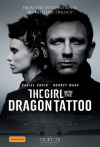
THE GIRL WITH THE DRAGON TATTOO: Worth A Ticket - David Fincher Meets Lisbeth Salander
The most remarkable thing about David Fincher's version of THE GIRL WITH THE DRAGON TATTOO (written for the English-language screen by Steven Zaillian) is that while remaining, for the most part, scrupulously faithful to the best-selling novel by Stieg Larsson, the new film fits so comfortably with Fincher's style and thematic concerns.
As probably no one needs to be told by now, Dragon Tattoo is the first of a massively popular trilogy of thrillers by the late Swedish novelist Larsson. It's also, very unusually, already been the source of a quite recent Swedish film, widely seen in the US ($10M at the boxoffice), which was directed by Niels Arden Opley and screenwritten by Nikolaj Arcel and Rasmus Heisterberg. The content of the two films overlap greatly, although Fincher and Zaillian have altered the solution to one of the novel's mysteries in a way that's more efficient without changing anything fundamental about the story, and the US version covers some territory omitted from the Swedish adaptation (a distinction that may vanish in the "extended edition" of the Swedish film recently released on video).
 In all of its various forms, Dragon Tattoo centers around a decades-old mystery. In the 1960s, on a small private island in the north of Sweden largely owned and occupied by the rich and corrupt Vanger family, teenager Harriet Vanger vanished, never to be seen again. Her only decent relative, patriarch Henrik (Christopher Plummer in the new film) has received taunting yearly reminders of Harriet from, Henrik assumes, her killer. As Henrik approaches his own appointment with the Grim Reaper, he decides to hire a very unconventional investigator, the journalist Mikael Blomkvist (Daniel Craig), currently in disgrace because of a libel conviction that stems from a story Blomkvist wrote about an industrialist who had once worked for Vanger.
All of this would normally set up an interesting but fairly routine detective story, one in which the initial puzzle leads, as these things do, to other and increasingly more disturbing mysteries that need to be solved. Larsson's master-stroke, however, was the creation of Lisbeth Salander (Rooney Mara), the woman who had performed Vanger's background check on Blomkvist and succeeded in unearthing--legitimately and otherwise--everything there was to know about him, and whom Blomkvist hires to help him with Harriet's case. Lisbeth is a fabulous character, utterly brilliant and profoundly damaged (due to events disclosed in later books, along with some dreadful experiences she suffers in this one). Distinctive in every way, from her spiky dyed hair and, yes, many flamboyant tattoos to her more-than-willing violence in the face of some sickening adversity, she takes possession of Larsson's books and the movies as well.
 Fascinatingly, although Lisbeth is of course a preexisting character who wasn't invented by David Fincher, she could be a punk cousin to the Mark Zuckerberg of Fincher's The Social Network, who also overwhelmed everyone around him with his sheer intellect and who otherwise seethed with impatience and frustration at nearly all human interaction. Lisbeth's outsider status, and the occasional glimpses we get of her longing for human contact, tie her in not just with Zuckerberg but with the title character of Fincher's The Curious Case of Benjamin Button. Her style and mindset are reminiscent of Fight Club's Tyler Durden. The lengthy, complicated investigation that takes up much of Dragon Tattoo's story recalls Fincher's Zodiac, and although Dragon Tattoo's mystery does come to more of a conclusion than Zodiac's did, the overall sense of moral hopelessness is very similar--and both that, and the psychopathic violence at the story's center, are themes also found in Se7en. (Consumer warning: another way that the film suits Fincher's sensibiliity is in its often extreme violence. Sensitive souls beware.)
In short, The Girl With the Dragon Tattoo, while a franchise movie, could have been written with David Fincher in mind. And although the initial Swedish film is thoroughly competent, and features an extremely strong performance by Noomi Rapace as Lisbeth (later chapters in the series continued to be well-acted, but suffered from directoral changes and seemingly lower budgets), it can't compare with what Fincher--plus a reported $90M budget--can bring to a project. The photography by Jeff Cronenweth is supple and atmospheric, and Trent Reznor and Atticus Ross's menacing, disturbing score outdoes their work on Social Network. Despite the 158-minute length, the editing by Kirk Baxter and Angus Wall shoots the story out of a gun barrel.
Fincher has surrounded Rooney Mara with a very fine supporting cast, and that includes Daniel Craig--his Blomkvist may technically be the protagonist of the story, but he too is mere support once Lisbeth enters the scene, and Craig seems content not to get in Mara's way. Along with Craig and Plummer, Robin Wright, Stellan Skarsgard and Joely Richardson play important characters with great skill. But any version of Dragon Tattoo will rise and fall on its Lisbeth, and Mara is all that readers could ask. Underneath her often deliberately blank exterior, we can see that she's almost entirely an exposed nerve ending, infinitely sensitive to every nuance of her surroundings and constantly gauging her potential for being hurt. Although Rapace was a superb Lisbeth, Mara is somewhat closer to the character of the book, in her youth and flickers of vulnerability. It's a great, commanding performance.
 The Girl With the Dragon Tattoo is, in the end, a genre story, and it obeys the imperatives of the form: we get the somewhat cliched scenes where a villain starts "monologuing" (as The Incredibles would say) at length before violence, and the sequences where tiny bits of evidence are examined and found to reveal further clues. Fincher stages all of these beautifully, but they're inescapably familiar. He and Zaillian also have a problem with the structure of the novel, which keeps going for quite a while after the story's central mysteries have been solved, an extended epilogue dealing with plot points of considerably less interest (the Swedish film, at least in the theatrical-release version, omitted much of this). The scenes connect to Larsson's larger political points about the nature of Swedish politics and society, and the way in which he saw the various storylines as illustrating the rot afflicting the nation; for an American audience, these are largely lost. The film can't achieve the perfect roundedness of, say, Se7en, which owed no allegiance to source material.