RSS
Showing posts with label teen. Show all posts

THE SHOWBUZZDAILY REVIEW: "Project X"


PROJECT X:  Not Even For Free - Don't RSVP

How is it that no one has yet produced a 3D found-footage movie?  You'd think the combination of the most (usually) mind-numbing gimmicks of the past decade would be a commercially sure bet, but so far it's an untapped market.

Meanwhile we have PROJECT X, which advances the found-footage genre in a particularly banal way.  The original concept of the "found-footage" movie (which, in a sense, dates all the way back to epistolary novels that purported to be mere reprints of actual letters) was that it increased the "reality" of the stories it was telling, and thus it's mostly been used to make the supernatural more convincing:  in horror movies like The Blair Witch Project and Paranormal Activity, and more recently with the science-fiction Chronicle.  Project X, though, is just a dumb teen party movie, rife with cliches and completely unremarkable other than its bare nod to being "filmed" by a couple of the participants.


The very basic set-up is that Thomas (Thomas Mann--several of the characters bear the same names as the actors who play them, presumably to boost verisimiltude) will be alone for his birthday weekend in his family's big North Pasadena house, because his parents are out of town.  Thomas is too much of a bland nice guy who do anything illicit on his own, but that's what troublemaking best friends in movies are for, and here that's Costa (Oliver Cooper), who likes to wax nostalgically about the glamor of his old life in Queens (has anyone associated with this movie ever been to Queens?) and who talks Thomas into a birthday party for the ages.  Also along for the ride is JB (Jonathan Daniel Brown), whose character consists of being fat, and we occasionally glimpse Dax (Dax Flame), who's theoretically recording all this on video.

One of Project X's selling points is that its producer is Hangover director Todd Phillips, but the promise of shocking  scandal or genuine envelope-pushing is unrealized.  This party goes out of control in all the most predictable ways--drugs, drinking, topless girls, bodily functions--until the last 10 minutes, when things go ludicrously over the top thanks to a crazy character who reappears from earlier in the story.  Even though the picture is a "hard R," it's notable--and characteristic of American movies--that our 3 protagonists are only seen drinking to excess, their drug use limited to a comic interlude and none of them managing to get laid.  In fact, Thomas is such a good, sweet guy, and the movie is so devoted to cliches, that although he supposedly wanted the party to have sex with hot girls, and has the chance to do so with the school's official Babe, in the end he realizes that the (equally gorgeous) girl he's known since childhood (Kirby Bliss Blanton as "Kirby") and since ignored, even though she banters with him while casting cow-eye glances his way, is really the girl of his heart.  In other words, we know the writers have seen Some Kind of Wonderful. 

There's nothing dramatically interesting or even mildly subversive in Project X, and it's certainly not worth seeing for the quality of the filmmaking.  The "found-footage" genre permits less talented directors to have an excuse for letting their movies look like crap, and first-timer Nima Nourizadeh makes ample use of that license, resulting in 88 amateurish minutes of shaky footage, periodically interrupted by music video montages that resemble outtakes.  While many found-footage pictures are, or at least try to appear to be, heavily improvised, Project X is clearly shot from a full script by Matt Drake and Michael Bacall; their dialogue makes improv look good. 

If Project X were shot in a conventional way, it would probably go straight to homevideo.  Filmed with what still, to some audiences, seems like a new "cool" style, it's likely to make millions this weekend (it's already grossed over $1M in midnight shows on Thursday) and turn a decent profit on its low $12M budget.  There may not be one born every minute, but there's certainly one buying a movie ticket.


  • Digg
  • Del.icio.us
  • StumbleUpon
  • Reddit
  • RSS

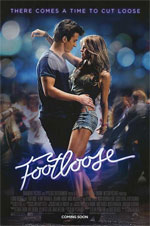
THE BIJOU REVIEW: "Footloose"


FOOTLOOSE:  Watch It At Home - Faithfully Reproduces the Original For Good and Bad

1980s week at the multiplex continues with a remake of FOOTLOOSE, a trip back to the territory of Herbert Ross's 1984 hit.  (Financially, by the way, there was no contest between the 1980s versions of this weekend's entries:  the original Footloose grossed $80M, while John Carpenter's The Thing only managed $20M 2 years earlier.)  

Meddling with Footloose isn't exactly like defacing Citizen Kane--while the movie made a lot of money, it was never iconic in the way that Saturday Night Fever was in 1977, or that The Breakfast Club would be in 1985--but not to worry, it's been treated with a remarkable amount of respect.  In fact, under Craig Brewer's direction, the surprise of the new Footloose is how sturdy the old script (the revised version is credited to Brewer and original screenwriter Dean Pitchford) has turned out to be.


For anyone who missed the 80s, the story is set in the small town of Bomont, where teenager Ren McCormack (Kenny Wormald in the Kevin Bacon role) moves from the big city.  (In 1984, his hometown was Chicago; this time it's Boston.  Also, Ren has a more tragic back-story this time--instead of arriving in Bomont with his mom, he's moving in with his uncle and aunt after having nursed his mother until her death from leukemia.)  Ren feels stifled as soon as he arrives, and he doesn't even know the bad news:  as a result of a fatal car crash several years earlier, whose victims included the son of the local minister (Dennis Quaid now, John Lithgow then), the town has passed a variety of ordinances to control teen behavior, the most egregious being a ban on any public dancing that isn't supervised by the church or school.  Ren also makes the acquaintance of the minister's hot, rebellious daughter Ariel (Julianne Hough in lieu of Lori Singer), and together, they unite the town's other teens to fight the good fight for free dancing in Bomont. 

The remake is quite faithful to the original, including any number of overt and subtle nods to Ross's film.  However, the politics--which weren't exactly radical even then--have been toned down (there's no longer a book burning to teach the minister he's gone too far), the sexuality is slightly more open (although Ren and Ariel still share only a setting-sun kiss), and the soundtrack mixes some of the original pop songs with country and hip-hop.  So this isn't Gus Van Sant's shot-by-shot reenactment of Psycho, but the fidelity does mean that as in 1984, the movie slows down quite a bit in the second half as it begins to take itself seriously and Ren morphs from a smartass city boy to an extremely earnest young politician who knows when to quote from the Bible. 

Herbert Ross started as a choreographer, and by the time he made the original Footloose, his films as a director included the dance-intensive Goodbye, Mr. Chips, Funny Lady, The Turning Point, Nijinsky and Pennies From Heaven.  (Although it turned out to be one of his biggest hits, the teen-oriented Footloose was originally considered a step back for Ross after the classy films he'd been making for more than a decade, something he undertook because of the recent flops of Nijinsky, Pennies and a couple of Neil Simon vehicles.)  One of the reasons the original Footloose is remembered so fondly is because of his very effective dance sequences, and a disappointment of the new film is that although Craig Brewer's Hustle & Flow and Black Snake Moon were deeply engaged with music, Brewer turns out not to be very gifted as a director of dance.  Wormald and Hough are both trained musical performers and--unlike Bacon and Singer--able to pull off their own numbers without doubles, but you could barely tell that from the flat, rhythmless way most of the dances are shot and edited.

The casting is uneven.  Wormald simply doesn't have Kevin Bacon's acting chops (by the time he did Footloose, Bacon had already been one of the leads in Diner, among other films), and Dennis Quaid, although a fine actor, was simply the wrong choice as the minister; pursed-lips disapproval isn't something that comes to him naturally, certainly not as compared with John Lithgow in the first film.  Hough, on the other hand, is charismatic and surprisingly strong as Ariel, even in the heavy-lifting acting scenes toward the end.  And Teller, like Chris Penn before him, practically steals the movie out from under the leads with great timing and some inspired comic dancing.  

Did Footloose need to be remade?  Of course not, although better that the studios play around with a negligible old hit like this than a genuine classic.  And it hasn't been particularly improved, on balance.  But as in 1984, it remains an entertaining story with some tuneful songs that provides diversion for a couple of hours.

  • Digg
  • Del.icio.us
  • StumbleUpon
  • Reddit
  • RSS

THE BIJOU @ TIFF: Gus Van Sant's "Restless"

Gus Van Sant has been making movies for 25 years, but Restless--apart from its technical polish--feels like the work of a Sundance newcomer. And one who's been reading too much Salinger, while meanwhile wearing out his DVD of Harold and Maude.

Restless is way beyond twee; its mega-tweeness is like a Transformers movie compared to a typical Syfy series episode. While certainly heartfelt, Jason Lew's script is nothing but affectation. Its hero, Enoch (!) (played by Henry Hopper, son of Dennis) has, since the untimely car crash death of his parents, treated death like a hobby. He crashes the funerals of strangers, draws chalk outlines around his own body, and has as his only friend the ghost of a Japanese WWII Kamikaze pilot. Clearly he needs to fully recognize and accept the emotional power of death.


Enter Annabel (Mia Wasikowska), who has the kind of magic movie cancer that kills you while causing no physical effect other than a pixie haircut. She and Enoch are made for each other, and once they're sappily in love (she memorizes descriptions of water-fowl) it's just a matter of waiting until Enoch sheds some really sad tears.

Van Sant is a gifted filmmaker even when his material is dross, and he works with a world-class team. (Not to mention a bigger budget than Sundance newbies can hope to have--that's an actual Beatles master playing over the opening credits.) Harris Savides, his customary cinematographer, contributes lovely, romantic-sad images, and Danny Elfman's score is all tinkling sentiment. For their parts, Hopper and Wasikowska are both excellent in their cliche-ridden roles, as is Schuyler Fisk as Annie's sister, the closest person on screen to a recognizable human being.

Van Sant is a hard-to-predict director, who moves from fine commercial product like Good Will Hunting and Milk, to esoteric art projects like Gerry and Paranoid Park, to occasional sorry efforts like Finding Forrester and (although the softhearted may disagree) this. He should be due for a good one next time out.


Sent via BlackBerry by AT&T

  • Digg
  • Del.icio.us
  • StumbleUpon
  • Reddit
  • RSS

THE BIJOU: "Submarine"


Worth A Ticket:  A teen movie unlike any other.

Richard Ayoade's emotionally rich SUBMARINE is shaping up as one of the sadder stories of the indie boxoffice season.   It was greeted rapturously at the Toronto Film Festival in September 2010, and the US distribution rights were acquired by Harvey Weinstein; Ben Stiller signed on to add his imprimatur (much as Oprah Winfrey and Tyler Perry had done for Precious).  Several months later, it turned up at Sundance, where it got less notice, since it already had a distributor and most of the critics had seen it the last time around.  Now, 5 months after that, it's opened without causing much of a stir (around $3500 in each of 17 theatres this weekend), so it may not be in multiplexes much longer. 


It's a small film, and I can't say it will be horribly diminished by being watched on a good home theatre system, but as always, the movie experience is best appreciated on a big screen.  Based on a novel by Joe Dunthorne, the story takes place in Wales.  Oliver Tate (Craig Roberts) is, as he would be the first to tell you, our protagonist.  Oliver isn't quite an outcast, but he's far from being one of the cool kids, and he observes his misadventures with some detachment, like a film fan watching a particularly compelling movie.  (He often imagines himself as the subject of a documentary or a foreign film.)  His parents (Noah Taylor and Sally Hawkins) are sunk in their own torpidity, and Oliver's most engaged moments are when he imagines himself with the subject of his crush, Jordana Bevan (Yasmin Paige).  He finds, much to his own surprise, that Jordana is interested in him too, and his (often horribly mistaken) interactions with her and with his parents provide the substance of the story.

Some have compared Submarine to a John Hughes film, others to Wes Anderson, and the great thing about it is that it's somewhere in between.  Ayoade's subject--and I don't know that any film has captured it better--is the utter self-consciousness and narcissism of teen years, that genuine feeling that nothing in the world could possibly be more important than your own pains and perceptions.  It can make even decent kids like Oliver treat the feelings of others callously.  In conveying this, Ayoade makes use of the formal sophistication you might see in an Anderson film (much fooling around with film stocks, structural ideas and motifs) to leaven and distance a Hughesian wit and heart.  Another not-so-shabby point of comparison is Renoir; like the master, Ayoade is fully aware of the awful things Oliver does, but he can understand and forgive him his failings. 

The movie isn't without flaws.  A chunk of the story is concerned with strains in the marriage of Oliver's parents, in particular with Oliver's fears that his mother may start an affair with an old boyfriend who's come back to town, now a garish psychic with a homevideo self-improvement course (Paddy Considine).  Although the 3 adult actors are very good, Considine's character seems to belong in another, broader movie.  And while Jordana has more shading than the love interests in most teen movies, the fact that the tale is told entirely from Oliver's point of view makes her a less developed figure than he is. 

All of this is outweighed by the film's special qualities.  Ayoade gets nuanced, rounded performances from Roberts and Paige, and makes gorgeous use of melancholy photography by Erik Wilson (he also shot Considine's extraordinary directing debut Tyrannosaur) and score by Andrew Hewitt, as well as a carefully chosen song score.  The movie feels all of a piece; there's nothing casual or unconsidered about any of his choices.

Submarine is the kind of movie that's extremely tough to market short of Harvey Weinstein standing on the street and pulling people into theatres (hey, he would have done it for King's Speech), especially in a summer season notable for its high-profile indie releases; it doesn't help that its long journey on the film festival trail seems to have diminished any momentum it might have had last fall.  It may never be widely seen on the big screen--it'll be sad, next week, to watch Fox Searchlight's insipid high school movie The Art of Getting By eclipse it--but those who see Submarine, in the multiplex or at home, won't forget it.

  • Digg
  • Del.icio.us
  • StumbleUpon
  • Reddit
  • RSS