RSS
Showing posts with label historical. Show all posts

THE SKED SEASON PREMIERE: "Downton Abbey"


It's not an exaggeration to say that many people probably had to check their cable and satellite listings just to find out where their local PBS station was, once it became clear that the first season of what's now called Masterpiece Classic's miniseries DOWNTON ABBEY was not to be missed.  Now, after a year-long hiatus, the show is back.

WHERE WE LEFT OFF:  War!  (World War I, to be precise.)  And so much more:  stoic, gallant valet Bates (Brendan Coyle) had defeated the scheming of lady's maid O'Brien (Siobhan Finneran) and footman Thomas (Rob James-Collier), and seemed to have a clear path to confess his love for his beloved, maid Anna (Joanne Froggatt), who stood by him no matter what scandal they set him up for.  Countess Cora (Elizabeth McGovern) was recovering from the miscarriage caused by the evil O'Brien (although she did feel bad about it afterward) when she thought Cora was trying to replace her as maid instead of seeking a new maid for her mother-in-law, the Dowager Countess (Maggie Smith).  Lady Sybil (Jessica Brown Findley) was tempted by liberal politics--and by the socialist chauffeur Branson (Allen Leech).  Lady Edith (Laura Carmichael) had lost yet another in a string of potential fiancees.  And most of all, Lady Mary (Michelle Dockery) and Matthew (Dan Stevens) continued their star-crossed ways:  despite being a middle-class relation, he's the heir to the Abbey, thanks to impossible rules of British inheritance, and she disdained him at first, but now that she's actually ifallen n love with him (and he with her), she nevertheless let her second-guessing get in the way and pulled them apart... forever?


WHERE WE ARE:  The War has affected every facet at life at Downton.  Matthew and Thomas are both at the front (although by the end of the episode, Thomas decided it was better to be shot than dead, and had maneuvered his way back to Downton).  Bates, who seems doomed to bear the ravages of all human evil, was reunited with his not-quite-ex-wife, who's so foul she makes O'Brien seem like a heroine, and to save the reputation of Lady Mary and the family (that damned dead Turk!), had to desert both Downton and Anna.  Stalwart housekeeper Mrs. Hughes (Phyllis Logan) and butler Carson (Jim Carter) know what she's done, though, so there may yet be justice--but now Matthew's valet Molesly (Kevin Doyle) has gone sweet on Anna.  Lady Sybil has broken Branson's heart but become a nurse, and Lady Edith has discovered that she's not averse to a bit of tractor-driving and rough trade. The Earl (Hugh Bonneville) is trying to get over the fact that his Colonel's commission in the local regiment is strictly ceremonial.  Kitchen maid Daisy (Sophie McShera) is still unthinkingly toying with the heart of former footman, now soldier William (Thomas Howes).  Lady Mary and Matthew, meanwhile, both have new beaus, although it's perfectly clear that neither of them cares as much about the new people in their life as they do about each other.

Downton Abbey is an extremely canny piece of work, because on the one hand, Julian Fellowes's scripts are classic PBS stately-manor-house porn, all fabulous rooms, gorgeous costumes, and details of fine living (on "the continent," servers may serve all the ladies first, but in Britain, tradition says they start with the highest nobility but then serve everyone in the order of seating--no, really), yet they also have the pace of Grey's Anatomy--filled with short, punchy scenes that are constantly moving characters and storylines forward.  The show barely pauses for breath, or to let the Dowager Empress let loose an impeccably haughty bon mot, and the combination is irresistible.  The show also has a superbly intricate sense of how all the relationships in the house work--Carson and Lady Mary's surprisingly father-and-daughterish affection for one another occasionally surfaces, as does the mix of vicious envy and genuinely high regard O'Brien has for Cora.

As extraordinarily fine as the show's writing and visual sumptuousness are, Downton Abbey rides to a great extent on its cast, and demonstrates how deep the bench is among British actors--with only Maggie Smith (who is what Betty White would be if Betty White were infinitely erudite and brilliant) at the Harry Potter level of celebrity, and Elizabeth McGovern, the ingenue from Ordinary People and Ragtime who's lived in London for decades, as the other familiar face for American audiences, the show mostly features an ensemble of performers who were obscure before Downton and are indelible now.  

Because PBS isn't advertiser-supported and doesn't pay for public Nielsen reports (as HBO, Showtime and Starz do), and because its shows air around the week at different times, depending on the vagaries of local stations, its ratings aren't released with those of other networks, so it's not clear when we'll know how well the new Downton Abbey is doing.  Creatively, though, the show continues to be very much in its Golden Age; if it were a feature film, we'd be discussing it as an Oscar frontrunner.

  • Digg
  • Del.icio.us
  • StumbleUpon
  • Reddit
  • RSS

THE BIJOU REVIEW: "War Horse"


WAR HORSE:  Watch It At Home -  Spielberg's Beautiful Muzak

Earlier this year, audiences were presented with Super 8, J. J. Abrams's pastiche of Steven Spielberg's classic sci-fi adventures from the 1970s and 80s (Spielberg was a producer on the project).  Now with WAR HORSE, we have Spielberg's own pastiche:  of John Ford, Carroll Ballard, David Lean, Stanley Kubrick, Robert Bresson, Gone With the Wind... and Steven Spielberg.  War Horse is the Colonial Williamsburg of Steven Spielberg movies, an exquisitely detailed but over-calculated and hence never convincing imitation of the real thing.


This War Horse, by the way, although based on the same Michael Morpurgo novel, is not an adaptation of the Tony-winning Broadway hit play by Nick Stafford.  The film, with a script credited to Lee Hall and Richard Curtis, tells largely the same story (the movie includes a few more episodes), but in a completely different visual form. 

Both play and movie begin in the period shortly before the beginning of World War I, in a rural English town where teenage Albert (Jeremy Irvine) becomes caretaker of Joey, a gorgeous black, um, beauty, with a distinctive white diamond shape on his head (which comes in handy when Joey needs to be identified). Albert's heavy-drinking, resentful father (Peter Mullen) bought Joey at an auction at which he badly overpaid in order to outbid the landlord (David Thewlis); now the family will lose its farm unless the thoroughbred Joey can be trained to work as a plowhorse.  With the encouragement of Albert's sympathetic mother (Emily Watson), this leads to very Black Stallion-esque sequences in which Albert trains Joey to do the impossible and the two bond for life.  

But the World War intervenes, and Joey is shipped off to France and a variety of owners, including a British officer (Tom Hiddleston), a French girl (Celine Buckens) and her grandfather (Niels Arestrup, memorable as the aging gangster in A Prophet), and so on.  Through Joey's microcosmic experiences of war, we as an audience are exposed to its brutality and occasional random humanity, the expressive beast serving as an object lesson in the ways combat damages the innocent. (This idea is closely related to Bresson's use of the donkey in Au Hasard, Balthazar, although the intensification of suffering by showing it inflicted on non-humans is a Spielberg trademark from ET to A.I. and beyond.)  But as soon as Albert is old enough to join the army, he's on another seemingly impossible quest: to be reunited with his horse.
 
The stage production of War Horse is famously and quite brilliantly stylized, most notably in its use of puppets operated by on-stage humans to play the horses, but also including projected backdrops, interruptions for chants and song and other overtly theatrical techniques.  Spielberg's film is stylized, too, but in a far more second-hand way:  it recreates the imagery of bygone movies.  So the early sequences, apart from Black Stallion, recalls How Green Was My Valley and other John Ford dramas, while the battles include homages to Kubrick's tracking shots of the trenches in Paths of Glory, Lean's warfare in Lawrence of Arabia and, it hardly needs to be said, Spielberg's own Saving Private Ryan.  

This is Spielberg's third consecutive retro project, after the dismal Indiana Jones and the Kingdom of the Crystal Skull and the more entertaining The Adventures of Tintin, and one can't help wondering what's on his mind these days.  In War Horse, he's not using the techniques of old movies to make any comment about film history (as Scorsese does in Hugo) or dichotomy between form and content (as in Scorsese's earlier New York, New York, Soderbergh's The Good German or Todd Haynes's Far From Heaven); he just seems to be indulging his own film buffery, and at the age of 65, and at this stage of his career, I think it's fair to ask more of him.  Spielberg went through a vibrant period in the 1990s and into this decade, with films like Schindler's List, Saving Private Ryan, Minority Report, A.I., The Terminal, War of the Worlds and Munich, which, whatever their ultimate success or failure individually, each had its own distinctive, eclectic look and feel.  Why retreat now to an aesthetic of film school imitation?  

The problem isn't merely that War Horse, while gorgeous and expertly made, feels synthetic, but that Spielberg's Hey-ma-look-at-this! style gets in the way of his own material.  When he bathes the film's ending in all the red lighting (and probably digital manipulation) in Hollywood, you may be thinking "Aha, there's his Gone With the Wind shot," or maybe just "Why the hell is everything so red?" but in either case, it pulls you out of the emotion of the moment to concentrate instead on his obtrusive direction.  War Horse, for all its mastery, is directed nervously--Spielberg is like a comic who keeps jabbing taglines into his act because he's afraid people will stop paying attention.  In this case, he pours syrupy sentimentality on material so emotional already that what it really needed was some restraint.

In fairness to War Horse, its overwhelming dollops of technique aren't in vain--you can't help but respond to the rich visuals and string-pulling score, let alone the sight of that poor suffering horse.  Spielberg is one of the world's great filmmakers, and every shot, every sequence is worked over to a shine.  He's collaborated with his creative team of cinematographer Janusz Kaminski, editor Michael Kahn, composer John Williams, and production designer Rick Carter for decades, and they respond to him like fingers of his own hand--the film is an often spectacular piece of moviemaking craft.

It just isn't very much more than that.  War Horse is, as much as Super 8, a tribute to Steven Spielberg and his own favorite movies.  Watching it is like watching someone hand himself an award, delivering both the presentation and the acceptance speech for 2 1/2 hours.  It's self-indulgence as epic filmmaking.  Spielberg's next film is his long-awaited biography of Lincoln, starring Daniel Day-Lewis and from a script by Tony Kushner.  Let's hope he's gotten his personal Netflix out of the way, and he's ready to make a real movie again.

  • Digg
  • Del.icio.us
  • StumbleUpon
  • Reddit
  • RSS

THE BIJOU REVIEW: "Sherlock Holmes: Game of Shadows"


SHERLOCK HOLMES:  GAME OF SHADOWS:  Watch It At Home - Far Too Elementary

We have to come to terms with the fact that an entire generation may recognize the name Sherlock Holmes not as the template for brilliant amateur crime-solving, but as a moderately intelligent action-comedy hero who dresses up in funny clothes.  This effect on the populace is what a $524M worldwide gross buys you, and with the sequel SHERLOCK HOLMES:  GAME OF SHADOWS, director Guy Ritchie, producer Joel Silver, and new screenwriters Michele and Kieran Mulroney, provide more of the same.  

Game of Shadows is in one way superior to 2009's Sherlock Holmes:  it does away with the supernatural mumbo-jumbo and takes place in some version of the real world.  There's no great mystery about who the villain is, since this time Moriarity (Jared Harris) himself is on the scene.  The convoluted and more-than-slightly ridiculous mystery Holmes has to solve is just what the evil one is plotting, which turns out to be not dissimilar from what master criminals have been plotting in big-scale action movies for decades. It all leads to a showdown between Holmes and Moriarity at a location that does come from Conan Doyle (and in being so used, reveals the ending). 


Watching Game of Shadows, one is struck more than anything else by the waste.  It's not just Robert Downey, Jr, Jude Law and Harris--the very fine cast includes Rachel McAdams, briefly reprising her role from the first movie, Noomi Rapace (Lisbeth Salander in the Swedish Dragon Tattoo series) as a Gypsy fortune-teller, Stephen Fry, having a fine old time as Holmes's brother Mycroft, and Eddie Marsan as Inspector Lestrade.  Philippe Rousselot again provides gorgeous, atmospheric photography, and Sarah Greenwood's turn-of-the-century production design is sumptuous.  No one can question Ritchie's ability to create sharp action sequences.

But to what end?  Even leaving aside the distortion of Holmes as a character, Game of Shadows is an action franchise that's already tired.  We get more signature sequences of Holmes anticipating every blow of a fight in slow-motion before the first punch is thrown or shot is fired, then enacting it all as planned; more giggly no-it's-not-really-homoerotic scenes of Holmes standing in the way of Watson's marriage to the understanding Mary (Kelly Reilly), more silly and unconvincing costumes (look, he's in drag!) for Downey to wear in disguise.  There isn't a scene that can't be overly worked for a gag; without spoiling the ending, it provides a microcosm of the movie by starting out as fairly clever and then continuing to push until it succeds in becoming farcial and dumb for the sake of a cheap laugh.  Downey seems to be leaking his ADD-plus-ego Tony Stark/Iron Man persona onto Holmes, and while the rapport between him and Law is still the center of the movie's appeal, it feels more studied and forced this time around. 

The Sherlock Holmes franchise clearly works for a wide audience, and Game of Shadows will inevitably make a great deal of money too.  Plenty of things blow up, and Downey and Law remain fairly good company.  Overall, though, the movie is 129 laborious minutes of paycheck-grabbing by a group of very talented people who don't particularly care if their secret motive is uncovered.

  • Digg
  • Del.icio.us
  • StumbleUpon
  • Reddit
  • RSS

THE BIJOU REVIEW: "A Dangerous Method"


A DANGEROUS METHOD:  Watch It At Home - A Visit to Dr. Cronenberg's Clinic

Throughout his career, David Cronenberg has been fascinated by twin compulsions:  the aberrant and the repressive.  The former was at the forefront of what are still his most celebrated films a quarter-century later, squishy biological horror movies like Videodrome and The Fly; later, he concentrated more on the demons inside, in pictures like M. Butterfly and A History of Violence.  It may have been inevitable that at some point he would be drawn to a story about the actual historical figures who created our modern paradigms of unacceptable impulses and their control, and A DANGEROUS METHOD is that story.  Unexpectedly, though, it's Cronenberg's driest and perhaps least satisfying film.

Based on the play The Talking Cure by screenwriter Christopher Hampton (itself based on a nonfiction book by John Kerr), Dangerous Method replays the complicated relationship among Carl Jung (Michael Fassbender), Sigmund Freud (Viggo Mortensen) and Sabina Spielrein (Keira Knightley), who became a patient and colleague to both (and Jung's mistress).  Jung was an early follower of Freud's controversial theories about the roots of psychological disturbance and the psychoanalytic techniques he developed to understand and control them; Spielrein, abused by her father, was afflicted by hysteria and came to Jung for treatment.  She was deeply troubled but also brilliant, and she eventually became a psychiatrist herself.  During the period when she was being treated by Jung and also studying psychiatry, she and Jung entered into a sexual relationship that seems to have largely sado-masochistic in nature.  

Meanwhile, Jung was chafing against some of Freud's most fundamental principles.  Freud believed psychoanalysis only existed to illuminate a patient's problems, that there was no "cure," while Jung felt people could truly be changed with treatment.  Jung also had a deeply-held interest in the spiritual and paranormal, outraging Freud, who was having enough trouble getting the establishment to recognize psychoanalysis itself as a real science, without religion or the supernatural getting in the way.  These issues, along with Freud's arrogance and what both would have called Jung's Oedipal complex, led to a gradual disengagement and then outright conflict between them.

All of this could well be the stuff of great drama, but that's not the way Cronenberg and Hampton approach it in Dangerous Method.  The film is very deliberately presented in a placid, carefully composed style (the lovely cinematography is by Cronenberg's usual collaborator Peter Suschitzsky) that is probably meant to ironically comment on the wild emotions of these characters whose aim in life is to bridle such impulses in others--but the style seems all too appropriate for the film's tone instead.  Both Fassbender and Mortensen give accomplished, intelligent, but bland performances that are odd under the circumstances.  (Whether by chance or not, Fassbender plays the character with sexual transgression issues in the about-to-open Shame, and there he does a spectacular job of revealing the emotional torture beneath a flat exterior.)  Although Knightley has been encouraged to accentuate the symptoms of her neurosis to an almost comical extent (strangely, she's also the only person in the cast to speak with an accent), it's a relief when she's on screen simply because she gets to express some feelings that go beyond the intellectual.

The film, which runs a spare 99 minutes although it carries its characters over a busy decade of their lives, also feels sketchy and superficial, as though there should be footnotes running along the bottom of the screen to explain the theories and historical incidents referred to glancingly in the dialogue.  Although the movie makes it clear that Sabina enjoys the physical violence Jung inflicts on her, we have no idea whether he gets sexual satisfaction from it as well, and his relationship with his wealthy wife Emma (Sarah Gadon) has no dimension.  We meet Otto Gross (Vincent Cassel), yet another crazy shrink who is both colleague and patient, but are never made to understand whether Jung truly believes Gross's philosophy of unbridled sexual impulse.  Freud is an even more undeveloped character, defined only by his ideas, his chomping on (phallic?) cigars and his growing resentment of Jung.

A Dangerous Method feels both overly polished and hastily drafted, frustrating in its depiction of intellectual concepts without emotion.  It's as though Cronenberg, approaching the root of his own cinematic obsessions, was compelled to take a step back, unable to face a diagnosis of his art.

  • Digg
  • Del.icio.us
  • StumbleUpon
  • Reddit
  • RSS

THE SKED'S PILOT + 1 REVIEW: "Hell On Wheels"


A lot can happen between the creation of a TV pilot in the spring and production of episodes for the regular season:  a writing/producing team is hired, audience focus groups weigh in, networks and studios (which may have had their own turnover in the off-season) give plenty of notes, both helpful and otherwise, and critics begin to rear their ugly heads.  The results can include changes to tone, pace, casting and even story.  Here at THE SKED, we're going to look past the pilots and present reviews of the first regular episodes of this year's new series as well.

Previously... on HELL ON WHEELS:  The post-Civil War Reconstruction era has just begun, and former Confederate soldier Cullen Bohannon (Anson Mount) is on a vendetta, systematically tracking down and killing the Northerners who, he believes, provoked his wife to suicide with their brutal attack on her.  His travels lead him to the far reaches of American civilization, where the Union Pacific railway is under construction; there he bides his time working on the line, supervising among others the former slave Elan Ferguson (Common).  (Although Cullen had been a slaveowner, he was convinced by his wife to free their slaves before the Emancipation Proclamation, so he's relatively liberal as Southerners go.)  Cullen finally has his chance to confront the foreman Daniel Johnson (Ted Levine), one of his wife's attackers.  Johnson tells Cullen that there's another man on the railway, the "Sergeant," who not only took part in the attack but actually murdered Cullen's wife--before he can say  more, though, Ferguson kills him.  Meanwhile, Lily Bell (Dominique McElligott), the wife of the railway's chief surveyor, is sole survivor of an attack by Indians furious that their land is being taken away; she escapes with surveyance maps that are critical to the Union Pacific, personified by its head, the rapacious (and loquacious) Thomas Durant (Colm Meaney) if the railway is to keep construction on schedule and collect the lucrative federal government bonuses he's been counting on.


Episode 2:  The main development of the show's second episode, written by series creators Tony and Joe Gayton and directed by pilot director David Von Ancken, is our introduction to a new villain played by Christopher Heyerdahl.  "The Swede" (actually he's Norwegian) is a former bookkeeper who discovered his dark side in the South's Andersonville prison camp and is now head of security for Durant.  The Swede, who dresses in high-buttoned black and acts like a road-company version of Death in The Seventh Seal, is after Cullen for the murder of Johnson, and most of the episode is concerned with Cullen's apprehension by the Swede and eventual escape, with a little help from the local preacher Reverend Cole (Tom Noonan) and Ferguson.  (Since there's no evidence at all against Cullen apart from the two of them having been seen together on the night of the murder, it's never clear why the Swede is so sure Cullen is the killer, or why Cullen doesn't just swear his innocence.)  This all leads to the necessary (for plot reasons) but unconvincing final scenes of the episode, where Cullen breaks into Durant's private railway car and convinces him in 2 minutes flat that he should take over as the new foreman because as a Confederate, he did such a good job of blowing up railway bridges.  

In B stories, the Swede reinforces his villainy by extorting money from Irish immigrant magic lantern projectionists Sean and Mickey McGinnes (Ben Esler and Phil Burke), while Lily demonstrates her inner Rambo by stitching up her own arrow wound, and is then rescued from the killer Indians by their leader's converted-to-Christianity brother Joseph Black Moon (Eddie Spears). 

Hell On Wheels has atmosphere to spare, but so far it's light on plot and character.  Even leaving aside comparisons to the late great Deadwood (which mostly come up when Durant starts spouting speeches like Al Swearingen's little brother), after 2 hours the show hasn't done much more than put Cullen in place on the railway.  Anson Mount is convincingly intense, and he and Common have a nice, wary acting rhythm together, but for now they're in isolation from the speechifying of Durant and Lily's entire storyline. 

Hell benefits from one of the best lead-ins on all of cable, the gigantic numbers pulled in by The Walking Dead, and it held a decent 55% of that 18-49 audience in its premiere.  We'll see whether that stays the case in its second week, but especially given the handicap that a historical, semi-western millieu has in the world of contemporary television, the show is going to have to start developing its stories and deepening its protagonists if it's to maintain a committed viewership.

Original Verdict:  If Nothing Else Is On...

Pilot + 1:  Railway Still Under Construction

  • Digg
  • Del.icio.us
  • StumbleUpon
  • Reddit
  • RSS

THE BIJOU REVIEW: "Immortals"


IMMORTALS:  Watch It At Home - Brainless, Violent and Weirdly Spectacular

There's no question that the director Tarsem Singh has an eye.  Singh started as a director of commercials and music videos--his most famous is probably REM's "Losing My Religion"--and his features The Cell and The Fall both had striking, memorable visuals.  Both also shared idiotic, barely comprehensible screenplays, and that brings us to his new film IMMORTALS.  

Immortals is no more, and often quite a bit less, than a rip-off of 300, complete with CG sets, nominally heterosexual heroes (who caress each other's mostly bare bodies with their eyes when they're not chopping them apart), and R-rated levels of flying, bloody heads as well as other body parts.  (This time in 3D!)  300, though, had some narrative punch, a few actors who knew what they were doing (Gerard Butler, Lena Headey, Dominic West), and a relatively simple narrative point.  Immortals seems to have been written (the script is credited to Charles and Vlas Parlapanides) on the back of the same packet that contained designer hallucinogenics ingested by the director and his designers.

Immortals does have a clearly identifiable hero and villain.  The former is Theseus (Henry Cavil, soon to be seen as Zach Snyder's Superman), a humble but extremely buff peasant who is apparently only able to function with his shirt off.  His opponent, sort of Ancient Greece's Blofeld, is King Hyperion (Mickey Rourke, chewing scenery like it's 15 minutes before closing time in a Vegas buffet), who gains possession of some kind of magic bow that can shoot an infinite number of phony-looking CG cartoon arrows into an infinite number of computer-generated extras.  With this weapon, he plans to take over not just the world, but also the realm of the gods, here portrayed as a group of extremely bad actors  (Luke Evans, Isabel Lucas, Kellan Lutz, Steve Byers, Corey Sevier), who look down at the earthly goings-on while acting like aristocrats in a collectivist propaganda video, occasionally unleashing their own fake-looking CG powers to help humanity out.  Also, there's Frieda Pinto as a seer who can tell the future only as long as she remains a virgin, and you don't have to watch Henry Cavil carve up bad guys with his shirt off for long to figure out how that's going to end up.

Once you forget about Immortals making any sense at all, and the flood of blood and hacked-up bodies stops registering, there is a loony pleasure to be had from the movie.  Singh is no storyteller, and little things like "credibility" mean little to him, but he sure as hell knows how to create an image.  Working with cinematographer Brendan Galvin, production designer Tom Foden, costume designer Eiko Ishioka, and an enormous visual effects team, Singh creates a universe of precipitous cliffs, endless tunnels, impossible magic prisons and outfits that look like Halloween in West Hollywood.  None of it is in any way believable or real, but it's often quite gorgeous to look at.

Actors performing on digital sets need special care from their director, since they don't have the usual ability to know what will be sharing the frame with them.  Clearly Singh has little interest in such matters; the stars are merely figures moving in his digital landscapes and wearing his outrageous costumes.  So it's unfair to put too much weight on the performances on view or lack thereof, but we can say that neither Cavil nor Pinto seems to be a self-starter when it comes to their acttng abilities, and that the cast members playing the gods were hopefully well paid. 

Immortals is ultimately boring, as any work of abstract art is likely to be after staring at it for 110 minutes.  Viewed in short bursts, however, when flicking through cable channels, its sometimes dazzling style could be seen to best advantage.

  • Digg
  • Del.icio.us
  • StumbleUpon
  • Reddit
  • RSS

THE BIJOU REVIEW: "Anonymous"


ANONYMOUS:  Watch It At Home - The Bard Was A Beard, Claims Wheezy Expose

ANONYMOUS is history tailored for the 1%.

Although screenwriter John Orloff and director Roland Emmerich have swirled it into a complicated tangle of conspiracies and scandals, the idea at the center of Anonymous is simple enough (uh, Spoiler Alert):  William Shakespeare (Rafe Spall in the movie) was an ignorant actor and full-time lout, utterly incapable of writing the plays attributed to him, which were actually the work of Edward DeVere, Earl of Oxford (Rhys Ifans). 


There are apparently many good reasons for believing this theory to be balderdash.  Among them is the fact that 2 of Shakespeare's late plays were not only first produced after DeVere had died, but were inspired by historical incidents that didn't occur until he was, as Monty Python would say, bleeding demised.  (The film doesn't help its believability by having DeVere write A Midsummer Night's Dream at the age of 9, a feat even Mozart would have found impressive.) 

But there's nothing wrong with fictional emendations of history.  I don't think any of us were aware of just what role super powers played in the Cuban Missile Crisis until this summer's X Men:  First Class.  Quentin Tarantino killed off Hitler and ended World War II prematurely in Inglourious Basterds.  Mark Zuckerberg may not be the sad misfit portrayed in The Social Network.  Shakespeare himself, for that matter, certainly wasn't above fiddling with facts in the historical plays.  And of course Shakespeare In Love invented Gwyneth Paltrow's character as not only a love interest, but the inspiration for some of his best plays.

But if you're going to screw around with history for the sake of a story, it had better be a good one.  And that Orloff and Emmerich don't have.  In fact, at least for an American audience, their tale is a snobbish swipe at the lower classes:  how could the plays of Shakespeare have been written by anyone other than a nobleman?  Only one born to power and erudition would be able to create such poetry and tell such tales.  This isn't just a false--maybe an offensive--premise, it's an unentertaining one, unless perhaps you're a member of the Trump family.. Who wants to see a movie about the triumph of superciliousness?  

Not being content with a bad central idea, Anonymous lards the story with increasingly far-fetched plots and revelations, for many of which a working knowledge of 16th Century British history would be helpful.  These culminate in one involving Queen Elizabeth (played by Joely and Vanessa Redgrave at various ages) and DeVere that has to be seen to be believed. 

Although the bones of Anonymous are brittle and creaky, no one ever said Roland Emmerich didn't know how to make a movie.  All that technical expertise that went into The Day After Tomorrow and 2012 are piled on here, and the film's production design, costumes and some bravura CG landscapes of old-time London are superb.  The actors, too, are committed.  Rhys Ifans, freed from his usual role as comedy relief, brings intelligence and suffering to the brilliant but hapless DeVere.  David Thewlis is a fine villain, and of course the Redgraves are impeccable.  It's a bit unsettling to see Derek Jacobi, a magnificent actor of Shakespeare himself, endorse the DeVere theory by more or less playing himself as the presenter of the tale, but this is why actors should mostly avoid talking about their deeply-held beliefs.  

Anonymous is a watchable display of craft, yet dramatically uninvolving and factually silly.  Somebody--but who?--once mentioned "a tale told by an idiot, full of sound and fury, signifying nothing."  Apart from everything else, it turns out he was the world's first film critic.


  • Digg
  • Del.icio.us
  • StumbleUpon
  • Reddit
  • RSS

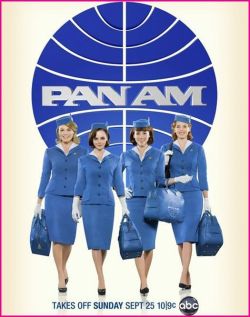
THE SKED'S PILOT + 1 REVIEW: "Pan Am"


A lot can happen between the creation of a TV pilot in the spring and production of episodes for the regular season:  a writing/producing team is hired, audience focus groups weigh in, networks and studios (which may have had their own turnover in the off-season) give plenty of notes, both helpful and otherwise, and critics begin to rear their ugly heads.  The results can include changes to tone, pace, casting and even story.  Here at THE SKED, we're going to look past the pilots and present reviews of the first regular episodes of this year's new series as well.

Previously... on PAN AM:  In the early 1960s, 4 stewardesses fly glamorously from continent to continent, hungry for adventure and juggling personal issues.  Maggie (Christina Ricci) is a Greenwich Village intellectual who puts on the Pan Am girdle to see the world; Colette (Karine Vanasse) has been having an affair with a married man; and Kate (Kelli Garner) and Laura (Margot Robbie) are sisters--Kate helped her younger sibling escape the conformity of her wedding day, but the two have jealousy issues.  Also, a fifth stewardess named Bridget (Annabelle Wallis) has vanished, and it turns out she's been working for the CIA and MI5 as a spy--and now Kate is her replacement.


Episode 2:  A very smooth flight, all things considered.  The main change from the original version of the pilot is that Dean, the pilot at the head of our heroines' crew, has been recast with Mike Vogel--he's fine, but this show belongs first and foremost to its women.  Also, as with last week's Charlie's Angels, ABC moved this episode up from being 3d to air to 2d, which since Pan Am is somewhat serialized, required some deft editing to avoid references to things we won't see till next week. (This presumably means we shouldn't get our hopes up for the quality of next week's episode.)

Pan Am is very much the airline that the men of Sterling Cooper would fly on their expense account business trips (before they became the more budget-conscious Sterling Cooper Draper Pryce):  sleek, luxurious and loaded with beautiful, interesting women.  The second (or "second") episode, written by series creator/Executive Producer Jack Orman and Producer Mike Daniels, and directed by Christopher Misiano (like Orman, a veteran of ER), follows the flight plan of the pilot, with the first two-thirds set on an overseas flight (this time to Paris) interspersed with a few flashbacks, and the last 20 minutes in the city itself

The episode resolves several of the stories set up in the pilot, while setting up some new ones.  Kate's spy intrigue this time leads her to a reunion with Bridget, who explains that she had been compromised on a previous mission and now has to go into the spy equivalent of witness protection with a new identity (presumably taking her out of the show); meanwhile, now that Dean, who had been in love with Bridget, and Colette, who's done with her married boyfriend, are both single, the two of them seem aimed for romance.  In the other main plotline, Kate and Laura's mother shows up as a passenger on the flight, and she's brought Laura's ex-fiance to Paris.  By episode's end, Laura has told her ex that the two of them are really over, and Kate and her mother have had a heart-to-heart.  There's also a nod to Mad Menesque sexual mores when a boozy passenger makes a pass at Maggie and she stabs him with a fork.

It's likely to take a bit of time for Pan Am to balance its triple goals of telling soapy stories, mixing in some espionage, and tackling the changing era of the 60s.  Right now, it's an uncertain mix--the spy story feels like it was carried in bodily from another show, and any time the series invites direct comparison to Mad Men, it's asking for trouble.  Also, both the pilot and initial episode weirdly underuse Christina Ricci, who's supposed to be the star of the ensemble.  Still, the show is entertaining enough to make its bumpy take-off endurable.  The women are far less bluntly drawn than their parallels on The Playboy Club, and there's some bright dialogue and breezier storytelling. The production design and photography are pure pleasure to watch, perhaps not achieving the stunning artistry of, yes, Mad Men, but far more accomplished than Playboy Club.

Pan Am got off to a good ratings start last week, and we'll know soon enough how many passengers boarded for the connecting flight.  So far, it's one of the season's higher-flying new dramas.

Original Verdict:  If Nothing Else Is On...

Pilot + 1:  Gaining Altitude

  • Digg
  • Del.icio.us
  • StumbleUpon
  • Reddit
  • RSS

THE SKED'S PILOT + 1 REVIEW: "The Playboy Club"


A lot can happen between the creation of a TV pilot in the spring and production of episodes for the regular season:  a writing/producing team is hired, audience focus groups weigh in, networks and studios (which may have had their own turnover in the off-season) give plenty of notes, both helpful and otherwise, and critics begin to rear their ugly heads.  The results can include changes to tone, pace, casting and even story.  Here at THE SKED, we're going to look past the pilots and present reviews of the first regular episodes of this year's new series as well.

Previously... on THE PLAYBOY CLUB:  It's the early 1960s, and somewhere in New York, Don Draper is creating his dazzling ad campaigns.  But in Chicago, the center of the world is the Playboy Club, Hugh Hefner's monument to bunnily clad women.  Maureen (Amber Heard) is new to town and to the Club, but no sooner does she catch the eye of shady lawyer/aspiring politician Nick Dalton (Eddie Cibrian) than the local crime boss assaults her, resulting in a murder by high-heeled shoe.  Nick helps Maureen hide the body, and while the killing isn't discovered, Nick's girlfriend Carol-Lynne (Laura Benanti)--who happens to be Maureen's supervisor at the Club--sees them together and dumps Nick.  Meanwhile, other bunnies include secret lesbian Alice (Leah Renee Cudmore), who has a marriage of convenience with a closeted gay man; Brenda (Naturi Naughton), who wants to be the first black Playboy Playmate; and Janie (Jenna Dewan-Tatum), who's hiding a secret.

Episode 2:  The series, even more than the pilot, feels like a drama set 20 years earlier than it actually is.  The first regular episode, written by series creator Chad Hodge, dispenses for the most part with the civil rights story that at least made an appearance in the pilot; instead, we get a sequence where lesbian Alice tries to restrain her drool when Maureen asks her to help with photos for a prospective Playboy cover shoot.  (Alice, although a bunny herself, being suddenly barely able to control herself in the presence of female flesh.)  The show is nothing more than a backstage soap opera, and old-fashioned to a fault.


Instead of any social commentary at all, we get the continuation of the main storyline from the pilot:  Nick and Maureen worry about whether the gangster's body is going to be found, while Carol-Lynn fumes over the attraction between the two. Although the episode flirts with the possibility of Carol-Lynn becoming a mentor to Maureen, by the end, even though Carol-Lynn's taken Nick back, she's making "scarlet woman" remarks about Maureen and darkly threatening her about the bad things that can happen to someone in Chicago.

In other plots, Nick moves forward with his run for State's Attorney by bribing Mayor Daley, and Alice's gay husband covers up a potentially incriminating photo of Nick with the dead gangster's son in order to make a good impression on Nick.  (The husband's whole family, Alice included, is ridiculously at the Club because her conservative father-in-law decided it would be a fun place to bring the wife and daughter-in-law.)  We also find out that Janie is on the run from an abusive husband, and that Brenda's ambition is to buy real estate.  In another hugely unconvincing story beat, Maureen is so moved by the latter that when she wins the competition to be a Playboy cover girl and the money prize that goes with it, she secretly gives the cash to Brenda.

With the exception of Laura Benanti, who definitely classes up the joint, the acting doesn't help much either.  Cibrian is starting to seem like Jason Sudeikis playing Jon Hamm, and Heard, while gorgeous, is inexpressive.  Compared to Pan Am (the pilot at least)--let's not even mention Mad Men--Playboy Club looks pretty skimpy visually, too.  Most of the action takes place in the club itself, and while Pan Am's lush production design is wonderfully specific--you just know months of research have gone into duplicating every detail--everything in Playboy is a little dull and generic. 

In all, there's no reason to feel better about The Playboy Club now that it's in series mode, and a few causes to doubt it even more.  They did make one good decision, though:  no more arthritic narration from Hef himself.

Original Verdict:  If Nothing Else Is On...

Pilot + 1:   Running Low On Potential

  • Digg
  • Del.icio.us
  • StumbleUpon
  • Reddit
  • RSS

THE BIJOU @ TIFF: Madonna's "W.E."


One of the enduring questions of Madonna's illustrious quarter-century career is how someone so brilliant in managing every other facet of her persona has consistently made such terrible decisions when it comes to movies.  It's the one medium where she's never succeeded, and even when she's occasionally done something right, she instantly follows it with another foul-up:  her bright debut in Desperately Seeking Susan preceded the famously dreadful Shanghai Surprise, and her decent performance in the hugely hyped Evita led to the even more unwatchableThe Next Big Thing.  Her last lead role was in the atrocious Swept Away, and now she's moved on to directing.  Her debut Filth and Wisdom came and went with little notice, but this time she's back on a much bigger scale:  W.E., which played the Toronto Film Festival last night.


W.E. refers to the initials of Wallis Simpson and the King who abdicated his throne for her, Edward VII of England, and the movie purports some kind of mystical tie between Simpson (Andrea Riseborough, unrecognizable from her meek waitress in Brighton Rock) and Wally, the dissatisfied wife (Abbie Cornish) of a Manhattan psychiatrist (Richard Coyle) in 1999, when the Windsors' possessions were being sold at auction at Sotheby's.  To put it bluntly, the script by Madonna and Alek Keshishian (director of her concert documentary Truth or Dare) makes no sense whatsoever, and if Madonna's name weren't attached to it, it's almost inconceivable that the picture could ever have been made.  From the intense whitewashing of Edward's (James D'Arcy) historical Nazi sympathies, to Wallis Simpson being some sort of fairy godmother to Wally, to Wally's romance novel affair with a Russian security officer at Sotheby's (Oscar Isaac, who's been popping up all over the festival in impressively diverse roles)--W.E. is a stranger to logic.

W.E. is an awful movie, all right, but it's often a watchably awful one.  The picture's been described as resembling a music video, but that's not really accurate (except for one scene--I think it was Wally's hallucination but who knows--where Wallis dances to a contemporary song even though it's the 1930s, at an amphetamine-fueled party)--it's much more like one of those videos fashion magazines and design houses do these days, for posting on their websites and in stores.  Madonna knows her way around a camera move, and although the movie may have been designed instead of directed, it's been designed within a milimeter of its life:  cinematographer Hagen Bogdanski (his films include The Young Victoria), production designer Martin Childs, and costume designer Arianne Phillips seem to have been told to spare no expense and pay no attention to objective reality (the security guy's insanely swanky apartment would probably go for mid-seven figures, which should spur a rush for jobs at Sotheby's). 

Apart from its visual thrills, W.E. offers little, except for authors of future dissertations who choose to analyze Madonna's interest in the isolation and emotional pain of rich women in the public eye.  Her and Keshishian's dialogue is like a knife in the ears, and even the very talented actors on display like Cornish aren't given anyone recognizably human to play.  The movie feels like, and essentially is, the ultimate vanity production.

People complained that Sofia Coppola's Marie Antoinette was superficial, but they didn't know what superficial looked like:  W.E. makes Coppola's film feel like it was made by Robert Bresson.  This kind of high-priced, unrestrained idiocy doesn't come along many times in a lifetime, so don't resist the temptation to take a look.  And for Madonna, it's never too late to consider a segue into animation.

  • Digg
  • Del.icio.us
  • StumbleUpon
  • Reddit
  • RSS