RSS
Showing posts with label horror. Show all posts

SHOWBUZZDAILY @ PALEYFEST 2012: "The Vampire Diaries"


When the PaleyFest panels end, cast members often linger for a bit to sign autographs and otherwise make contact with the fans.  Therefore when the moderator says "Thank you" and the lights go up, there's usually a movement of audience members toward the stage.  But "movement" doesn't do justice to the full-scale rush that greeted tonight's salute to THE VAMPIRE DIARIES, a rock-concert level scramble that left onlookers ducking out of the aisles.


To some extent, that kind of response isn't a surprise:  Vampire Diaries is in its 3rd year as the unquestionably biggest--well, only--hit on CW, and the viewers who watch that network are younger and in better shape than those of the others.  Because of its genre and demographic, Diaries is also regularly underrated, almost never given full credit as one of the smartest, wittiest and most narratively satisfying serialized dramas on the air. 

The evening began with a screening of this coming Thursday's episode, the first back after a hiatus.  At the request of series co-creator/showrunner (with Kevin Williamson) Julie Plec, its climactic revelation won't be spoiled here, except to say that it's in keeping with the grand story twists that have marked this show from the beginning, and sets the stage for a new conflict to play out over the rest of the season.  

After a brief (inconclusive) discussion of said twist, the main part of the panel began.  Apart from Plec, most of the major cast members were in attendance:  Elena (Nina Dobrev), beloved of vampires and constantly stalked; brother vampires Stefan and Damon (Paul Wesley and Ian Somerhalder); Alaric (Matt Davis), who started as a vampire-hunter and is now Elena's guardian and a veritable vampire bud; witch Bonnie (Kat Graham); and relatively new vamp Caroline (Candice Accola).  

These folks have been together on a hit for years, and they're a loose, talkative bunch (the moderator mostly just had to toss in a question every so often and let them go).  Any spoilers were more in the nature of hints:  before the season is over, Elena will have to make "a" choice (but not necessarily "the" choice) between the brothers, we haven't seen the last of Klaus and the Original Vampires, it's possible that we'll meet Elena's parents in a flashback.  Plec was noncommittal about whether the show would ever consider following the L.J. Smith novels and making Elena into a vampire, or when evil Katarina, Elena's vampire doppelganger (just go with it) would make a return appearance.  Dobrev got the evening's biggest laugh when she wondered aloud why Gossip Girl got to film episodes in Paris and they were stuck in Mystic Falls.  Somerholder was appropriately Damon-ish caustic much of the time, but like his character, he could become surprisingly heartfelt, notably when he talked about how he'd survived the brutal audition process for the show.   Audience squeals greeted any mention of the Elena/Stefan/Damon triangle (and for those more interested in the tabloid side of things, Somerholder placing his jacket around Dobrev's shoulders made their night.)  

The Vampire Diaries airs in the toughest hour on television, the 8PM slot that's home to the deadly battle between American Idol and The Big Bang Theory, and yet its ratings have barely budged.  Beyond that success, it's as smoothly and effectively run as any series in primetime.  Young audience tastes change--Buffy the Vampire Slayer is a legend now, but when it left the air, its ratings had preceded it--and Diaries' status won't last forever.  Nonetheless, it should have plenty of frenzied audience response still ahead of it.


  • Digg
  • Del.icio.us
  • StumbleUpon
  • Reddit
  • RSS

THE SHOWBUZZDAILY REVIEW: "Silent House"


SILENT HOUSE:  Watch It At Home - A Curiosity

SILENT HOUSE isn't the first feature-length film to provide the illusion that it's all been shot in a single continuous take.  The most famous was Hitchcock's Rope, but in his era, it was technologically impossible to actually shoot for 90 minutes straight, because rolls of film were only so long, and cameras had to be reloaded.  Digital video, however, has made the stunt doable, and recently Alexander Sokurov's Russian Ark apparently pulled off the feat, with extraordinarily complicated content that included battle scenes and banquets as part of its history of Russia.  


Even though technology now permits genuine feature-length takes, Silent House cheats--a few cuts are hidden in moments where the screen goes dark or blindingly light and in sudden camera movements.   Still, one has to give directors Chris Kentis and Laura Lau (and cinematographer Igor Martinovic) credit for sustaining graceful, lengthy shots in constant motion that must have been enormously challenging to light and continuously reframe.  

When discussing Silent House, the emphasis is always going to be on the movie's camerawork, because there's not much else there.  The picture itself is an increasingly muddled haunted house thriller.  Sarah (Elisabeth Olsen) has come back to the house where she grew up, which she and her father (Adam Trese) and uncle (Eric Sheffer Stevens) are cleaning out in preparation for selling it.  The windows are boarded over, most of the doors are padlocked, and there's no electricity, so when Dad goes missing a short time into the story, what remains is an awful lot of Elisabeth Olsen stumbling from one room to another, armed much of the time with little more than a (not to be relied-upon) flashlight and becoming increasingly frazzled as creaks and slammed doors give way to bodies.

This is all fun for a while, and Kentis and Lau, who previously directed the legitimately terrifying Open Water, know how to draw out moments of suspense.  Olsen, alone on screen for most of the movie, does a terrifically charismatic job of finding gradations of fear, determination and hysteria that have to be sustained for the extended length of each very long shot.  Things become monotonous, though, because the limitations of the movie's gimmick and its content mean that not very much can actually happen, just a lot of unexpected noises and shadowy figures glimpsed in the corner or background of the frame scurrying about.  Although the movie provides explanations for why Sarah doesn't just leave the damn house, one gets progressively more impatient with her.  And eventually, even a low-budget horror movie has to be about something, and that's where the script by Lau (based on a 2010 Uruguayan film that was barely released in the US) really falls apart.  The last reel or so grows increasingly confused in that hey-what's-really-going on here? kind of way that's become its own cliche, raising more questions than it answers.

As cinematic stunts go, Silent House is reasonably fun--it's certainly a nice change of pace from the endless "found footage" thrillers pouring in these days, and Olsen again proves herself a magnetic presence on screen.  The movie's attic, however, is ultimately empty.


  • Digg
  • Del.icio.us
  • StumbleUpon
  • Reddit
  • RSS

THE SKED MIDSEASON PREMIERE REVIEW: "The Walking Dead"


Previously On... THE WALKING DEAD:  Our erstwhile humans spent many, many episodes on a farm owned by cranky vet Hershel (Scott Wilson), while they searched for the missing Sophia (Madison Lintz).  There were lots of lengthy conversations about the meaning of life in a zombie-infected universe, and whether it was worth going on--let alone having a baby, as it turned out Lori (Sarah Wayne Callies) was going to do.  Meanwhile, her husband Rick (Andrew Lincoln) revealed that he knew about the affair Lori had been having with the increasingly Travis Bickle-like Shane (Jon Bernthal) while Rick was believed dead.  Glenn (Steven Yuen) found romance with Hershel's daughter Maggie (Lauren Cohan).  And then it developed that Hershel had been keeping a barn full of Walkers, including Hershel's wife, and even feeding them to keep them "alive," because he believed that one day there might be a cure.  When Shane found out about the Walker barn, he started with the slaughtering, and at the very end of the fall finale, we discovered that--guess what?--Sophia was in there too, and had been for all the many, many weeks we'd all been on the farm.  Rick shot her in the head, so that this plotline could finally, mercifully end


And Now:  This week's episode picked up exactly where the fall finale left off, but it marks a key transition in Walking Dead's history:  after a season and a half under the leadership of Frank Darabont (best known for theatrical films like The Green Mile and The Shawshank Redemption), the show is now being run--after Darabont exited under circumstances still not completely explained--by Glen Mazzara, a TV vet with stints on shows like Hawthorne, Crash, Life and The Shield

So goodbye to windy expositioning, and hello to lots of gooey zombie bang-bang, right?  No more Boardwalk Empire-style measured pace, it's time for a nonstop horror joyride, yes? 

Well, not so far.  The ratio of dialogue to action in Walking Dead makes its massive success a continuing mystery.  We're still on that damn farm, and the first two-thirds of the episode, written by Evan Reilly and directed by Clark Peters, is still pretty much the characters debating the morality of Shane's actions and life in general.  Hershel gets depressed, and when Maggie tells Glenn she loves him, he doesn't say it back.  Awwwww.  The only fun is when Andrea (Laurie Holden), transporting a pick-up truck loaded with shot-up zombies, has to nonchalantly retrieve a fallen severed arm from the road.

In the episode's second half, we do get what could be a big event:  Lori gets into a car crash, and while she's certainly still going to be alive, that could put her pregnancy in danger, and should eventually also make for zome Walker action.  However, all of that will have to wait for future episodes:  this one let her crash and never came back to her for the next 20 minutes.

Instead, we spent the last section of the episode in a bar where Hershel, who it turns out was an alcoholic who had sworn off the stuff when Maggie was born, had gone to drown his sorrows.  Rick and Glenn go to bring him back, and 2 strangers, led by Dave (Michael Raymond-James) show up.  This leads to a very Tarantino-ish sequence where the 5 men chat with seeming amiability and we just wait for the shooting to being.  That does eventually happen, and it's a fairly well written and extremely well acted scene (too bad Dave won't be making a return appearance), but not exactly a cure for the show's doldrums.

The Walking Dead, for all its success, is intense without being all that interesting, more grim and talky (and not even good talk) than exciting.  AMC could well say "If it ain't broke...", because it's the biggest hit the network has ever had, putting the sacred Mad Men and even Breaking Bad deep into the shadows.  It would be nice, though, if under its new regime, the series could move a little faster, and have more of a plan, than its zombies do.


  • Digg
  • Del.icio.us
  • StumbleUpon
  • Reddit
  • RSS

THE SKED'S PILOT + 1 REVIEW: "The River"


A lot can happen between the creation of a TV pilot in the spring and production of episodes for the regular season:  a writing/producing team is hired, audience focus groups weigh in, networks and studios (which may have had their own turnover in the off-season) give plenty of notes, both helpful and otherwise, and critics begin to rear their ugly heads.  The results can include changes to tone, pace, casting and even story.  Here at THE SKED, we're going to look past the pilots and present reviews of the first regular episodes of this year's new series as well.

Previously... on THE RIVER:  A small boat called the Magus heads up the Amazon, in search of vanished TV nature series host Dr. Emmet Cole (Bruce Greenwood).  The crew is a mix of Cole's family and friends--wife Tess (Leslie Hope), son Lincoln (Joe Anderson) and Lena (Eloise Mumford), the daughter of his trusted cameraman--and a TV crew headed by Clark (Paul Blackthorne) that's documenting the search.  Also along are mercenary Brynildson (Thomas Kretschman) providing security, and the boat's engineer (Daniel Zacapa) and his adolescent daughter Jahel (Paula Gaitan).  There are plenty of tensions among this group as they follow breadcrumbs of clues they find in the videotapes Cole has left behind.  And along the way, at every stop they encounter all manner of supernatural phenomena.  The entire show is supposedly edited together from the footage shot by the documentary crew itself.


Episode 2:  Although The River aired as a "2-hour premiere," it was actually the original pilot with the first regular episode appended.  The building blocks of exposition and mythology having been established in the pilot, that second hour gives a good picture of what the series is planning to be.  Clearly it'll be quite a while before the Magus finds Emmet Cole, and some of the show's episodic adventures will only tangentially involve the search for him.

In the 2d hour episode, written by Executive Producers Michael Green and Zack Estrin, and directed by pilot director Jaune Collet-Serra, some kind of magic CG bug flew into Jahel's mouth and temporarily possessed her with Cole's spirit (and Bruce Greenwood's voice).  The spirit tried to talk the group into going home, but of course then there'd be no show, so they ignored him/it and pressed on.  Something the spirit said seemed to indicate that Cole was still alive but being held in captivity, which set the Magus to this week's part of the Amazon.  Cole wasn't there, but they did find the ghost of a dead colonial family's child.  The site where the girl drowned was surrounded by dolls who sometimes came alive, and since the dead girl missed her dead mother, in her loneliness she took Tess as a substitute.  (This storyline oddly echoed The Woman In Black, which opened in theatres last weekend.) 

The hour had a few creepy moments, but it never made the use that it should have of those dolls, which didn't do much more than open their eyes and stare (limited series CG budget?).  Watching Leslie Hope get pulled under muddy water was a good deal less frightening.  The episode also made clear some of the limitations of the show's concept.  Since the show-within-the-show is being filmed by a professional TV crew, the "found footage" gimmick doesn't mean much (unlike, say, the ingenious use of technical imitations in Paranormal Activity 3), because it all looks like any other TV show except for the shaky hand-held camerawork used to accentuate panic in the action sequences, and there's already overuse of genre cliches like images suddenly cutting to static or flaring in the face of the supernatural.  Also, the conventions of series television mean that the regular characters aren't in all that much mortal danger until we get near the season finale, which lessens any suspense, and thus far, the relationships between those characters are none too scintillating.

Since the hunt for Emmet Cole is a very loose underpinning for the series at this point (this week we got a B story suggesting that it's Lena, not Lincoln, who's the "chosen one" that will have to fight evil to rescue Cole), each episode of The River will mostly have to fend for itself, based on the strength of that week's story.  This episode was medium-scary, and the show will have to do better if the repeated scenes of people stumbling through jungle or looking off the side of the boat and exclaiming "What the hell was that?!?" aren't to get tiresome.


Original Verdict:  Potential DVR Alert

Pilot + 1:  Beware of Shaky-Cam Seasickness

  • Digg
  • Del.icio.us
  • StumbleUpon
  • Reddit
  • RSS

THE SKED PREMIERING TONIGHT: ABC's "The River"


Disclaimer:  Network pilots now in circulation are not necessarily in the form that will air in the Fall.  Pilots are often reedited and rescored, and in some cases even recast or reshot.  So these critiques shouldn't be taken as full TV pilot reviews, but rather as a guide to the general style and content of the new shows coming your way.

THE RIVER -  Midseason on ABC:  Potential DVR Alert

THE RIVER is a solid sleeper, a pleasurably nerve-rattling B-movie creepfest set on the Amazon.  ABC is holding it for midseason, where at the very least it should stand out from other network arrivals.


As every promo will surely be heralding, The River comes from Steven Spielberg's Amblin production company and producer Oren Peli, of Paranormal Activity fame.  Peli's involvement is more obvious, because the show uses the same "found footage" format as the Paranormal movies, where everything we're watching is supposedly filmed either by the show's characters or surveillance cameras (this illusion only goes so far, unless there's an invisible helicopter around for a few of the shots).  The backstory of the premise is that America's beloved TV explorer Dr Emmet Cole (Bruce Greenwood), who had traveled around the world for 20 years with his wife Tess (Leslie Hope), his son Lincoln (Joe Anderson) and an ever-present camera crew, suddenly decided to head up the Amazon on a small boat without his family.  When the pilot begins, he's been missing for 6 months, and Tess and Lincoln, funded through a TV show to be produced by Cole's sometime partner Clark (Paul Blackthorne), set out in search of him. 

Naturally there are complications:  Lincoln has daddy issues (Emmet may have cared more about his show than his son); Clark may not be trustworthy, and that goes for the group's head of security Brynildson (Thomas Kretschman) too; Lena, the daughter of another missing colleague (Eloise Mumford) knows more than she's saying.  More bothersome, the young daughter (Paula Gaitan) of the boat's engineer (Daniel Zacapa) senses... evil.  And it won't come as a surprise that she's not wrong.  Before too long, the handheld cameras are shorting out, there are weird rustling noises in the trees, and the question becomes:  just what was Emmet Cole looking for?

Peli contributed to the story of The River, but the script is by Michael Green (Heroes) and Michael R. Perry (the TV version of Dead Zone and last summer's oddball Persons Unknown).  They capably deliver some old-fashioned spookiness, and lightly sketch in potential plot and character complications for later episodes.  The pilot is directed by Jaume Collet-Serra, who helmed Unknown with Liam Neeson a few months ago, and had previously done the notably kinky horror movie Orphan (watch out, she's not really an orphan!); those incessantly shaky hand-held cameras can get awfully annoying if overdone, but Collet-Serra keeps it stylistically under control.  Even though a show like this isn't exactly a showcase for actors, Anderson is a strong lead, and Blackthorne a practiced hand at untrustworthiness.  (It appears that we'll mostly see Greenwood in videotapes he's left behind, although presumably that might change.)

The River could easily become unintentional comedy--a couple of episodes too many of people peering off the side of the boat and muttering "What is that?" and the game will be lost.  (At some point, it'll also need to show more of its monsters than the fragmented glimpses we get in the pilot.)  Plus it's a difficult series to schedule, especially on ABC, which now that Lost is gone relies mostly on female-skewing dramas for its one-hours.  If the network and producers can find the right creative and marketing harbors for it, though, this could be a cruise worth taking.

Read more about TV's new shows at THE SKED PILOT REPORT.

  • Digg
  • Del.icio.us
  • StumbleUpon
  • Reddit
  • RSS

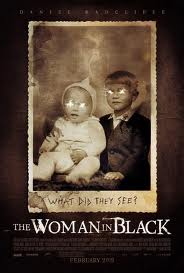
THE SHOWBUZZDAILY REVIEW: "The Woman In Black"


THE WOMAN IN BLACK:  Watch It At Home - Fun, But Creaky As Its Doors


THE WOMAN IN BLACK is so aggressively old-fashioned it sometimes feels like the horror movie version of The Artist.  A haunted house story in the grand style, it may be in color and wide-screen, but its heart is with the black-and-white thrillers of an earlier age, and at a time when the genre seems interested in little more than shock-therapy soundtracks and extreme gore, its restraint can be charming. 


Jane Goldman's script (she's co-written most of Matthew Vaughn's movies, including Stardust, Kick-Ass and X-Men:  First Class), based on Susan Hill's novel, is set early in the 20th century, in a remote English village where the lady of the local great house has died.  London solicitor Arthur Kipps (Daniel Radcliffe, in his first significant post-Harry Potter role) is sent down to go through the dead woman's papers and set her estate in order.  Arthur is himself something of a wreck--his wife died in childbirth, and his grief threatens to estrange him from his young son.  

His troubles, of course, have only started.  Just about everyone in town makes it clear they don't want him there, he begins to learn about the dreadful secrets of the house's inhabitants, and when he insists on entering the old place to do his job, it turns out to be very much on the creepy side.  You name it:  locked doors that unexpectedly open, rocking chairs that rock intensely without anyone being seated, a very insistently loud crow, jnexplicable faces at the windows, and wouldn't you know it, a mysterious Woman In Black who appears in the family cemetery and then everywhere else.  Meanwhile, something terrible is starting to happen to the children in town.  

Director James Watkins embraces every creak, thump and roar of the old house, sometimes to a fault.  If you've ever seen a horror movie before, the long-silence-then-boo! moments become all too obvious and predictable when they're repeated a dozen times.  And although it's a time-honored cliche to have the protagonist wander alone through the thickly silent darkness of the haunted abode, that trope is also used here to the point of self-parody.  The movie could have used some modicum of a sense of humor, and a few more people on hand besides Radcliffe and Ciaran Hinds and Janet McTeer as a couple with very different views about the supernatural.  

Nevertheless, for the most part the movie works in its retro way.  Radcliffe proves he can hold the camera without spectacles, wand or forehead scar, and he's convincing as a young father.  The production design of the house and town (by Kaye Quinn) and the superbly atmospheric photography (by Tim Maurice-Jones) are marvelously dank, although Marco Beltrami's score is disappointingly obvious.  And the script has a few surprises in the late going, even if the final one is more fantasy than horror.  

The Woman In Black is one of the first new pictures made by the revivified Hammer studio, a new version of the company that produced many of the Christopher Lee and Peter Cushing British horror classics of the 1950s-60s.  Like it's forebears, it's a a solidly fun piece of unpretentious entertainment.

  • Digg
  • Del.icio.us
  • StumbleUpon
  • Reddit
  • RSS

SHOWBUZZDAILY @ SUNDANCE REVIEW: "The Pact"


It takes about an hour, but Nicholas McCarthy's THE PACT, which premiered in the Park City At Midnight section at Sundance, eventually turns out to have a neat twist up its sleeve, one that switches the movie from haunted house horror to an entirely different subgenre of thriller.  And after that, a solid reel or so of scares and suspense kicks in, and the picture moves into another gear.

The question will be whether that's enough, given that the hour preceding the twist has been an exceedingly routine low-budget chiller, and that the ending afterward is a cruddy, obvious cheap-shock coda. 


The Pact is McCarthy's first feature, expanded from a short that previously screened at Sundance.  It's set mostly in and around a house where a single mother (of the sadistic variety, not the noble, self-sacrificing kind) raised 2 daughters, both of whom left town as soon as they were old enough.  When the story begins, mom has recently died, and a prologue mysteriously dispatches the older sister, herself a (much better) single mother, while having an ill-fated Skype session with her young daughter.  (This year's Sundance lesson of both The Pact and V/H/S:  stay away from Skype.)  This brings biker sister Annie (Caity Lotz) somewhat reluctantly to town, less to attend her mother's funeral than to find out what happened to her older sister.  We're immediately plunged into the world of inexplicable sounds, disquieting nightmares, unseen forces that fling our heroine against the walls, and shadowy was-that-really-there? figures.

All of this comes right out of the haunted house movie textbook, and McCarthy isn't a skilled enough filmmaker to hide the lack of production values.  Instead we get the usual silences leading to sudden musical and sonic zings, many lightbulbs that flare and then burst, and ghostly visitations.  Even lay-up set-pieces like the visit of an eccentric psychic (who Annie, in an unlikely development, knew in high school), offer minimal fun.  With the exception of Lotz (she played the niece of Don Draper's California "wife" on Mad Men), who has plenty of charisma as the Ripley-like Annie, the acting is for the most part wooden and subpar.

And then The Pact zigs when you expect it to zag, and McCarthy suddenly gets his directing feet under him for a few minutes.  It builds a lot of goodwill... which he then squanders with his dumb, predictable epilogue.  This leaves The Pact as a severely mixed bag, one that has its jolting moments, but doesn't deliver consistently or professionally enough to justify its festival berth.
 

  • Digg
  • Del.icio.us
  • StumbleUpon
  • Reddit
  • RSS

SHOWBUZZDAILY @ SUNDANCE REVIEW: "V/H/S"


V/H/S, which screened as part of Sundance's Park City At Midnight series, is a gimmick piled upon a gimmick.

First is the horror anthology itself, familiar from the Twilight Zone movie and Rod Serling's Night Gallery TV show, among many others.  In this case, half a dozen unrelated short films, each from a different director, are presented as an omnibus film.  The additional gimmick is that all the stories are variations of the "found footage" horror subgenre that kicked off with The Blair Witch Project and became a franchise with Paranormal Activity.  The connective tissue (so to speak) of the movie is a loose story (directed by Adam Wingard) about a group of thieves hired to steal a mysterious VHS tape from a house; to no one's surprise except theirs, as various members of the gang settle down to watch the videos, they're slaughtered one by one. 


There was a fair amount of imagination put to finding different excuses for the "found footage" to exist.  In one story, directed by David Bruckner, the camera is embedded in a pair of spy eyeglasses worn by one of a trio of frat-boy idiots who are on the hunt for sex--and we all know how well that ends in movies like this.  Another mini-movie (direcred by Joe Swanberg and Simon Barrett), is entirely in the form of Skype chats.  Another, set in the 1990s, and directed by Ti West (House of the Dead), the closest thing to a "name" director in the group, is composed of "home movies" from a second honeymoon that goes wrong.  There is, of course, a slasher-in-the-woods story, directed by Glenn McQuaid.  And in what is probably the most elaborate of the chapters, directed by the collective known as Radio Silence (Matt Bettinelli-Olpin, Chad Villella, Justin Martinez, Tyler Gillett), another group of morons is unwise enough to spend Halloween night at a "haunted house" party that lives up to its name. 

There are certainly some shocks and enjoyably gruesome violence to be had along the way (the picture will probably have to go out unrated or be edited to avoid an NC-17 in its current form), but the project inevitably suffers from a serious case of diminishing returns.  Because of the stylistic homogeneity imposed on the anthology, chapter after chapter features the same mannerisms:  shaky hand-held (or head-held, in the case of the eyeglass camera) visuals, sudden cuts to blue when the "VHS" picture goes out, staticky interference as supernatural events are captured on tape.  The most controlled chapters are West's and Swanberg/Barrett's, but theirs also have the dumbest stories with the worst endings; the rest are mostly just exercises in watching people wander around for 10 minutes or so and then get hacked apart.  

There are no characters to speak of in any of this, little of what one would call "acting," and certainly no memorable dialogue.  By definition the production values are low-rent.  So V/H/S just exists as a vehicle for gore and creatures jumping out of the shaky, hand-held dark, and 116 minutes of that is far more than anyone who isn't an obsessive could need.

  • Digg
  • Del.icio.us
  • StumbleUpon
  • Reddit
  • RSS

THE SKED'S MIDSEASON RETURN: "The Vampire Diaries"


CW's biggest only hit THE VAMPIRE DIARIES returned to the schedule.

WHERE WE LEFT OFF:  The painstakingly-mounted plot to once and for all kill Original Vampire Klaus (Joseph Morgan) failed when Stefan (Paul Wesley), realizing that Klaus had rigged things so that if any harm came to him, Stefan's brother Damon (Ian Somerholder) would be murdered by Klaus's army of half-vampire, half-werewolf, virtually unkillable (you have to pull out their hearts and chop off their heads) hybrids.  Klaus, having been saved, freed Stefan from his Compelled loyalty, and Stefan promptly stole Klaus's entire semi-dead family in their coffins, where they'd been waiting for Klaus to eventually bring them back from the dead.  If Klaus hurt Stefan's true love Elena (Nina Dobrev) or anyone else, Stefan threatened, he'd destroy all the relatives.  Meanwhile, Elena let Klaus's sister Rebekah (Claire Holt) know that Klaus had, hundreds of years before, killed their mother, then stabbed Rebekah with the same kind of magic knife Klaus had used on everyone else in the family,  temporarily killing her.  Whew!

WHERE WE ARE: The midseason premiere of Kevin Williamson's series was a somewhat unusual episode, but all, as it turned out, for the good:  at least for now, the series got rid of its single drippiest character, Elena's little brother Jeremy (Steven R. McQueen).  Jeremy just didn't figure into the "This is insane, but what the hell" spirit the rest of the characters have, and the show never really knew what to do with him--he was involved with witch Bonnie (Kat Graham), he fell for a ghost, he was constantly narrowly escaping death, Elena had to worry about him all the time, and basically he was an appendage and an annoyance.  Now he's been Compelled by Damon to move to Denver and date live girls, and he should live and be well.

The other major event of the episode, for those particular shippers, was what appeared to be a major Damon/Elena kiss, which will surely have repercussions down the road, as Stefan seems too consumed for now by his deal with the witch spirits to hide the coffins from Klaus to have much time for romance.  Thinking of romance, Alaric (Matthew Davis), recovering from one of his now-you're-dead-now-you're-not experiences, met a comely doctor we seem sure to be seeing more of down the road.

All of these events meant that the episode had little time for other characters--charming vampire Caroline (Candice Accola) didn't appear at all.  Disappointingly, although Elena made a deal with Klaus to give Rebekah back in exchange for Jeremy's safety, Klaus instantly re-killed Rebekah, since he knew that because she was now aware he was guilty of matricide, she'd be trying to kill him as soon as she regained consciousness.  But now that all this narrative shoe leather has been laid down, next week the show should be back to its usual speedy form.

Vampire Diaries obviously suffers from content restrictions that True Blood doesn't have to worry about (one can only imagine how that hybrid decapitation would have been lovingly detailed on HBO), but its plotting and wit are often superior to the more celebrated show.  (Come on:  half-vampire, half-werewolf, unkillable hybrids?!?)  Diaries hits the right tone of wry humor mixed with deadly serious storylines, and while it's not anywhere near the pantheon of Buffy as high school comedy-horror goes, it's consistently entertaining in a way most broadcast dramas can only envy.

In the ratings, Diaries is American Idol by CW's terms, and even though it's down a bit from last year's average, that still leaves it the 600-pound gorilla of the network's schedule.  As long as the series can stay as inventive and amusing as it's managed so far, it deserves to be invited into America's households to continue its undead reign.

  • Digg
  • Del.icio.us
  • StumbleUpon
  • Reddit
  • RSS

THE SKED'S MIDSEASON RETURN: "The Secret Circle"


After a hiatus so long that it seemed as though CW had found its own witchcraft to create more repeats of THE SECRET CIRCLE than there'd been original episodes to start, the series finally returned to original episodes.

WHERE WE LEFT OFF:  The major revelation of the fall finale was that heroine Cassie (Britt Robertson) wasn't just a member of the titular coven through the powers she'd gotten from her mother--she had also inherited "dark magic" powers from her mysterious dad.  Also (hunky) witch/witchhunter Jake (Chris Zylka) betrayed his fellow hunters to rescue Cassie from their clutches, and rode off on their boat to an uncertain future.


WHERE WE ARE:  The midseason premiere was a surprisingly self-contained hour.  Mostly it concerned the arrival of Diana (Shelley Hennig)'s grandmother played by Stepfanie Kramer (I'll pass over how old the fact that Stepfanie Kramer is playing grandmas makes me feel).  After Cassie almost killed (hunky) Adam (Thomas Dekker) out of pique, Granny confirmed that Cassie's dark powers come from an evil place--her dad was apparently much the Anakin Skywalker type--and lured Cassie to the woods to "cure" her of her evil potential.  It seemed like she was trying to murder the girl, but subsequent dialogue indicated that it was some kind of test, and the fact that Cassie lived meant she could be a force for good or evil.  This plot didn't tell us much we hadn't already guessed, but it had one good moment, with Cassie going all Kill Bill as she decisively escaped from being buried alive by Granny.

In the B story, the show increased its hunk quotient by adding a voodoo expert for Mean Witch Faye (Phoebe Tonkin) to exchange banter with as she tried to get power to perform spells without the rest of the Circle--doubtless we'll be seeing more of him.  (And of Jake, revealed at the episode's close to be done with his sea voyage.)

Although Secret Circle has Kevin Williamson as an Executive Producer, he's not the showrunner, and the show is far inferior to Williamson's own Vampire Diaries, lacking the self-aware wit and intricate plotting of that show.  Secret Circle is very much a 90210-level horror teenfest, with a cast that can't bring much shading to their bland roles.  Still, with Diaries as lead-in, Circle is CW's 2d-highest rated series, and considering how badly the rest of its schedule is slumping, the show is almost certain to be back for a 2d season.

  • Digg
  • Del.icio.us
  • StumbleUpon
  • Reddit
  • RSS

THE BIJOU REVIEW: "The Twilight Saga - Breaking Dawn Part 1"


THE TWILIGHT SAGA - BREAKING DAWN PART 1:  Watch It At Home - The Saga Sags In Slow Prelude To The End

The worldwide phenomenon that is Twilight often finds itself compared to Harry Potter, and for obvious reasons:  both are multi-film, multi-billion dollar franchises aimed at young audiences and telling a single continuous story.  The two series, however, are more different than they are similar:  even leaving aside evident disparities in quality, the Potter films, like J. K. Rowling's novels, are crammed with plot, character and mythology, such that when Warners made the decision to split the final Potter novel into 2 feature-length films, the only disappointment was that even with 4 1/2 hours of screen time, there was still plenty in the book that had to be left out.


This appears not to have been the case with Stephenie Meyer's final Twilight novel, because until things liven up in the last half hour or so, BREAKING DAWN PART 1 is a long, slow slog through the romantic lives of everyone's favorite supernatural threesome, Bella, Edward and Jacob (in case names are needed, respectively Kristen Stewart, Robert Pattinson and Taylor Lautner).  The first half of the movie is almost exclusively concerned with the marriage and honeymoon of the Cullens, as Bella continues to practically vibrate in her impatience for vampiric sex and Edward continues to put off her loss of virginity for as long as inhumanly possible.  Finally he gives in on the private island where the two are honeymooning, and while the PG-13 rating doesn't permit us to see more than a tiny bit of what happens, the indications are that he just barely manages to restrain himself from killing her in the act--much, by the way, to her satisfaction.

A great deal has been written, of course, about Meyer's metaphoric treatment of virginity and her equivalence in the novels of premarital sex with death, and Breaking Dawn 1 makes that even more uncomfortable, mixing in implications of rough sex that results in Bella being covered in bruises that only leave her hungry for more (the kind of bruises that disappear entirely, to be sure, once Bella wants to don a sexy negligee).  Then we move on to a weird anti-abortion screed, as Bella instantly becomes supernaturally pregnant, and refuses to end the pregnancy despite the fact that the demon child is literally eating her alive from the inside.  (Even though she's not a vampire herself, Bella has to drink human blood to keep the little fetus--baby, an apparently pro-life vampire insistently corrects another--happy.)  But however disquieting this particular story's messages may be, the fact is that the horror genre will always be a landing place for queasy allegory, as everything from David Cronenberg's films to American Horror Story can testify.

Once Edward and Bella hurry home to tend to her dangerous pregnancy, we get the return of the fifth-est wheel in all supernatural romance:  Jacob the werewolf, who alternates between scowling and swearing undying loyalty to Bella even though she's rejected him an infinite number of times.  There's also way more about the werewolf code and pack politics than we could possibly need.  Meanwhile Kristen Stewart convincingly looks emaciated, while her vampire family hovers around with concerned expressions.  (Why is it, incidentally, that only Peter Facinelli's Carlisle has the complexion of Casper the Friendly Ghost?)  It isn't until Demon Baby is born (almost entirely off-screen, again presumably to avoid an R rating) that things spark with a little excitement before the finale's end of Act 1 of the story.

As a movie, Breaking Dawn 1 is better than the last chapter of the saga, but not as compelling as the original Twilight.  Bill Condon is known best these days as director of the classy Dreamgirls and Kinsey, but his early low-budget movies were in the horror genre, and even his biography of James Whale, Gods and Monsters, had genre sequences.  Aside from a few fun nightmare bits, though, he doesn't bring much personality to the film.  He's hindered by the plodding script (the adaptation, as always, is by Melissa Rosenberg), the need for a PG-13 rating and the format and styles that had already been set in place--Condon was presumably in no position to change the cruddy CG look of the werewolves.  One would like to think he wasn't responsible for some of the movie's truly terrible ideas, like a conversation among the werewolves played out in voice-over that's like a scene from a bad DreamWorks Animation flick (the audience laughed out loud at it), or the changes taking place in one character's body conveyed by CSI-type sequences of the camera zooming along CG veins and ganglia. 

Another difference between the Twilight and Harry Potter series is that the actors here haven't found anything new or deeper in their characters as their stories have continued.  Stewart is less mannered than she was early in the series--not so much stuttering or hair twisting--and is the best of them, but Bella still has little to do beyond casting looks of yearning, emotional agony and grim determination.  Pattinson is so much a pretty-boy that when the movie revealed that his sexual savagery had caused physical injury, the audience laughed once again.  And Lautner just plain can't act very well.  The supporting cast, virtually all of them back from previous installments, do what they'd done before, although it's odd now to see Anna Kendrick, a bona-fide leading lady in 50/50, reduced to playing a wisecracking high schooler again.  (Incidentally, for those who miss some of the most high camp characters of the entire saga, be sure to stay for a coda scene in the middle of the end credits.)

The Twilight franchise has also never had the visual or technical wizardry (sorry) of the Potter films.  Breaking Dawn 1 is glossily shot by Guillermo Navarro (his previous work includes Pan's Labyrinth), but its sets often look like they're shot on soundstages, much of the CG is second-rate, and even by the standards of movies aimed at a teen crowd, it has an unusually insipid score of pop songs.

Honestly, though, it doesn't matter much what one says about a Twilight movie:  the picture will doubtless make hundreds of millions of dollars both in the US and overseas, and the series will happily move along to its ultimate  conclusion just about a year from now.  And make no mistake, compared to Jack and Jill, Breaking Dawn 1 is Kurosawa and Gone With the Wind combined.  Audiences who want a satisfying, sexy, scary vampire story, however, would be better of tuning in to The Vampire Diaries on TV instead.


  • Digg
  • Del.icio.us
  • StumbleUpon
  • Reddit
  • RSS

THE SKED REVIEW: "American Horror Story"


AMERICAN HORROR STORY - Wednesdays 10PM on FX - Potential DVR Alert

The first inkling of just how deranged AMERICAN HORROR STORY is going to be comes with one of the early "normal" scenes.  The location isn't the haunted house, so we're away from the girl with Down's Syndrome who tells people they're going to die in there, the brutally murdered identical twins, the body parts and fetuses preserved in jars... I could go on. But at this point in the story, we're at the private high school where teen Violet (Taissa Farmiga, sister of Vera, who played the younger version of her sister in the recent Higher Ground) is merely smoking a cigarette where it's prohibited, and the local mean girls don't approve (one of their grandmas died of lung cancer).  Yet even this scene is staged with such intense, hyped-up rage that you might think a massacre is about to take place.  The message is clear:  Abandon restraint, all ye who enter here.


"Restraint" isn't a word associated with Ryan Murphy and his co-creator Brian Falchuk in any case (Murphy also directed the pilot)--whatever their strengths and failures, both Nip/Tuck and Glee have been all-in propositions, veering wildly from serious drama to wild perversity often in the course of a single episode.  Letting Murphy and Falchuk loose in the horror area is like granting them a license to kill, mutilate, and generally rampage.  American Horror Story, with its oddly emblematic title ("American" as opposed to what, exactly?  A Portuguese horror story?) embraces all the leeway the genre provides; watching it, you can almost feel Murphy and Falchuk exulting: Where has this genre been all my life?

On the most basic level, American Horror Story has a classic set-up:  the very troubled Harmon family moves from Boston to Los Angeles, where they buy a house with a history of terrible events.  (The gay couple who owned the house previously died in a murder/suicide, and that's just the beginning.)  Vivien (Connie Britton) had suffered an awful late-term miscarriage and hasn't been, psychologically or physically, the same since; after that, her psychiatrist husband Ben (Dylan McDermott) cheated on her with a 21-year old, Vivien walked in on them, and while the couple has remained together, they're completely estranged.  Violet is an outcast who hates LA and cuts herself, but she finds her life livened up when she meets Tate (Evan Peters), one of Ben's patients, who has elaborate fantasies about wreaking Columbine-type vengeance on his schoolmates and is also suicidal.  Plus there's the next-door neighbor Constance (Jessica Lange), mother of the Down's Syndrome woman who "has a way" of getting into the house even when all the doors are locked; Constance has some as-yet unclear involvement with whatever terrors the house contains.

There are many influences here, but the predominant one seems to be The Shining.  Like the novel and especially the Kubrick film, there's the general idea of a family's psychosexual dysfunction being absorbed and amplified by the evil spirits of their dwelling (just as Jack Torrance saw a beautiful, naked woman in place of a rotting corpse, when Ben looks at the elderly housemaid Moira, he doesn't see Frances Conroy, but rather the young, very sexual Alexandra Breckinridge).  More specifically, there's the suggestion that Ben will be coaxed by the house into trying to murder his family, which is apparently what happened to previous owner Larry Harvey (Denis O'Hare).

Luckily for American Horror Story, the genre doesn't require too much in the way of logic, which is typically a weak point for Murphy and his team.  On the other hand, it's very unclear how they're going to sustain this premise beyond a few episodes--after a certain point, there are only so many repellent, terrifying incidents the family can undergo before they'll seem like complete idiots for staying in the house.  For now, though, the show is quite compelling in its crazed way (it certainly isn't dull).  It's also graced by some terrific acting.  Even though Vivien is hardly comparable to Tami Taylor on Friday Night Lights in terms of depth or fullness, Britton brings the same kind of commitment and intelligence to the role, while McDermott, Farmiga, O'Hare, Peters, Conroy and especially Lange offer effective creepiness.

It remains to be seen whether American Horror Story will offer anything beyond superficial scares, let alone a coherent story or meaningful theme.  But the horror genre is, if nothing else, a flexible one, and cheap thrills can be satisfying too, if they're well done.  So far, the show is off to a darkly entertaining start.

  • Digg
  • Del.icio.us
  • StumbleUpon
  • Reddit
  • RSS

THE SKED'S PILOT + 1 REVIEW: "The Secret Circle"


A lot can happen between the creation of a TV pilot in the spring and production of episodes for the regular season:  a writing/producing team is hired, audience focus groups weigh in, networks and studios (which may have had their own turnover in the off-season) give plenty of notes, both helpful and otherwise, and critics begin to rear their ugly heads.  The results can include changes to tone, pace, casting and even story.  Here at THE SKED, we're going to look past the pilots and present reviews of the first regular episodes of this year's new series as well.

Previously... on THE SECRET CIRCLE:  When Cassie Blake (Britt Robertson)'s mother is mysteriously killed, she goes to stay with her grandmother in the picturesque seaside town of Chance Harbor.  There she discovers that she is the sixth, and pivotal, member of a coven of teen witches, who will collectively wield great power if they bind themselves together.  What none of them know is that they're being manipulated by the survivors of the previous generation's coven, who had their powers taken away when something they did caused the deaths of many of the members.  That older coven--which includes the high school principal (Natasha Henstridge)--is responsible for killing Cassie's mother in order to get the girl to town, since the new coven's existence will somehow bring back their elders' powers.


Episode 2:  The biggest problem with The Secret Circle is that The Vampire Diaries exists (and airs as its lead-in), and although both shows are produced by Kevin Williamson and based on books by L.J. Smith, Vampire is infinitely more fun.  Circle is much more of a "teen" show, partly because some of the high school students in Vampire are actually hundred-year old vamps, but more because Vampire early on abandoned all but the barest pretext of teen life and turned to the business of intricately plotted, darkly romantic storytelling.  Vampire also has a flair for killing off just about any character at a moments noticej (not that they always--heh heh--stay dead), making for some genuine suspense, while the victim in tonight's Circle was so obvious that he should have been carrying around his own burial instructions.

In the series' second episode, written by Executive Producers Williamson and Andrew Miller, most of the action involved Cassie's deciding whether or not to join the coven's "binding spell" that would focus their powers but also place them under group control.  After she and designated cute-boy Adam (Thomas Dekker)--naturally another coven member's boyfriend--had adorably made lightbulbs fizzle and explode with their repressed passion for one another, and Mean Witch Diana (Shelley Hennig) almost killed a civilian, Cassie reluctantly agreed to the spell, and its casting ended the episode.

Thus far, Secret Circle is more than a little plodding.  Cassie, as played by Robertson, is all too normal, without any of the snap that Nina Dobrev brings to her heroine Elena in Vampire (even before we knew that Elena had an ingeniously bloodthirsty vampire doppelganger--but I digress).  The villains are a colorless lot, and with their very limited powers--they have to clutch a crystal to be able to cast any spells--they're none too scary.  The show's jokey references to Harry Potter aside, Circle needs a Voldemort--and fast.  

Secret Circle has the most cushioned spot on the CW schedule, with Vampire handing it a lead-in every other show on the network can only envy.  So unless the ratings collapse, it'll have an extended chance to prove itself.  But it's soon going to need sparks beyond the ones from its many shattered lightbulbs if it's to justify its existence.

Original Verdict:  If Nothing Else Is On...

Pilot + 1:  Keep Looking--Something Else Probably IS On

  • Digg
  • Del.icio.us
  • StumbleUpon
  • Reddit
  • RSS

THE BIJOU @ TIFF: "The Moth Diaries"


Mary Harron's career has previously included such fascinatingly transgressive films as I Shot Andy Warhol, American Psycho and The Notorious Bettie Page, which is the only sensible explanation for the inclusion of her new, dreadful sub-CW gothic thriller THE MOTH DIARIES in this year's Toronto Film Festival.


Diaries, which Harron adapted from a (reportedly more nuanced) novel by Rachel Klein, makes the Twilight movies look like high art.  The familiar setting is an all-girls school, which is a refuge for Rebecca (Sarah Bolger) after the suicide of her poet father.  There she has good friends, and is able to relax into her old life.  But inevitably an interloper arrives:  the charismatic, ethereal Ernessa (Lily Cole).  It's never entirely clear what Ernessa really is--she seems to be a cross between a Mean Girl, a ghost and a vampire, and then there are those clusters of moths--but one by one, she starts driving Rebecca's friends away, and Rebecca becomes convinced that she's literally sapping the life from Rebecca's best friend Lucy (Sarah Gadon).  Rebecca tries desperately to convince everyone of Ernessa's evil powers, but--wait for it--no one will believe her!

There's nothing at all wrong with hokum if it's staged well and performed convincingly, but you'd be hard-pressed to recognize Moth Diaries as the work of a veteran filmmaker.  The acting is hit-or-miss:  Bolger is fine as the troubled heroine, but while Lilly Cole has the kind of otherworldly beauty that suits a supernatural being, her line readings are sometimes more stilted than even her character justifies.  Scott Speedman shows up as the only male teacher at the school, in a role that may have had a point (other than providing literary references to "Dracula" and "Carmilla") before the movie was edited, but certainly doesn't now, and most of the other characters are merely types (the girl with the wild hair?  She's the rebel). Presumably Harron was drawn to the material because of its intertwining of relationships among young women with a supernatural element, but in a post-Buffy the Vampire Slayer world, that's hardly an original metaphor, and it's been handled far better elsewhere.  

Moth Diaries has little or no suspense, making for low suspension of disbelief and causing the cliches and coincidences to feel even more obvious.  Whatever the mythology was meant to be, it's so obscure and confusing that even the supposedly shocking moments provoke little more than a confused shrug.  The very fine cinematographer Declan Quinn (Rachel Getting Married, In America) is behind the camera, but there's nothing particularly atmospheric or interesting about the movie's look, and despite an 85-minute running time and action taking place over most of a year, the movie feels slow and listless.

Toronto's film festival shows hundreds of films each year, and there are bound to be a few shambles; Harron, herself a Canadian native, may have gotten a hometown vote from the selection committee.  Her Moth Diaries is best kept under lock and key.

  • Digg
  • Del.icio.us
  • StumbleUpon
  • Reddit
  • RSS

THE BIJOU @ TIFF: Midnight Madness - "The Incident"


As has been reported, there really was an ambulance outside the Ryerson Theatre in Toronto after the midnight premiere of Alexandre Courtes' THE INCIDENT, there to rescue at least one person who had fainted during the movie.  Of course, this may just mean that Toronto Film Festival patrons have delicate sensibilities--an idea supported by the fact that someone also fainted at the premiere of Shame (apparently because of the film's one violent scene, not the sex).  The Incident has some wild violence toward the end, but it's not nearly scary or shocking enough to be a menace to the public health.


The movie is an extremely slow-burning thriller.  It's one of those "based on a true story" things, set in Washington state in the late 1980s, where all 4 members of an aspiring rock band (Rupert Evans, Kenny Doughty, Joseph Kennedy, Richard Brake) work together in the kitchen of an asylum for the criminally insane.  We watch in much too painstaking detail (and even padded out, the picture only runs 85 minutes) as the buddies bicker, cook, plan for their next gig, talk about the menu and the food delivery schedule, and so on.  (We only see the personal life of one of the men, which in movie terms tells you something about how things will go once the violence begins.)  Courtes, working from a script by Jerome Fansten, is careful to show us all the security--the thick plexiglass, multiple locks and sliding metal doors that separate the kitchen, with its sharp objects, ovens and other potential weapons, from the inmates--and the muttering hostility of the patients.

Finally, when we've almost given up on the possibility of seeing people get butchered, a lightning storm fries the asylum's electrical system, and every single inmate instantly becomes a homicidal maniac.  Even here, there are lots of scenes of our heroes plodding down one identical hallway after another, laboriously discovering that the doors are unlocked (except the ones that could get them out) and the guards are being slaughtered.  Finally, in the last reel or so, the lunatics start inventively murdering our heroes, and The Incident offers a few minutes of dirty thrills before it ends.

This is Courtes' film debut after directing a host of music videos, but The Incident doesn't even have the superficial slickness we associate with that kind of work; it's cheap-looking and the gore, while sometimes very graphic, is low-rent.   The movie's been acquired by IFC Midnight, which typically mounts a token theatrical release but concentrates on pay-per-view and cable, and that's probably where this belongs--remember, if you see it on the channel guide, no need to tune in until the last half hour.  And don't worry, it's unlikely you'll need to have the local hospital alerted that an ambulance might be necessary--unless you, too, are a film festival delicate flower.

  • Digg
  • Del.icio.us
  • StumbleUpon
  • Reddit
  • RSS

THE BIJOU @ TIFF: Francis Ford Coppola's "Twixt"

It's anyone's guess why Francis Ford Coppola, at the age of 72, with some enduring cinema classics to his name, would decide to make a movie that's a cross between a David Lynch retread, an old horror cheapie, and a hallucination.  What matters is that the resulting TWIXT is utterly dreadful, the worst film this great director has ever created.


Before the Toronto screening, Coppola said that Twixt is based on a dream he'd had--always a danger sign in itself--from which he'd been woken before reaching the ending.  He's duplicated this all too literally in the film:  hero Hall Baltimore (Val Kilmer) is a third-rate horror novelist determined to dream his next book, but he keeps waking up before reaching the ending.  Baltimore is in the small, menacing town of Swan Valley, flogging his latest novel, when he runs into any number of idiotic and senseless incidents.  A teenager has been killed with a stake in her heart; another (ghost? vampire?) young girl (Elle Fanning) wants to chat; there's a (witch? vampire?) motorcycle gang on the other side of the lake; the crazy sheriff (Bruce Dern) wants to collaborate on a book; and the very talkative ghost of Edgar Allen Poe (Ben Chaplin) is hanging around.  Don't expect any of it to make sense.

Coppola is all over the place here.  He's using music video gimmicks from the 1990s (oooh, black and white with just a chosen few colors in the image!), revisiting Rumble Fish, doing goofs on Apocalypse Now (Kilmer, himself approaching Brando-esque proportions, does a Colonel Kurtz bit when he has writer's block), throwing 3D into a couple of sequences.  The picture seems like a joke, but then Kilmer delivers a highly emotional speech about the death of his child in a boating accident, and one remembers that Coppola's own son died in just such an accident in 1986.  The whole movie makes you wince.

It's impossible to evaluate the acting, because since it's never clear just what Coppola has in mind, one can't tell whether the rampant over-emoting is justified or not.  (The one exception is Fanning, who remains an arresting screen presence even in this farrago.)  Mihai Malaimare Jr, who's been shooting all Coppola's recent films, keeps everything looking low-budget and cruddy--but maybe that was the intention.  Ditto the disjointed editing by Robert Schafer.

Coppola's sort-of comeback, after 10 years of inactivity, is a mystifying one.  Youth Without Youth was a mess, but at least it was a beautiful one; Tetro seemed to be finding its way to something more dramatically compelling.  Twixt, though, would be laughed off a Midnight Madness screen, much less serving as a festival Special Presentation.  Some master filmmakers--Bunuel, Bergman, Kurosawa, recently Woody Allen and Clint Eastwood--retain and even enhance their skills late in their careers. Others, like Billy Wilder, are sad remnants of their old selves.  It's beginning to look, tragically, as though Francis Coppola may be one of the latter.

  • Digg
  • Del.icio.us
  • StumbleUpon
  • Reddit
  • RSS

THE BIJOU REVIEW: "Don't Be Afraid of the Dark"


DON'T BE AFRAID OF THE DARK - Not Even For Free:  No, Really--Don't Be Afraid


FilmDistrict has gone out of its way to identify co-writer/co-producer Guillermo del Toro with DON'T BE AFRAID OF THE DARK, to the extent that from the marketing, one could easily fail to realize that the movie is actually directed by first-timer Troy Nixey.   Fair enough:  del Toro has made it clear that although he's not in the director's chair, this is a passion project for him, a remake of the 1973 ABC TV movie that terrified him when he was young.  However, if del Toro wants the association, he also has to take the blame for a dull and not particularly scary horror B-movie.


There are a couple of critical differences between the movie del Toro's made and the one that frightened him.  For one thing, the ABC thriller was a brisk 73 minutes long, to fit a 90 minute timeslot with commercials.  For another, the protagonist of the TV movie was the adult Kim Darby, playing the wife of a couple that moves into a spooky old house, where Darby starts hearing the voices of... something... that lives in the walls.  In del Toro's version, the heroine is the young girl Sally (Bailee Madison, who was one of Jennifer Aniston's kids in Just Go With It).  Sally is the daughter of architect Alex (Guy Pearce), who is divorced from Sally's mother.  Mom (an unseen presence in the movie) has the child on Adderall and has decided that she can't raise the girl any more, so she's unceremoniously delivered Sally to live with Alex and his interior designer girlfriend Kim (Katie Holmes).  They're restoring an old mansion where something terrible once happened, and soon enough Sally is hearing the voices in the walls, who claim to be her friends.

The movie's focus on young Sally makes Don't Be Afraid feel like a low-grade rip-off of del Toro's own great Pan's Labyrinth (there's a scene of Sally wandering in the maze-like back garden that's like a Pan's outtake).  But where Pan was a brilliant mixture of fantasy, political allegory and terror, Don't Be Afraid has nothing on its mind but haunted-house cliches and cheap scares.  Which is another problem, because Don't Be Afraid has exactly one shock that works, and you've already seen it.  It's in all the trailers, and even the TV spots:  Sally peers deeper and deeper into the covers on her bed, the folds of the blankets moving aside ever so slowly and gradually, until BOO!--a creature jumps into close-up while the soundtrack shrieks.  (There's also one notably gross scene at the very beginning that likely singlehandedly won the picture its R rating.)  That bedcovers bit comes about halfway through the movie, and after that things get even less scary:  once del Toro makes the mistake of actually showing the creatures, (spoiler alert) they look like nothing so much as the pixies unleashed by Kenneth Branagh in the second Harry Potter movie. 

Don't Be Afraid has some of the bells and whistles of old-time haunted mansion movies:  the handyman (Jack Thompson) who knows more than he's saying, the important dinner party that you know won't go well, the crucial materials about the past that have to be tracked down in the local (and oddly luxurious) public library.  Much of this is unintentionally funny, and nothing more so than the mythology of the creatures, when we learn what that is (it's got something to do with a black market for teeth, approved by a Pope).  The letdown extends even to the very end, when the voices of the creatures reveal something that's meant to be far more chilling than it actually is.  

Del Toro is the one who contorted this picture so that it would be reminiscent of Pan's Labyrinth, and it was a bad idea in terms of craftsmanship as well as substance and tone, since the new picture is inferior in every way:  whoever was responsible for the movie's look, whether del Toro or Nixey or a combination, has come up with a production design that looks soundstage-bound and photography that's dank without being creepily enveloping.  The acting is no better.  Pearce seems completely unengaged, and Madison spends the whole movie looking glum and/or fearful.  Holmes is a more engaging presence, and her character had the most possibilities, but there just isn't enough meat in the script for her to have any impact.  

Even leaving behind Pan's Labyrinth or the original TV version of the story, the remade Don't Be Afraid of the Dark doesn't have any of the wit or originality of Insidious, the haunted house movie FilmDistrict released earlier this year to remarkable success.   Guillermo del Toro would have been better off preserving his memories by popping the old movie into his DVD whenever he felt the urge to relive his movie-watching youth.


  • Digg
  • Del.icio.us
  • StumbleUpon
  • Reddit
  • RSS

THE BIJOU REVIEW: "Fright Night"


FRIGHT NIGHT - Watch It At Home:  At Least Farrell Had Fun

The new remake of Tom Holland's 1985 FRIGHT NIGHT has a great set of credentials.  Craig Gillespie, the director, was behind the well-regarded indie Lars and the Real Girl, and has since been house director of United States of Tara for Showtime.  The cast includes Anton Yelchin, about to make a big splash in the wonderful Sundance prize-winner Like Crazy, along with Colin Farrell, the very talented young British actress Imogen Poots, David Tennant, and Gillespie's Tara star Toni Collette.  And most notably, the new script is by Marti Noxon, who cut her--sorry--teeth on the classic Buffy the Vampire Slayer and has since worked on shows like Angel, Mad Men and Grey's Anatomy.


And with all that, mostly it's just another crappy horror movie with a supposed comic edge. Holland's picture (which grossed only $25M in 1985, so this is hardly a grab for the riches of a lucrative franchise) was an arch, even campy black comedy in which Charley (William Ragsdale), obsessed with horror movies and lore, came to realize that his new next door neighbor Jerry (Chris Sarandon) was actually a vampire, and enlisted the services of Peter Vincent (Roddy McDowell), host of the local low-rent, late-night horror TV show, to bring him down.  

That basic outline is still the plot of the remake, but there are quite a few shifts in detail and emphasis.  Most of the changes seem to stem from the idea of resetting the tale from the midwest to Las Vegas, which was a promising concept--a city that truly never sleeps--but because (for budget reasons, no doubt) the movie was actually shot in New Mexico, Vegas as a physical location plays virtually no part in the picture.  This time, Jerry (Farrell) isn't an old-world Dracula type like Sarandon; he's a contemporary douchebag who supposedly works construction on the strip, wearing tight t-shirts--Charley's mom (Collette) and even his girlfriend (Poots) can't help themselves from leering at him.  Peter Vincent (Tennant) is now the star of a campy, but higher-scale, horror-themed stage show at the Hard Rock Hotel.   Meanwhile, Charley (Yelchin) is now more of a post-nerd guy who, for reasons even the movie doesn't understand, has a hot, compassionate girlfriend, and he spends the first part of the movie not believing the vampire story at all, despite the efforts of his former pal Ed (Christopher Mintz-Plasse) to convince him.

You can see how all of this may have pitched well:  in these Jersey Shore days, the idea of a douchebag vampire could have been fun, and Charley, dumping his own friend for the sake of popularity and hovering on the edge of becoming a douche himself, could have been a complex match for Jerry.  In the movie, though, with its imperatives of getting to the 3D bloodshed, very little of this is developed.  Yelchin basically does his best Shia LaBeouf as Charley, and the movie turns into Suburbia with fangs. Farrell has some really good moments as Jerry--he's scary and funny as he preens in front of Collette and Poots, and when he hovers just outside Jerry's doorway, frustrated not to be invited in--but the script betrays him by turning Jerry into a crazy killing machine much too early on.  Tennant livens things up as Peter Vincent (he's basically doing Russell Brand in Get Him to the Greek), although even he can't do much with an extraordinarily clumsy chunk of exposition late in the story that's supposed to explain why he's helping Charley.  Poots, who's given very interesting performances in indie movies like Cracks and Solitary Man, is here just "the girl."  And although Collette grounds her mom character nicely, it's hard to see what she's doing in the movie, other than as a favor to Gillepsie.  

The movie is badly constructed even as a genre piece.  Apart from the sloppy vampire mythology, which introduces a late gadget into the story just to ensure a happy ending, all the set-piece action sequences go on forever, and at 106 minutes, the picture feels 15 minutes too long.  Gillespie has no particular feel for atmosphere or pace beyond the obvious quiet-quiet-quiet-BANG of horror cliches, and the picture is never at all scary.  There's nothing notable about the picture technically, either:  vampire movies aren't really ideal for 3D, since by definition, they tend to take place in the dark and the dim 3D image makes things even murkier; it's hard to tell whether Javier Aguirresarobe's photography ever had any distinction. 

In an era where we're inundated with vampire stories, a new entry in the genre really has to take some chances to make a mark.  (And if it does, as with last year's Let Me In, the audience may reject it.)  Fright Night sounded like it might be one of those, but it's just another late-summer grab for ticket sales, part of the August/September low-budget horror fest.  Next week's entry:  Don't Be Afraid of the Dark.  


  • Digg
  • Del.icio.us
  • StumbleUpon
  • Reddit
  • RSS

THE BIJOU REVIEW: "Final Destination 5"


FINAL DESTINATION 5 - Watch It At Home:  Death Takes No Holiday

There's only one thing worth mentioning in FINAL DESTINATION 5... and it's the one thing I can't talk about.  Let's just say that if you've been a follower of the series all along, the filmmakers (whether it was screenwriter Eric Heisserer or the producers) have come up with an ending so ingeniously satisfying that all things considered, it should mark the end of the franchise--but that would happen only if the movie flops.


Apart from that, Final 5 is more of the same.  You know the drill:  a group of deeply uninteresting characters is on its way to a grisly shared death, when one has a premonition and saves them all at the last moment.  Death, feeling cheated, then eliminates them one by one, mostly by means of lengthy, complicated "accidents" involving ordinary objects, but with a few sudden attacks just to keep the audience on its toes.  In the end, anyone who thought they were safe turns out not to be.  

Final 5, like its immediate predecessor, is in 3D, which means more impalings, spurting blood and flying body parts than usual.  The director, Steven Quale, has worked as a crew member and Assistant Director for years with James Cameron, and while he has no particular sense of visual style or skill with actors, he knows how to make things leap at the camera, and keep things moving (the movie is technically 95 minutes, but that includes extended opening and closing credits sequences).

For those who care about the specifics of the plot, this time the disaster escaped by our leads is a fairly spectacular (if somewhat tacky-looking) bridge collapse, and rather than high school or college students, the survivors are co-workers at an anonymous company.  There's a cute intern who does gymnastics (watch out!), a womanizer who decides to try acupuncture (bad idea!), a cool chick considering Lasik for her bad vision (keep the glasses!), and our hero is an aspiring chef, who doesn't seem to realize that all those blades and cooking oil in a restaurant kitchen can be bad for one's health.  The token authority figures are Courtney B. Vance as a cop--he must have had a mortgage payment due--and Tony Todd in his recurring role as a sinister coroner.  None of the performers have the opportunity to do much acting (their names this time are Nicholas D'Agosto, Emma Bell, David Koechner, Miles Fisher, Ellen Wroe, PJ Byrne, Arlen Escarpeta and Jacqueline MacInnes Wood)--like porn stars, they're basically meat, each one on screen to play his or her part in a particular set-piece.

Final Destination has always been a fairly curious franchise, basically a blackly comic collection of slaughters presented for our amusement--without even a villain who can himself be harmed.  There's never been anything particularly scary or suspenseful about the movies, and even the deaths are so cartoonish that they aren't shocking on any realistic level.   This fifth installment isn't any different--except for that ending.  Have to give them credit for coming up with that.

  • Digg
  • Del.icio.us
  • StumbleUpon
  • Reddit
  • RSS

THE SKED: Limping "Dead"? UPDATED

UPDATE:  Glen Mazzara, who'd been Frank Darabont's #2 on the WALKING DEAD writing staff,  has indeed been appointed to take over showrunning duties.  (Darabont's continued presence, if any, is still being discussed.)  Mazzara has a lot of experience as a writer/producer on shows like Hawthorne, Crash and The Shield, but not as a show creator--and Walking Dead, with only 6 episodes in its first season, is still forming its creative vision.  No doubt all fingers at AMC are firmly in the "crossed" position.

The creator and showrunner of AMC's biggest hit series THE WALKING DEAD has just stepped down from those duties, and may (or may not) be leaving the show entirely.  Frank Darabont, who'd been known before Walking Dead as a feature writer/director (most notably of The Shawshank Redemption and The Green Mile) has stepped down--it appears very suddenly, since he took part in the show's panel at Comic-Con just a few days ago.  The effect of this on the series is unknown at this point--Darabont's #2, Glen Mazzara, is an experienced writer/producer, so he would be the logical choice to take over, but no one ever said TV was logical.  Meanwhile the show continues in production for the October 16 premiere of its second season.

There is without doubt some story behind this, so stay tuned...


  • Digg
  • Del.icio.us
  • StumbleUpon
  • Reddit
  • RSS