RSS
Showing posts with label scifi. Show all posts

THE SKED: "Terra Nova" Becomes Extinct


FOX did what it had to do today, shutting the time-travel portal on TERRA NOVA.  The show (which, because of its CG postproduction, would have needed an early renewal to be ready for air in Fall 2012) was enormously expensive, and its ratings trajectory was steeply downward, ending its run at a level barely over a 2.  Creatively, the series never jelled--too much bad dialogue, not enough dinosaurs--and there was no indication new viewers would have any interest in joining the show in a Season 2.  While there was hope that potential international and ancillary value could make up for low US ratings because FOX's sister studio 20th Century Fox Television produced the series, clearly the studio and network couldn't make the economics work.


The spin is that Terra Nova will now be shopped to other networks, but while its genre could certainly work on a cable network like Syfy or even TNT, there's no way those networks would pay a license fee equal to FOX's for such damaged goods, and unless the studio is willing to take an enormous deficit (in which case, they would have done it for their own network), or there's a way to sharply cut the show's cost, it seems unlikely to find a savior.

Some side notes:  Steven Spielberg is having a productive but not terribly successful season.  THE RIVER is overwhelmingly likely to join Terra Nova on the scrap-heap, UNITED STATES OF TARA was canceled, and apart from the modest cable success FALLING SKIES, that just leaves SMASH, which has a very good chance of renewal, but not because it's a hit in the ratings.  (WAR HORSE and TINTIN haven't given him much joy on the big screen, either.)

And with Terra Nova dead, THE FINDER shipped off to Fridays and ALCATRAZ showing little promise, FOX's only serious chance for a renewed drama this season is TOUCH, if that show can live up to its "special preview" ratings.  And with HOUSE officially nearing its end, the network will clearly be in need of new 1-hours for fall.  Which, in circle of life fashion, is good news for the producers of this development season's drama pilots. 

  • Digg
  • Del.icio.us
  • StumbleUpon
  • Reddit
  • RSS

THE SKED PREMIERING TONIGHT: ABC's "The River"


Disclaimer:  Network pilots now in circulation are not necessarily in the form that will air in the Fall.  Pilots are often reedited and rescored, and in some cases even recast or reshot.  So these critiques shouldn't be taken as full TV pilot reviews, but rather as a guide to the general style and content of the new shows coming your way.

THE RIVER -  Midseason on ABC:  Potential DVR Alert

THE RIVER is a solid sleeper, a pleasurably nerve-rattling B-movie creepfest set on the Amazon.  ABC is holding it for midseason, where at the very least it should stand out from other network arrivals.


As every promo will surely be heralding, The River comes from Steven Spielberg's Amblin production company and producer Oren Peli, of Paranormal Activity fame.  Peli's involvement is more obvious, because the show uses the same "found footage" format as the Paranormal movies, where everything we're watching is supposedly filmed either by the show's characters or surveillance cameras (this illusion only goes so far, unless there's an invisible helicopter around for a few of the shots).  The backstory of the premise is that America's beloved TV explorer Dr Emmet Cole (Bruce Greenwood), who had traveled around the world for 20 years with his wife Tess (Leslie Hope), his son Lincoln (Joe Anderson) and an ever-present camera crew, suddenly decided to head up the Amazon on a small boat without his family.  When the pilot begins, he's been missing for 6 months, and Tess and Lincoln, funded through a TV show to be produced by Cole's sometime partner Clark (Paul Blackthorne), set out in search of him. 

Naturally there are complications:  Lincoln has daddy issues (Emmet may have cared more about his show than his son); Clark may not be trustworthy, and that goes for the group's head of security Brynildson (Thomas Kretschman) too; Lena, the daughter of another missing colleague (Eloise Mumford) knows more than she's saying.  More bothersome, the young daughter (Paula Gaitan) of the boat's engineer (Daniel Zacapa) senses... evil.  And it won't come as a surprise that she's not wrong.  Before too long, the handheld cameras are shorting out, there are weird rustling noises in the trees, and the question becomes:  just what was Emmet Cole looking for?

Peli contributed to the story of The River, but the script is by Michael Green (Heroes) and Michael R. Perry (the TV version of Dead Zone and last summer's oddball Persons Unknown).  They capably deliver some old-fashioned spookiness, and lightly sketch in potential plot and character complications for later episodes.  The pilot is directed by Jaume Collet-Serra, who helmed Unknown with Liam Neeson a few months ago, and had previously done the notably kinky horror movie Orphan (watch out, she's not really an orphan!); those incessantly shaky hand-held cameras can get awfully annoying if overdone, but Collet-Serra keeps it stylistically under control.  Even though a show like this isn't exactly a showcase for actors, Anderson is a strong lead, and Blackthorne a practiced hand at untrustworthiness.  (It appears that we'll mostly see Greenwood in videotapes he's left behind, although presumably that might change.)

The River could easily become unintentional comedy--a couple of episodes too many of people peering off the side of the boat and muttering "What is that?" and the game will be lost.  (At some point, it'll also need to show more of its monsters than the fragmented glimpses we get in the pilot.)  Plus it's a difficult series to schedule, especially on ABC, which now that Lost is gone relies mostly on female-skewing dramas for its one-hours.  If the network and producers can find the right creative and marketing harbors for it, though, this could be a cruise worth taking.

Read more about TV's new shows at THE SKED PILOT REPORT.

  • Digg
  • Del.icio.us
  • StumbleUpon
  • Reddit
  • RSS

THE SKED PILOT REPORT: PREMIERING TONIGHT - "Alcatraz"


Disclaimer:  Network pilots now in circulation are not necessarily in the form that will air in the Fall.  Pilots are often reedited and rescored, and in some cases even recast or reshot.  So these critiques shouldn't be taken as full TV pilot reviews, but rather as a guide to the general style and content of the new shows coming your way.

ALCATRAZ -  Midseason Monday 9PM on FOX:   If Nothing Else Is On...

In this season of paired projects (Grimm and Once Upon A Time, The Playboy Club and Pan Am), it makes sense that we have two series produced by JJ Abrams:  CBS's fall Person Of Interest and FOX's midseason ALCATRAZ.  Of the two, Alcatraz has by far the more potential, but it's a ragged piece of work that'll need quite a bit of improvement before it hits the air.


Alcatraz posits the idea that in 1963, when the Bay Area maximum-security prison was shut down, the inmates were not transferred to other facilities--instead, they vanished off the face of the earth.  The mass disappearance was kept secret by the government, and only now, almost 50 years later, the criminals are beginning to reappear, not having aged a day and on mysterious missions to kill contemporary people for reasons even they don't understand.  Spooky!  And worthy of the co-creator of Lost (Alcatraz is written by Elizabeth Sarnoff, a Lost producer, along with Steven Lilien and Bryan Wynbrandt, both junior writers on Kyle XY).  So far so good.

Alcatraz loses its grip when it tries to build a series structure around the premise.  For the millionth time, we're back in the storyline where a gritty local detective (Sarah Jones as Rebecca Madsen) starts investigating the murder committed by one of the reemerged convicts, and despite being warned off by mysterious federal agent Emerson Hauser (Sam Neill), she doggedly pursues the crime, until she proves herself instrumental in tracking the killer down and by the end of the pilot, she's been added to the task force.  Naturally there's a quirky expert (Jorge Garcia--hi, Hurley!) and a intense techie (Parminder Nagra), and naturally there are vague hints that Rebecca and her uncle (Robert Forster) may have more connection to what's really going on than they realize.  It's all terribly routine, and the rudimentary dialogue doesn't add anything to the pilot's by-the-numbers plotting, not to mention the problem of balancing between the time spent with our heroes and with the guest star villain, who's part time traveler and part cipher.

The casting is also lacking.  Jones is very pretty, but not exactly ideal as an up-from-the-streets cop, while Neill's done this kind of untrustworthy authority figure countless times, most recently in Happy Town and Daybreakers.  Garcia has earned a giant amount of audience goodwill, but they might as well have called his character (a professor who creates his own Alcatraz-themed comic books) Hurley and be done with it.  Nagra, who was a solid part of the latter-year ER ensemble, gets little to do.  In the pilot, none of them mesh into much of an ensemble, and the direction by Danny Cannon, a CBS procedural veteran, has a minimum of visual panache.  

Alcatraz won't air until 2012, when House will move to 8PM on Mondays and the show will take the medical drama's slot, so there's plenty of time for some heavy polishing.  Few new series have as original and enticing a premise as this one; now they just need to find a format and style that will keep the show from feeling like hard time.

Read more about TV's new shows at THE SKED PILOT REPORT.

  • Digg
  • Del.icio.us
  • StumbleUpon
  • Reddit
  • RSS

THE BIJOU REVIEW: "Rise of the Planet of the Apes"


RISE OF THE PLANET OF THE APES - Worth A Ticket:  Simian Power

Although it's positioned as the last big adventure epic of the summer, for most of its length Rupert Wyatt's RISE OF THE PLANET OF THE APES isn't really an action movie.  Somewhat surprisingly, while it establishes an alternative mythology to explain (spoiler alert?) apes taking over the world, the script by Rick Jaffa and Amanda Silver honors the ethos of the original 1968-73 film series and concentrates on (simian) character and story.  Despite some flaws that ultimately catch up with it, the result is one of the more satisfying pictures of the season.


In the new timeline of Rise, it isn't the aftermath of nuclear war that causes the mutation leading to intelligent apes and the downfall of humanity.  Rather, the culprit is that ever-popular bugaboo, genetic tinkering.  Will Rodman (James Franco) works at the multinational pharmaceutical company Gen-Sys, where like many a movie scientist who shouldn't have tampered with nature, he only wants to do good.  Specifically, he's trying to find a cure for Alzheimer's, a malady that hits close to home because it afflicts his music teacher dad (John Lithgow).  Will has come up with a drug that builds healthy cells in the brain, counteracting the effects of the disease, and he's ready to start testing it on chimps (the name of the first test subject is the first of several nods to the original Apes).  Disaster ensues, and the tests are abandoned, but not before Will manages to rescue a chimp baby from the lab and bring it home with him.  That baby, ominously for those who remember Roddy McDowell's second incarnation in the Apes series, is named Caesar, and he's been exposed to the miracle drug.

Since Caesar's brain cells were healthy to begin with, the drug creates even more brain power for the chimp, giving him super-intelligence.  In sequences that won't be the last to echo the recent documentary Project Nim, we follow Caesar over a period of years with Will and his father, living somewhere between a pet and a younger brother.  (Along the way, Will acquires a vet girlfriend, played by Frieda Pinto.)  But of course, Caesar is still an ape, and when Will's father is attacked, and Caesar tries to rescue him, he does so in a way more fit for the jungle than the suburbs.

This leads to the most interesting section of the movie, which is essentially a jailbreak caper:  Caesar is imprisoned in a "shelter" where owner Brian Cox (who starred in Wyatt's indie The Escapist, another prison break picture) and his reliably evil son Tom Felton mistreat the captives, and where Caesar plots his escape.   Caesar, for the first time in his life, is among other apes, and there's very little dialogue; the almost purely visual sequences of Caesar figuring out how to form alliances and strategize the simian power structure are beautifully done.

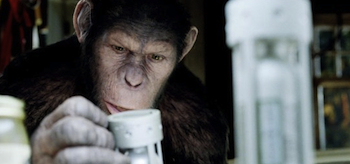
Here's the place to note that, thanks to the new wonders of CG and performance-capture technology, "Caesar" isn't a guy in an ape suit, as in the original Apes films (and in Tim Burton's misbegotten 2001 remake), but a wholly computer-generated creature who interacts with complete believability alongside the human actors.  His performance is created by Andy Serkis, who's previously done this with Gollum in the Lord of the Rings pictures and as Peter Jackson's King Kong.  As in Avatar, the line between "special effect" and "acting" are all but erased here; the eyes and expressions of Caesar look utterly real.

The special effects are a little less effective in the last section of the movie, where crowds of apes are required, and where the conventions of big-budget Hollywood action lead to the apes performing super-simian stunts that look as fake as when CG'd humans perform them in other movies.  This is also where Wyatt's inexperience with big action sequences shows, and where the script starts to falter by becoming more generic popcorn entertainment.  (It doesn't help that there are suddenly advances in Caesar's abilities that seem too abrupt, or that this section is kicked off by one too many salutes to the original Apes, a blunt gag that comes at what should be a critically important point in the story.)

The bigger underlying problem with Apes is that the humans are never remotely as interesting as the simians.  While Caesar is a fully-fledged, complex character, and even the supporting apes have their moments of characterization, Will is completely bland, and Franco does nothing to make him more engaging (I'm not sure Franco is ever going to be a movie star, if that's even what he wants to be); Pinto, Cox, Lithgow, Felton and David Oyelowo as Will's boss have even less to do.  People were never at the center of the Apes series (Charlton Heston aside), but this story is set in the contemporary human world, so it's a more serious shortcoming here.

Glitches aside, Rise is mostly a smart and even soulful entertainment that retains the spirit of its 1960s-70s roots.  It's the rare tentpole movie that makes the idea of sequels seem like a prospect, rather than a chore.  (Thinking of which, don't jump from your seat as soon as the end credits start.)  Franchise of the Planet of the Apes, anyone?

  • Digg
  • Del.icio.us
  • StumbleUpon
  • Reddit
  • RSS

THE BIJOU REVIEW: "Cowboys & Aliens" - Circle the Spaceships!


COWBOYS & ALIENS - Watch It At Home:  Genre Mash-Up Zaps Itself In the Foot

It's admirable, in a way, that for much of its length, COWBOYS AND ALIENS is willing to be more of a western than a scifi extravaganza, even though scifi is a safer commercial bet.  The problem is that as westerns go, it's not all that impressive--and that goes for its otherworldly dimensions too.

The extended development process for Cowboys and Aliens has been much reported.  It was first acquired for the screen 14 years ago, based on a title and pitch for a graphic novel that hadn't even been written yet.  Through the years, the project went through prospective studios, directors, stars and many, many writers.  The final film credits include half a dozen of the latter (Damon Lindelof, Roberto Orci, Alex Kurtzman, Mark Fergus and Hawk Ostley for the script, and the last 2 of those plus original scribe Steve Oederkerk for the story), which in Hollywood means at least twice that many had their hands in it.  Over the years its tone no doubt changed many times, as did the balance between its twin genres.  The ultimate choice for director was Jon Favreau, and the film has a cast of producers to give any studio accountant pause:  Steven Spielberg, Brian Grazer, Ron Howard, Favreau and several of the writers are among those with fingers in the profit pie.  


Despite all those cooks in the kitchen, the film manages to feel all of a piece, but it's a curious piece.  The main creative decision seems to have been to play against the jokey title that was the reason the project was bought in the first place--the movie has precious little humor, and never plays western conventions against the aliens-from-outer-space genre in any kind of entertaining, let alone provocative or ingenious, way.  Instead, it trots out as many western cliches as a TCM theme night:  we have a Man With No Name (Daniel Craig, eventually revealed to be Jake Lonergan) who rides into a town dominated by all-powerful cattle baron Dolarhyde (Harrison Ford) and his sadistic drunken son Percy (Paul Dano).  Dolarhyde's chief aide is a Native American (Adam Beach) who's a much better man than Percy, but Dolarhyde won't recognize that.  In town, Percy makes trouble for the sheriff (Keith Carradine) and the tenderfoot saloon owner called Doc because he wears glasses (Sam Rockwell); Doc also has a Latina wife (Ana de la Reguera).  There's also a tough but kind preacher (Clancy Brown) and a boy determined to fight with the men (Noah Ringer)Finally, the town has a gorgeous woman of mystery named Ella (Olivia Wilde).  

The story doesn't do anything with those cliches other than plopping spaceships down beside them.  It begins when Jake finds himself jerked awake in an empty expanse of wilderness; he has almost complete amnesia, and a curious metal bracelet around one arm.  As soon as he reaches town, of course, he antagonizes Percy, which brings Dolarhyde into his life--which is when the alien spaceships attack, taking much of the cast captive for nefarious purposes, and Jake discovers that the bracelet is actually a weapon that can shoot down the ships.  He, Dolarhyde, and most of the surviving town (and eventually some Apaches and outlaws) have to join forces to track down the prisoners and stop the aliens.

This form of Cowboys and Aliens must have satisfied the battalions of studio executives and producers who had to sign off on it, and why not--it's entirely predictable, made up of pieces of better movies.  Memorable westerns, though, stay in our minds not so much because of their shootouts as the characters and tone, and that's the case whether the films are John Ford classics, dark, latter-day Clint Eastwood dramas or last year's Coen Brothers' snappy remake of True Grit.  Even a Sergio Leone epic like The Good, the Bad and the Ugly, with all its striking imagery, is built in great part around the iconic performances of Eastwood, Eli Wallach and Lee Van Cleef.

There's nothing comparable in Cowboys and Aliens.  Craig is a perfectly functional hero, but the fact that he's amnesic forces him to be fairly blank for most of the story.  Ford, of course, has an iconic screen presence of his own, and he manages a few pungent scenes, but there's little to his character, in large part because Favreau and the writers don't have the nerve to keep Dolarhyde a bad guy for very long.  Olivia Wilde's performance makes sense once her Ella is fully explained, but that doesn't make the character more satisfying.  The rest of the strong supporting cast mostly fades into the background--even Sam Rockwell, for whom the word "irrepressible" is usually apt.  

This was a film that badly needed a visual stylist as director, and although Favreau has genuine strengths as a filmmaker, that's not one of them.  The Iron Man movies have splashy special effects, but they work because of the sharp, witty dialogue and the comic license Favreau gives Robert Downey Jr and the rest of the cast.  None of that comes into play here, and Favreau's western landscapes and alien action sequences all look pretty dull, even with the great Matthew Libatique (Black Swan and Inside Man, among others) behind the camera.  Harry Gregson-Williams' score is routine, and the CG aliens and spaceships break no new ground.

Cowboys and Aliens earns some goodwill, because it does mark a change from the superheroes and genetically gifted teens who inhabit our fantasy films these days.  Unfortunately, while it puts on a moderately entertaining show, its only clear accomplishment is wasting a very cool title.

  • Digg
  • Del.icio.us
  • StumbleUpon
  • Reddit
  • RSS

THE BIJOU REVIEW: "Another Earth" - Deep Space


ANOTHER EARTH - Worth A Ticket:  Tiny Story With Big Ambitions
 
For ANOTHER EARTH, the Sundance Film Festival went exactly the way it's supposed to.  The low-key picture was made on a miniscule budget (a few hundred thousand dollars) by complete unknowns, director/cinematographer/editor/co-writer/co-producer Mike Cahill and star/co-writer/co-producer Brit Marling, with far less buzz than many of the other titles at the festival, but by the time Park City emptied out, it had won a Festival award and something more valuable:  a US distribution deal through Fox Searchlight.  (Marling had an even better week:  another movie she starred in, co-wrote and co-produced, Sound of My Voice, was also acquired by Searchlight and will be opening soon.) 


Another Earth became a festival darling because it takes a lot of typical Sundance elements--a quest for personal redemption mixed with troubled romance and much contemplation of fate--and gives them an original, unexpected sci-fi bounce.  Marling plays Rhoda, a gifted science student who does something horribly careless the night she finds out that she's gotten into MIT, something that changes her life forever.  It also changes the life of John (William Mapother, perhaps best known as Ethan on Lost).  Some years later, Rhoda tries to apologize to John, who now lives a secluded existence far from others, but she can't quite make herself do it; instead, she becomes part of his life by pretending to be from his housekeeping service.  The two become increasingly close, but of course her secret will ultimately have to come out.

So far, so indie film.  What makes Another Earth different is that its title is (among other things) quite literal:  as all these events are transpiring, the world has discovered that a parallel planet to Earth exists, and is drawing closer to this one.  Communication is established between the planets, and travel to the second Earth is going to begin.  There is the revelation (mild spoiler alert--it's in the trailer) that at least to some extent, the new planet is a duplicate of ours, even including the people who inhabit it.  On a thematic level, this underscores the movie's exploration of the possibility of new beginnings, and the question of whether the lives we lead are in fact our destinies.  

Cahill and Marling do a marvelous job balancing the personal story of Rhoda and John with the (extremely low-tech) fantasy plot, culminating in an ending that manages to be satisfying even as it makes one hope for a sequel.  Another Earth is both emotionally involving and intellectually provocative, a neat trick even for filmmakers who have lots of extra zeroes on their production budgets.  Cahill provides evocative photography, and there's effective music by the group Fall On Your Sword.  The sparing special effects are lyrical, and despite the tiny budget, there's a terrifically executed trick sequence in the first reel. 

Wearing her acting hat, Marling gives a lovely performance as Rhoda, torn between guilt and yearning; Mapother, who's often played negative characters in the past (he was In the Bedroom's terrible ex-husband) does a fine job with a far more rounded role.  The story of the two of them could have been a satisfying film by itself; the added layer of speculative fiction makes it more than that.

Another Earth has some of the flaws familiar in low-budget indie films--metaphoric details (Rhoda works with a wise, disabled Indian man) are obvious, there are awkward stretches of concentrated moodiness.  But the picture works, and it identifies potentially major new talents.  That's a lot to accomplish with little more than dreams as overhead.
.

  • Digg
  • Del.icio.us
  • StumbleUpon
  • Reddit
  • RSS

THE BIJOU REVIEW: "Transformers: Dark of the Moon" - Toy Story 3


TRANSFORMERS:  DARK OF THE MOON - Worth A Ticket - But Only If You Insist On Seeing It

This is what gives ulcers to control freak movie directors:  despite Michael Bay's well-publicized orders to theater projectionists, at tonight's premiere IMAX showing of TRANSFORMERS:  DARK OF THE MOON in West Los Angeles, the 3D system imploded an hour into the film and was never fixed, causing the rest of the picture to be projected in a mere 2 dimensions. 

As much as I would have liked to see the entire film as the director intended, there's something reassuringly karmic about Michael Bay being betrayed by his own technology, since that's ultimately all he's got.  Transformers 3 isn't suspenseful or surprising, and it isn't even exciting, really; what it is, is Big.  Fantastically, impossibly, spectacularly Big.  And Big is one of the things movies do better than any other form of entertainment.  No medium can so convincingly create the illusion of seeing and experiencing a reality that couldn't exist.  So Transformers 3, if it's to be seen, should by all means be caught on the biggest theater screen, with the loudest sound system, by means of 3D technology that actually works.


This third installment in the fabulously successful Transformers franchise ($700M worldwide gross for the first movie, $835M for the second) is easily the best, which is faint praise but nonetheless earned.  The stupid comedy scenes have been minimized (although Ken Jeong is briefly around to remind us why), Kevin Dunn and Julie White as the parents of Sam Witwicky (Shia LaBouef) are barely around, the plot (script by Ehren Kruger) is more or less comprehensible, and Bay's action sequences have a geographical coherence they've lacked in the past.  More to the point, unlike Pirates of the Caribbean 4, Green Lantern, Thor or any of the other summer action blockbusters except X Men First Class (which is on a far smaller scale), Transformers 3 delivers the set-piece goods, one giant scene after another of massive machines blowing up buildings, people, entire cities, and each other.

None of this makes the picture "good," exactly.  Kruger's script may be an improvement over its predecessors, but it takes far too long to get going and I won't even bother to detail what the plot is (something about materials hidden on the moon for the nefarious use of the bad robots), and the dialogue credited to him (which may well have been partly written by others) is for the most part horrible.  The robots themselves are completely uninteresting piles of machinery, some of them good and some bad (and some purportedly cute, which is painful).  Most of the people don't fare much better.  LaBouef has become less appealing with every part he's played, and as his new love interest, Rosie Huntington-Whiteley manages the considerable feat of making Megan Fox look like an accomplished actress (in the one scene where she's called upon to do some, you know, acting, she makes Fox look like Meryl Streep); even in the looks department--which is why, let's face it, she was cast in the first place--her gorgeousness is pretty generic.  Patrick Dempsey, Josh Duhamel and Tyrese Gibson are among the others who barely register amidst the carnage.  Luckily, Bay has a few self-starters in the smaller roles:  Frances McDormand, John Turturro, John Malkovich and Alan Tudyk supply some bright moments as they support the more worthy independent work they do. 

But Michael Bay movies aren't about scripts, characters or actors.  So it should be noted that in the hour of 3D that was screened, the quality was exceptionally good, by far the best since Avatar--his insistence on bright projection doesn't just rescue the image from dank blurriness, it eliminates the eye-strain we've all been taking for granted the past year and a half.  The special effects, too, are absolutely top of the line; the presence of those robots on real streets, ripping apart real buildings, is completely convincing.  Amir Mokri's cinematography is crisp and fluid, and even though the movie is inevitably overlong at 154 minutes, the editing by the team of Roger Barton, William Goldenberg and Joel Negron moves things along.  The score by Steve Jablonsky is mostly pounding noise, which is surely what Bay wanted.  

The depressing thing about TransformersDark of the Moon is that it's good enough to guarantee more installments.  Which is also the depressing thing about Michael Bay--he's undeniably talented, and so successful he has no reason to change, but there may never have been a talented filmmaker less interested in humanity or nuance.  On some level, he is Megatron; he wants us under the dictatorial thumb of his overwhelming, unstoppable imagery.  And yet, take some comfort in this:  he can be defeated by as little as a busted 3D projector.

(TRANSFORMERS:  DARK OF THE MOON - Paramount - PG 13 - 154 minutes - Director:  Michael Bay - Script:  Ehren Kruger - Cast:  Shia LaBouef, Rosie Huntington-Whiteley, John Turturro, Josh Duhamel, Frances McDormand, Tyrese Gibson, John Malkovich, Patrick Dempsey, Kevin Dunn, Julie White, Alan Tudyk, Ken Jeong, and Voices of Peter Cullen, Hugo Weaving, Leonard Nimoy - Wide Release)

  • Digg
  • Del.icio.us
  • StumbleUpon
  • Reddit
  • RSS

THE SKED @ CABLE REVIEW: "Falling Skies"


FALLING SKIES - Sundays 10PM on TNT - If Nothing Else Is On...

Or:  how is FALLING SKIES not Terra Nova?  I've raved about FOX's Fall dinosaur spectacle, and here's another Steven Spielberg special-effects extravaganza, centered around a family trying to hold onto its identity and its life in a hair-raising environment--so what's the problem?

One is sheer familiarity.  Other than the Jurassic Park series, we haven't had all that many fantasies about modern-day humans mingling with dinosaurs, so although Terra is obviously heavily indebted to Jurassic, it still feels somewhat fresh.  Falling Skies, on the other hand, is set in the same post-apocalyptic world of The Walking Dead and Jericho, with the same alien invaders as V.  The "mech" robots sent by the aliens to hunt humans are slicker versions of the "toasters" in Battlestar Galactica, and the "skitters," the aliens themselves, have that same vaguely walrusy look we've seen in any number of alien thrillers.


The bigger issue, though is as always the script. Here we have to mention the phenomenon of the 2-hour premiere.  Very often, this marketing "event" is really just a packaging of the original 1-hour pilot with a second episode that may have been produced months later; there can be significant differences between the two, including different writers and directors.  (This may also be the case with Terra Nova, of which I've seen only the first hour--although that one ends with a cliffhanger, which hopefully means more consistency with the initial hour.)  In the case of Falling Skies, the first hour of the premiere was written by Robert Rodat (the show's creator and best known for his script for Spielberg's Saving Private Ryan), and the second hour by Graham Yost (creator of FX's terrific Justified).  Yost's hour is far superior.

The Rodat hour sets out the basic situation:  former history professor Tom Mason (Noah Wyle), his wife killed by the alien invaders, and one of his sons taken hostage in a high-tech version of slavery that involves harnesses injected into the body, is now a soldier, trying to rescue his imprisoned son, watch over his other 2 boys, and also retain some level of humanity.  His commander, and also adversary, is Weaver (Will Patton), a doctrinaire soldier who cares little for civilians; and Tom's friend--and, almost certainly, eventual romantic interest--is doctor Anne Glass (Moon Bloodgood).  There's a lot of windy speech-making about the military's interests versus the general populace, and clumsy exposition (we know Tom is a history teacher because he can't open his mouth without citing some ancient battle or other).

Yost's script is much better, partly because a lot of the background is out of the way, but also because it has action that's tauter and more surprising (although, the series budget having kicked in, there are fewer special effects).  There are also some sharp new characters, notably John Pope (Colin Cunningham), a cunning bandit who threatens to kill Tom, but who (if the show is at all smart) will become one of the good guys. If Falling Skies can continue along this path, the show may become a better way to waste a summer hour.

The premiere's ratings were good but not sensational:  its 5.9 million total viewers were less than TNT had for its launch of Rizzoli & Isles last year (which was promoted as far less of an event), while its 2 rating in 18-49s was well below the premiere of Walking Dead on AMC.  Still, if these numbers hold up, the network will be quite happy, and with the season's end of Game of Thrones (we have to wait months until it returns!), there's a place on the night for this genre.  If the show's second hour is to be trusted, the quality of Falling Skies may be rising, which would be good news for TNT, and for us.  

  • Digg
  • Del.icio.us
  • StumbleUpon
  • Reddit
  • RSS

THE BIJOU REVIEW: "Green Lantern" - Shining Not So Bright


Watch It At Home:  For Fans of Florescent Green

Another summer weekend; another superhero epic.  What used to be an extravagant event genre is now hard-pressed to muster more than a yawn.  What is there to say about GREEN LANTERN?  Well, it's better than January's sophomoric Green Hornet, so at least it's got color war going for it.  Apart from that, not much.

Green Lantern is more a consumer product than a work of creative impulse, so let's look at it from that angle.  For Warner Bros, it's a crucially important property, because their decade-long cash cow franchise Harry Potter is about to expire.  And although next year will bring the sure-thing blockbuster Dark Knight Returns, Christopher Nolan appears to be serious about it being his last Batman movie, and no franchise has ever been so dependent on its director (there's also the reboot of the Superman series, but with Zack Sucker Punch Snyder behind the camera, that's a big question mark).  So the studio desperately needs to generate some serious revenue out of its DC Comics affiliate, especially since the last 2 tries, Watchmen and Jonah Hex, were money pits.  (And competitor Marvel is kicking sand in their face.)

Possibly because of all this commercial pressure, Green Lantern is as impersonal as an adventure can be.  It offers a buffet of attitudes we've seen in other superhero pictures (a little smart-aleck wit from Iron Man, a bit of faux grandeur a la Thor, a touch of romantic fantasy as in Spiderman), without committing to any of them fully.  The result is very busy, but it doesn't arouse much interest, and when the inevitable mid-credits easter egg scene set up the sequel, no one in the audience seemed thrilled about it.

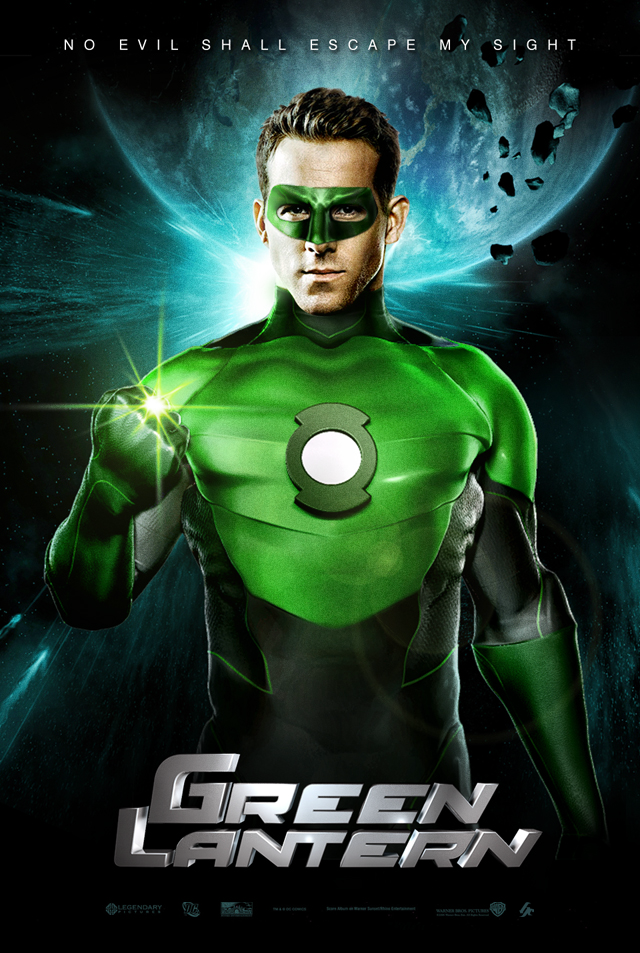
The picture doesn't get off to a bad start:  after the outer space prologue (portentous narration by Oscar winner Geoffrey Rush, introduction of the personification-of-evil enemy creature Parallax), we're introduced to Hal Jordan (Ryan Reynolds), a cocky test pilot who blows mechanized planes out of the sky when he's not bantering through his on-again off-again relationship with heiress Carol Ferris (Blake Lively). Before long, though, since this is an origin story, we're sentenced to the land of endless exposition in the script credited to Greg Berlanti, Michael Green, Marc Guggenheim and Michael Goldenberg.  Hal is given his magic green ring, weapon and insignia of a corps of intergalactic guardians, by an elder warrior (Temeura Morrison) who's in the process of dying from Parallax-inflicted wounds.  Then Hal has to be transported to the planet of the greenies for training by the digitized Rush and Michael Clarke Duncan, and the heavily made-up Mark Strong; Hal is told repeatedly that he's the first human ever to be honored with a ring (the lantern corps apparently isn't subject to civil rights laws).  He learns that the ring's powers are basically limitless, since a ring-bearer can bring into existence anything his will can create.  Meanwhile, a speck of Parallax has found its way into Hector Hammond (Peter Sarsgaard), an old colleague of Hal and Carol and a fairly mad professor to begin with, who's soon transformed into a nutcase with a seriously receding hairline.  Many speeches about tactics, will, fear and responsibility later, the blob that is Parallax shows up for the final confrontation, and we can all go home.

Despite the hundreds of millions of dollars spent to realize all this, and even though the director is Martin Campbell, who did a sensational job with the James Bond reboot Casino Royale, there's scant excitement and more than a little dullness here.  Reynolds is a very lightweight hero--fine when he's flying planes and displaying his romantic-comedy chops, less so when being stouthearted.  Despite all the articles and interviews presenting Lively as a movie star in waiting, nothing she does in Green Lantern suggests a reach beyond Gossip Girl.  Sarsgaard mostly lets his prosthetic devices do his acting, and everyone else who shows up (Tim Robbins as Sarsgaard's senator father, Angela Bassett as a government agent) barely registers.  There are plenty of digital effects, but they have surprisingly little impact.  Partly it's because the things Hal visualizes and thus brings into being all emerge in glowing green (the color of will; if you're decorating, yellow is the color of fear), so none of it looks real, and the same goes for his digitally painted-on suit and mask.  Parallax is an animated lump with a generic "face" that's neither scary nor unique, and the expanses of the various planets we see look like the same CG backdrops that show up in other movies. 

After decades of superhero pictures, we're all a little jaded; the merely spectacular is now routine.  Kids may like this Green Lantern--there are lots of creatures, and objects get thrown about loudly--but for the rest of us, it's merely inoffensive and forgettable.  And we're not done:  a few weeks off for Pixar, Transformers 3, and the last Harry Potter, and then the next superhero to bat will be Captain America.  Be still my heart...

(GREEN LANTERN  Warner Bros - PG 13 - 114 minutes - Director:  Martin Campbell - Script:  Greg Berlanti, Marc Guggenheim, Michael Green, Michael Goldenberg - Cast:  Ryan Reynolds, Blake Lively, Peter Sarsgaard, Tim Robbins, Mark Strong, Angela Bassett - Wide Release)

  • Digg
  • Del.icio.us
  • StumbleUpon
  • Reddit
  • RSS

THE SKED PILOT REPORT: FOX's "Terra Nova"


Disclaimer:  Network pilots now in circulation are not necessarily in the form that will air in the Fall.  Pilots are often reedited and rescored, and in some cases even recast or reshot.  So these critiques shouldn't be taken as full TV pilot reviews, but rather as a guide to the general style and content of the new shows coming your way.

TERRA NOVA -  Monday 8PM on FOX:  Potential DVR Alert

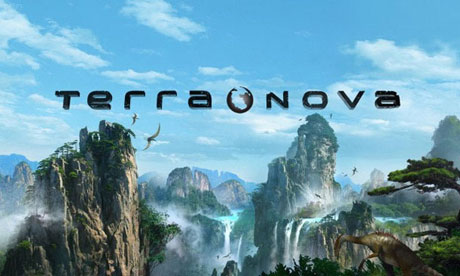
This is--maybe--what a big fat hit looks like.  Maybe, because anything can happen between a pilot and its series, or even between episodes (remember when Heroes came back for Season 2 and suddenly it was terrible?)-- especially, as here, where only the first hour of the 2-hour pilot exists, and even that hour has some temp special effects.  So TERRA NOVA is far from a sure thing.  But it sure has the makings of a show that could hit the mass TV audience right in its sweet spot.


What if Jurassic Park were a housing development?  That's essentially the basis for Terra Nova, although actually the two concepts take place in completely different earthly time frames:  Jurassic imagined the contemporary reanimation of dinosaurs, while in Terra Nova, people of a dystopian future are transported back millions of years to live in the era when dinos were native.  But both projects take place in and around similar-looking complexes built to keep the carnosaurs out, and both, not coincidentally, have Steven Spielberg as wizard in charge.

In classic Spielberg style, the drama rotates around a troubled family:  dad Jim Shannon (Jason O'Mara) was a futuristic Chicago cop whose marriage to scientist Elisabeth (Shelley Conn) was in danger of falling apart when the two of them decided to have a third child, an action forbidden by law; Jim ended up in jail.  But when Elisabeth is recruited with their 2 legal teens (Landon Liboiron and Naomi Scott) for the Terra Nova time-travel project, Jim breaks out of prison to take their youngest (Alana Mansour) with them.  Beyond the dinosaurs and other local threats, the Shannons will continue to have their interpersonal strains.

The script (lots of people worked on it, including Rene Echevarria, Allan Loeb, Brannon Braga, Craig Silverstein and Kelly Marcel--it's not clear yet just who's getting screen credit) isn't smarter than your average Hollywood blockbuster-it's not Game of Thrones, and it's not Battlestar Galactica--but it's cunningly constructed to allow for plenty of potential storylines.  Despite his criminal record, Jim quickly proves his worth to the leader of the community, Nathaniel Taylor (Stephen Lang), and joins his security service; soon Jim discovers there are other settlers from the future trying to sabotage the project.  Meanwhile, there's the Shannons' shaky marriage, their kids' budding romances, giant man-eating beasts, and where did those strange designs outside the Terra Nova walls come from?

Alex Graves, whose credits include the pilot for Fringe, serves as director, and even with temp effects, Terra Nova has the scale and energy of a feature film, with gorgeous cinematography and a huge production design.  (Just what will happen when the show has to deal with inevitably smaller episodic budgets is unclear.)  The cast is capable, with the early standout being Lang, who does a less blatantly evil version of his Avatar role (it won't be much of a surprise if his character turns out to be less than a good guy here, too).  For now, the Shannon family is basically photogenic and personable; there's so much going on in the pilot that we only get a superficial handle on them.

FOX could have paired Terra Nova with their new X-Factor for a superpowered launch, but they have so much confidence in the show that they're letting it kick off their Monday nights as the lead-in to House.  The gamble may pay off; the show has potential to be an "all quadrants" smash, appealing to families, men and women, young and old.  (Mitch Metcalf's Monday projection has it behind ABC's Dancing With the Stars and the How I Met Your Mother/2 Broke Girls combo on CBS, but the show will certainly be hyped by FOX into a major premiere event, and it could be a breakout hit.)   The dinosaur-sized question now is whether they can successfully translate their strong hour into a successful series.

Read more about TV's new shows at THE SKED PILOT REPORT.

  • Digg
  • Del.icio.us
  • StumbleUpon
  • Reddit
  • RSS

COUNTING TO 10: Best Spielbergs


On the occasion of Super 8's release, the Top 10 movies directed by Steven Spielberg:

10. THE SUGARLAND EXPRESS (1974):  His first feature film, it suggests that had he never touched a special effect in his life, Spielberg would still have been a great American filmmaker.  A movie about celebrity and family that moves like a dream and anticipates reality television decades before it existed, it also has the best performance of Goldie Hawn's career.

9.   INDIANA JONES AND THE TEMPLE OF DOOM (1984):  Undoubtedly a controversial choice--it's widely considered the least of the original trilogy (but, I trust, far ahead of the ugly 4th).  And yet, for sheer thrills and insane set-pieces, it's the best of the bunch.

8.   MINORITY REPORT (2002):  Roughly 7/8 of a masterpiece, equal to Blade Runner and A Clockwork Orange in its view of a future civilization, and as prescient as either.  Here, though, his pesky need for happy endings tears the picture apart in the last reel.

7.   SAVING PRIVATE RYAN (1998):  One of the greatest first reels in the history of motion pictures.  Then the plot kicks in, and it's a little less great.  Still, a magnificently made vision of war.

6.   CATCH ME IF YOU CAN (2002):  A master filmmaker at his storytelling peak; it may not have the intensity or thrills of some of his other films, but it's bliss to watch, just about flawless.

5.   MUNICH (2005):  For decades, critics pleaded with Spielberg to make a film about serious, complicated themes that didn't have a happy ending; when he finally did, they wanted him back in blockbusters.  His most underrated film.

4.   CLOSE ENCOUNTERS OF THE THIRD KIND (1977):  Made the same year as Star Wars, a fantasy about other worlds that stayed rooted on this one.  Brilliantly designed, scored, and imagined.

3.   JAWS (1975):  36 years later, when we finally see that shark it's as much a sight gag as it is scary.  And yet the movie remains thrillingly, exhilaratingly, sometimes hilariously exciting.  Imitated countless times and never ever equalled.

2.   E.T. THE EXTRA-TERRESTRIAL (1982):  The quintessential Spielberg movie, able to jerk tears from strong men, yet not manipulative in any cynical way--no one, you feel, is weeping or grinning as much as Spielberg himself.

1.   SCHINDLER'S LIST (1993):  Yes, it's sentimental and can be criticized as the Holocaust movie where almost all the characters survive.  It's also the single greatest scripted account of the supreme event of the 20th Century.  Spielberg earned his accolades and, finally, his Oscar.


  • Digg
  • Del.icio.us
  • StumbleUpon
  • Reddit
  • RSS

THE BIJOU: "SUPER 8" - Spielberg Much?

 
Watch It At Home:  That's MR. Spielberg To You

JJ Abrams' SUPER 8 is the Beatlemania of Steven Spielberg movies.   Abrams is no doubt absolutely genuine in his reverence for classics from the 1970s and 80s like Jaws, Close Encounters, ET, Poltergeist and The Goonies, all produced or directed by the master--Abrams even brought Spielberg himself on as a producer of the movie--but as they said in that very unSpielbergian series The Wire, you come at the king, you best not miss. 

I am exactly the right age to appreciate SUPER 8, which in itself is bad news for Paramount.  I cut school to see Close Encounters on opening day, and stood on line at the Movieland in Times Square for something like 4 hours to see a sneak preview of ET a couple of weeks before it opened.  (Later that summer, there would be a weekend where Spielberg had 3 movies simultaneously in the Top 10:  ET, Poltergeist--which rumor said he'd co-directed as well as produced--and a re-release of Raiders Of the Lost Ark.)  All of this says I'm out of the demo that drives summer blockbusters in 2011, and since Super 8 exists solely to be a feature-length homage to that era, it's a big reason the film has been tracking badly at the weekend boxoffice.  The studio has been desperately trying to raise word of mouth among younger audiences, including promotions with movie geek websites, Twitter and day-long "previews" of the film.

The bigger problem, though, is that great word of mouth requires something like a great film.  Super 8 conscientiously assembles the pieces of a Spielberg movie, but it lacks his essence; Spielberg didn't make his great movies the way that he did because he was trying to be "Spielbergian" (that would come later, in the sad days of Hook and Always), but because it was his vision of the world.  JJ Abrams is trying, not without skill, to dub his voice onto Steven Spielberg's song. 

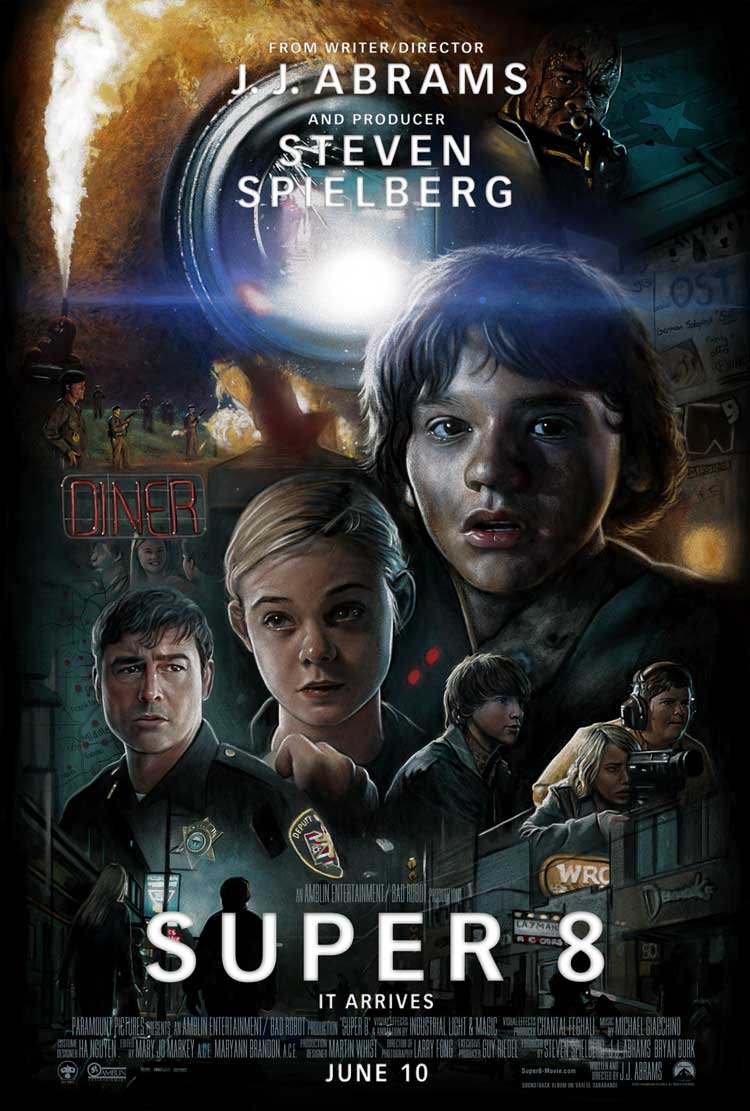
Super 8 is set, of course, in a comfortable small town, where our hero Joe (Joel Courtney) has had his young life touched by a tragedy, the accidental death of his mother.  Joe's deputy sheriff dad (Kyle Chandler) is doing the best he can, but he's too staggered by his own grief to really make contact with Joe.  The boy instead throws himself into helping his friend Charles (Riley Griffiths) make an amateur zombie movie; Joe is in charge of make-up and other technical tasks, while their other friends (Gabriel Basso, Ryan Lee, Zach Mills) provide acting, pyrotechnics and similar necessaries.  Most important, Charles has talked Alice (Elle Fanning) into joining the cast, and she's an ideal first love for Joe, being both beautiful and forbidden (Joe's dad wants nothing to do with her family, because her drunken father contributed to Joe's mother's death).  Of course, Super 8 isn't really about the making of that zombie movie--as all the trailers have made clear, the kids' camera is on when a military train crashes spectacularly outside town, and something... dangerous... gets loose.  

I won't say much more about the story,  both to avoid spoilers and because there's not much to say; in its latter stages, Super 8 owes almost as much to Roger Corman as to Spielberg.  You won't really be surprised when you see what was in that train, or the ways the young filmmakers team up to protect the town.  All through the film, Abrams does everything he can to suggest the look and feel of Spielberg's movies--Larry Fong's photography has the kind of light flares that Allen Daviau provided in ET, Michael Giacchino has composed a lush John Williams-style score (although lacking the tunefulness that make Williams' themes still hummable 30 years later), and so on. 

Sadly, Abrams never manages to measure up to his model.  For one thing, he simply doesn't have Spielberg's genius with objects.  Think of the way the director used the phonograph and toy in the scene in Close Encounters where the aliens take Melinda Dillon's son, or the stuffed animals and candy in ET, or the blank television set in Poltergeist.  You can't copy that kind of instinctive lyricism; you either have it, or--if you aren't Steven Spielberg--you don't.

Even more fundamentally, Abrams isn't interested in his characters as people the way Spielberg has been.  An example:  one of the gifts Abrams has in Super 8 is that Elle Fanning appears to have all the makings of a genuine movie star.  Early on in Super 8, before we really know who Alice is, she plays her first scene in the kids' zombie movie, and she shocks everyone, her fellow filmmakers as well as the audience, by being flat-out brilliant, a naturally talented actress.  This is a fascinating thing to find out about her, and you'd think as the movie goes on, and she becomes a central character, you'd learn more about how she feels about acting, the way it's affecting the way she sees her life.  But you'd be wrong; Abrams finishes the scene and never comes back to the idea.  Compare that to the way Spielberg nurtured Roy Scheider's fear of the water in Jaws, or the relationships between the siblings in ET.  Great filmmakers understand that it's the throwaway bits in big-budget movies that can become the ones we remember most (the scene in Jaws where Robert Shaw crushes a beer can and Richard Dreyfuss does the same with a paper cup is at least as great a moment as anything the shark does). 

Super 8 doesn't come from a bad or cynical place--unlike just about everything else this summer, it was made because of a love of movies, not merchandising revenues.  (Be sure to stay for the closing credits, by the way, which include the homemade zombie movie--one of the best things in the picture.)  And it's not a bad piece of work, certainly not compared to Thor or Pirates 4.  It's been made proficiently and with affection, it's pleasant enough to watch, it has some thrills.  But the one thing it isn't is super.

(SUPER 8 - Paramount - 112 minutes - PG 13 - Director/Script:  JJ Abrams - Cast:  Joel Courtney, Elle Fanning, Kyle Chandler, Ron Eldard, Ryan Griffiths, Ryan Lee, Gabriel Basso, Zach Mills - Wide Release)

  • Digg
  • Del.icio.us
  • StumbleUpon
  • Reddit
  • RSS

"X-MEN FIRST CLASS" - First Class Indeed


Worth A Ticket:  Superheroes Behind the Camera, Too.

The most substantial movie of the summer so far is, depending on how you calculate, the fifth in a comic book series, a prequel or a reboot.  X-MEN:  FIRST CLASS arrives with its own secret weapons, namely a smart script, a well-chosen cast, some genuine thematic ideas, and even historical scale.

The X-Men franchise has had a somewhat bumpy road in Hollywood, at least creatively.  Bryan Singer's initial film in 2000 was a step above most in the genre, and then his follow-up, 2003's X2:  X-Men United was even better, the rare action sequel that wasn't just bigger, but more thoughtful.  Singer left the series in 2006 for his misbegotten Superman Returns, and his place was taken by the terminally unremarkable Brett Ratner on X-Men:  The Last Stand, which was far less interesting (although the most successful at the box-office, with $460M worldwide).  This was followed by Gavin Hood's prequel X-Men Origins:  Wolverine in 2009, a bland star vehicle for Hugh Jackman.  That spinoff series may yet continue (Darren Aronofsky was supposed to direct its sequel but backed out after Black Swan hit); meanwhile Fox and Marvel launched this origin story, which overhauls the entire cast and moves the story back to 1962.


This move emphasizes the unusual moral ambiguity that made the Singer X-Men films so interesting.  (Singer has returned to the series to the extent of sharing a story credit with Sheldon Turner; the script is credited to the team of Ashley Edward Miller and Zack Stentz and director Matthew Vaughn and his writing partner Jane Goldman.)  Singer's films embraced the freakishness of mutant powers as metaphor--most obviously for homosexuality (in one of the movies a teen mutant had to come out to his parents), but more generally for any way in which people were victimized because of their differences from the norm.  (Magneto isn't just Jewish, he's a concentration camp survivor.)  The films also had an explicitly political dimension, as senators and other politicians campaigned for measures oppressing the mutants. 

In First Class, the politics affecting mutants are still in the process of forming.  The story covers the period when the leader of the "hero" mutants, Charles Xavier (James McAvoy), is a friend and ally of Erik Lehnsherr (Michael Fassbender), who will become the villainous Magneto, and the First Class itself, the initial group of young mutants who are tutored by Charles and Erik (they include Jennifer Lawrence, Nicholas Hoult, Caleb Landry Jones, Zoe Kravitz, Alex Gonzalez and Edi Gathegi), are torn between the views of the two men:  some wanting to be assimilated into "normal" society, others seeking revenge for their victimization.  The decision whether to join one or the other is less morally clear-cut than it was in the contemporary stories, because Erik hasn't become a bad guy yet.  This is pretty heady stuff for a genre movie, and it's made even more so by placing the story within the real-life intrigue of the Cuban Missile Crisis. 

Vaughn previously directed the semi-satiric Kick-Ass, but while that picture was done on a limited indie budget, here he's got the resources of a profitable franchise behind him.  First Class looks terrific (the handsome photography is by John Mathieson, and the lush production design by Chris Seagers) and it has the kind of epic globe-trotting sweep we associate with James Bond adventures.  But Vaughn keeps the focus on the characters, and the extremely strong cast (which also includes Rose Byrne and Oliver Platt in smaller roles) delivers.  McAvoy and Lawrence are particularly good, but it's Michael Fassbender who steals the show, absolutely--sorry--magnetic as the movie's antihero center.  

For all this genuine quality, the movie does have one weakness:  the villains.  With Erik one of the good guys in this story, there had to be an adversary, and he's a fairly colorless super-rich world-conquering type named Sebastian Shaw (Kevin Bacon).  Bacon gets off to a solid, disturbing start in the opening sequences, where he makes Erik's acquaintance at the concentration camp, but once he's in the 1960s, his character and even his mutant powers turn generic and only barely worthy of Fassbender's level of hate.  Shaw's henchpeople are Emma Frost (January Jones, looking great in limited clothing and sounding remarkably like Betty Draper), and Azazel (Jason Flemyng), who has some cool-looking CG powers but is the most "comic book" of all the characters, parading around like a cartoon devil, complete with tail.  Bacon and his team feel like a thin pretext for the action, simplistic compared to everyone else.

X-Men:  First Class is so generally strong, though, that even its ordinary villain can't seriously damage it.  At 132 minutes, it zings along with action sequences that don't overwhelm the story and characters that have some meat to them.  Since it ends (spoiler alert, I guess) with Charles and Erik assuming their adult roles of Professor X and Magneto, it's not clear that future entries in the series will be as complex and provocative as this one--but never underestimate a studio motivated to find new facets to a franchise.

(X-MEN:  FIRST CLASS - 20th Century Fox - PG 13 - 132 minutes - Director:  Matthew Vaughn - Script:  Vaughn, Jane Goldman, Ashley Edward Miller, Zack Stentz - Cast:  James McEvoy, Michael Fassbender, Jennifer Lawrence, Rose Byrne, Kevin Bacon, January Jones - Wide Release)

  • Digg
  • Del.icio.us
  • StumbleUpon
  • Reddit
  • RSS