RSS
Showing posts with label green hornet. Show all posts

SHOWBUZZDAILY 2011 IN REVIEW: The Year's Worst Movies


The problem with 2011 on screen was more the pervasive mediocrity than an overload of terrible movies, but that doesn't mean there weren't some awful films to be found--and, if possible, avoided.  Here are 10 or so:

10.  ONE DAY:  Admittedly, a cheat:  One Day wasn’t a complete disaster--it was far less painful to sit through than I Don't Know How She Does It, among others.  But it deserves mention as an object lesson in how a movie can seem to do everything right--a fine novel by Nicholls as source material, script by the novelist himself, direction by Lone Scherfig coming off An Education, a cast headed by Anne Hathaway, Jim Sturgess, and Patricia Clarkson—and yet end up utterly flat and unmoving.


9.  UNCLE BOONMEE WHO CAN RECALL HIS PAST LIVES:  Apichatpong Weerasethankul's Thai fantasy was the most willfully impenetrable and pretentious art film of the year--naturally, it won the Grand Prize at Cannes and abject acclaim from worshipers of the incomprehensible for incomprehensibility's sake like the NY Times. 

8.  THE ART OF GETTING BY:  Gavin Wiesen's dreadful indie (picked up at Sundance by Fox Searchlight, to no discernible audience interest), may actually have been the nine millionth film festival movie about a quirky, oversensitive teen, or just felt like it.  Agonizingly twee, unfunny and charmless.

7. HALL PASS:  Remember the Farrelly brothers?  Remember There's Something About Mary?  They continued down their downward path with this witless, visually ugly sit-com about attempted adultery that dragged Owen Wilson, Jason Sudeikis, Christina Applegate and Jenna Fischer down with it.  (Coming in 2012:  The Three Stooges.)

6.  DON'T BE AFRAID OF THE DARK:  Producer/co-writer Guillermo del Toro's name was all over the marketing for this flick, so even though technically Troy Nixey gets blame for the dull, virtually scare-less direction (the one and only boo! moment was used in every single trailer and promo), del Toro was the man in charge.  The combination of this and #2 below suggests that Katie Holmes may be the Hollywood actress most in need of a new agent.

5. THE NICOLAS CAGE SHOW:  A one-man extravaganza of dreadfulness, he gave us Season of the Witch, Drive Angry and the essentially direct-to-video Trespass, all in one calendar year.      


4.  THE DILEMMA:  What was Ron Howard thinking?  A witless script--yet again, about the hilarity of adultery--credited to Allan Loeb couldn’t even have looked good on the page, and wasted not just Howard’s talents, but a cast that included Vince Vaughn, Kevin James, Jennifer Connelly, Winona Ryder and Channing Tatum.  


3.  ANY SUPERHERO MOVIE WITH THE COLOR GREEN IN THE TITLE:  Yes, another cheat, but how can one choose between Green Lantern and The Green Hornet, two of the genre’s all-time worst?  Lantern (combined with The Change-Up, which could also easily have made this list) turned what was supposed to be the year of Ryan Reynolds into one he’ll have to hope people forget; Hornet, co-written by as well as starring Seth Rogen (and directed by Eternal Sunshine of the Spotless Mind’s Michel Gondry!) was a flat-out embarrassment.


2.  JACK & JILL:  Even by the very, very low standards of Adam Sandler vehicles, this drag “comedy” was an unfunny, endlessly stupid piece of crud.  


1.  SUCKER PUNCH:  But nothing in 2011 was worse than Sucker Punch, Zach Snyder’s putrescent exercise in PG-13 fanboy porn that was so senseless, ugly and incompetent in every way that I’m surprised it hasn’t been “rediscovered” yet as an unappreciated masterpiece.  (If only it were in subtitled Thai!)  Good luck to Warner Bros, which now has Snyder behind the camera on its giant Superman reboot…

  • Digg
  • Del.icio.us
  • StumbleUpon
  • Reddit
  • RSS

THE BIJOU REVIEW: "Extremely Loud and Incredibly Close"


EXTREMELY LOUD AND INCREDIBLY CLOSE:  Worth A Ticket -  Earns Its Tears

If EXTREMELY LOUD AND INCREDIBLY CLOSE accomplishes nothing else--and it actually accomplishes quite a bit--it's served to let us know exactly where the third rail of current American popular culture is located.  It's not every day that the august NY Times informs its readers that their correct response to a drama should be "rage," but that's the vitriolic conclusion of Manohla Dargis's review (this same week she had no such trouble with the sex-plus-Bosnian-war-atrocities parade of In the Land of Blood and Honey).  This is where we are:  it is now socially acceptable to tell fictional stories amid the background of the Holocaust, Bosnia, Vietnam, Pearl Harbor, any number of other wars (if you go back to World War I and really lay on the suds like War Horse, Dargis's colleague A. O Scott will praise your "bravery"), racial bigotry, religious conflict--but the one subject that can't be touched is 9/11.  Is it that 10 years isn't enough distance?  The fact that this particular terrible event took place in New York, the nexus of US cultural standard-making?  Others can speculate.  For the purposes of Extremely Loud, however, it means that a lovely, small-scale drama that happens to use 9/11 as its point of inception has become more divisive critically (57% among Rotten Tomatoes "Top Critics") than Shame and The Girl With the Dragon Tattoo combined.


Hysterical overreaction aside, Extremely Loud and Incredibly Close, based by screenwriter Eric Roth on the novel by Jonathan Safran Foer, is simply a story about a troubled boy named Oskar (played in the film by Thomas Horn) attempting to cope with an awful loss, the death of his beloved father Thomas (Tom Hanks).  That death happened to occur at the Twin Towers on what Oskar calls "the worst day."  Oskar is enormously bright and creative but also obsessive and neurotic by nature--there is the suggestion that he may have Aspergers--and beyond the grief one would expect and the way it affects his relationship with his mother (Sandra Bullock), he's also nursing his own secret about that day that we don't find out until late in the story.  

Oskar's dad adapted to the boy's tendencies by designing games for the two of them that were detail-oriented treasure hunts, where Oskar's devotion to fanatical organization and tracking down every angle of a potential clue helped him to solve some invented mystery.  After Thomas's death, Oskar becomes obsessed with the imagery and events of what happened in the Trade Center, and then he seizes on something in his father's belongings--an unexplained key labeled "Black"--and in his desire to establish one last connection with his dad, he decides that this is a final puzzle that's been left for him:  he has to track down the person named Black and find out what this key opens.  As he traipses all over the New York area, he has the help of his grandmother's mysterious tenant "The Renter" (Max Von Sydow) who can't or won't speak, and communicates by means of notes and the words "Yes" and "No" imprinted on the palms of his hands.  As the story develops, we find out The Renter's behavior is part of his own idiosyncratic reaction to great loss.

We in the audience understand early on that Oskar is on a search that can't supply the answer he really seeks, but Extremely Loud is more than anything else a study of grief in its various and very personal forms:  Oskar's, his mother's, The Renter's, and all the people he meets on his journeys.  In that sense, the fact that this particular death occurred on 9/11 isn't exploitative, or "kitsch":  it ties into the entire city's sense of grief, and Oskar, although concentrating on his own quest, is able by it to make a connection with all the people he meets (and they, even if he's not aware of it, are making connections to him); in this way they can begin to heal.

Not a terribly disturbing or offensive notion, is it?  One can certainly criticize Extremely Loud's central concept as precious, or find Oskar's mannerisms annoying, or consider the multiple endings too heavy-handed.  Those are a matter of taste.  But to blast the movie as socially unacceptable for its very existence feels like a statement more about the critic than the work of art.

In this case, despite those arguable flaws, Extremely Loud and Incredibly Close is an exquisite piece of filmmaking.  Director Stephen Daldry, dealing with material that requires enormous dexterity of tone, handles the whimsy and sadness beautifully, working with a technical crew that includes the great cinematographer Chris Menges (his films include The Mission, The Killing Fields and Michael Collins), editor Claire Simpson, composer Alexandre Desplat and production designer K.K. Barrett (a veteran of Spike Jonze's films).

The performances are sublime.  It's almost impossible to believe that Thomas Horn had never acted before (he was discovered as a contestant--and winner--on Teen Jeopardy):  in a stunningly difficult role that requires him to be center stage for the bulk of the story and share the screen with some of the world's best actors, he never makes a wrong step.  The supporting cast, apart from Hanks, Bullock and the spectacularly good Von Sydow, includes Viola Davis, Jeffrey Wright, John Goodman and Zoe Caldwell.  

It's unfortunate that Extremely Loud and Incredibly Close is in danger of becoming the victim of a cultural war beyond its control.  All filmmakers can do is tell the best story they can, trying their utmost to move us, make us laugh and cry and feel, and illuminate the human condition.  Extremely Loud is one of the best pictures of the year; let the pundits rage on.

  • Digg
  • Del.icio.us
  • StumbleUpon
  • Reddit
  • RSS

THE BIJOU: International Footnote

There's been quite a bit written in the last few years about the phenomenon of US films doing much better business overseas than domestically, sometimes more than making up for American disappointment or failure--and rightly so, as a glance at Mitch Metcalf's chart today confirms.  Indications are that the latest Harry Potter and Transformers sagas may end up doubling their US boxoffice overseas, Kung Fu Panda 2 has done even better than that, and the international results from Pirates 4 make up an incredible 76% of its worldwide total.  

Just as striking, though, are the different results once beyond the Top 10.  The "bonus" foreign grosses on the Top 10 films over their US boxoffice may ultimately exceed $2B, making foreign distribution look like hitting the lottery.  But the discrepancy is incredibly top-heavy:  after those gigantic animated and fantasy-action franchises are cleared away (7 of the Top 10 are in 3D), things are quite different.  Not one of the films ranked 11-20 on the SHOWBUZZDAILY chart has grossed more than $35M higher internationally than its total in the US.  A few of those, to be sure (Captain America is the most obvious) are still very early in their foreign runs.  But most of them, like Green Hornet, Just Go With It, Rango, and Battle:  Los Angeles are pretty much exhausted worldwide, and none did a tremendous amount more overseas than they had at home.  Even Bridesmaids and Super 8 have now played in more than half the world, with results that are currently below their respective US grosses.

All this suggests that studios hoping for international bonanzas to bail them out of soft US boxoffice are taking a big risk:  while foreign audiences respond to the "event" status of a few mega-movies--fulfilling studio dreams by seemingly having little regard for their quality--that charity doesn't extend to the lower, or even the middle, parts of the release schedule.  Most movies that look like frogs on their US release don't transform into princes just because they've been kissed overseas.

  • Digg
  • Del.icio.us
  • StumbleUpon
  • Reddit
  • RSS

COUNTING TO 10: Bad Superhero Movies


To commemorate Green Lantern's arrival, 10 superhero movies that couldn't fly:

10. WATCHMAN (2009):  Not a total disaster, but Zack Snyder's failed epic earns its place by providing definitive proof that monk-like faithfulness in adapting a comic to the screen is doomed to failure:  endlessly long (more than 3 hours on DVD!), impenetrably plotted, and neither viscerally nor intellectually exciting.
 
9.   THE GREEN HORNET (2011): Seth Rogen as an idiot fratboy schooled by Asian sidekick Kato into becoming an idiot superhero.  The last movie on earth Rogen should have made, and so badly directed it seemed like Michel Gondry's name in the credits had to be a typo.

8.   DAREDEVIL (2003):  Ben Affleck as a blind lawyer who moonlights as a crimefighter.  Luckily for Affleck, he can direct.  (There are people who claim that Mark Steven Johnson's  "Director's Cut" available on DVD is actually good, but it's just slightly less bad.  Johnson, by the way, has a special place in Bad Superhero Movie history since he also directed Ghost Rider, which just narrowly missed this list.)

7.   CATWOMAN (2004):  Halle Berry won the Oscar for Monster's Ball and jumped into this; her career never really recovered.  Sharon Stone, as a supervillainess cosmetics executive, set new standards for campiness.

6.   MY SUPER EX-GIRLFRIEND (2006):  The only movie here not based on a preexisting comic:  Ivan Reitman's supposed comedy about a bitchy crimefighter embarrassed Uma Thurman, Luke Wilson, Anna Faris, and self-respecting superwomen everywhere.


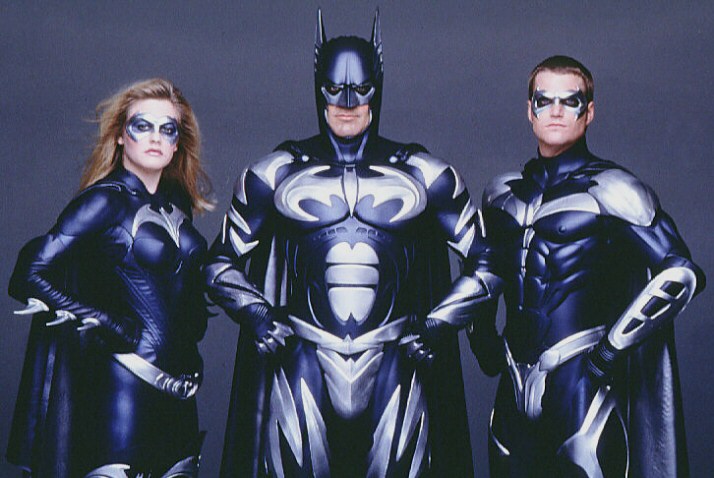
5.   BATMAN AND ROBIN (1997):  Joel Schumacher's garish exercise in superhero fabulousness killed off the franchise for 8 years (Christopher Nolan practically had to perform an exorcism to bring it back), and almost took George Clooney down with it.  And let's not forget Alicia Silverstone as Batgirl.
 
4.    THE PHANTOM (1996):  If Billy Zane's turn as a masked avenger is released in theaters and no one goes to see it, does it make a sound?
 
3.   .THE SPIRIT (2008):  Frank Miller's adaptation of the Will Eisner comic was an utter mess of stylized visuals, arch dialogue and clunky action.  With Samuel L. Jackson as the Nazi villain (his character needed to catch up on world history).

2.   THE SHADOW (1994):  Would you believe... Alec Baldwin as a superhero?  No one else did, either.

1.   SUPERMAN IV:  THE QUEST FOR PEACE (1987):  A sad end to the franchise that began the whole genre 9 years earlier, with Christopher Reeve (who also took a story credit) battling dirt-cheap special effects when he wasn't making windy speeches about World Peace.  The franchise hasn't yet managed to come back:  Bryan Singer's attempted reboot with Superman Returns was a pompous bore, and next year The Man of Steel will try once again... directed, as we come full circle, by Zack Snyder.


  • Digg
  • Del.icio.us
  • StumbleUpon
  • Reddit
  • RSS